Search This Blog

Saturday, September 20, 2014

The One I Love (4/5 Stars)


It is impossible to write about this movie without revealing the twist so hinted and hyped in the online movie trailers. This is because the twist is revealed in the first twenty minutes of the movie. So it's not so much of a twist as it is a premise. I figure that makes it fair game in my blog. The premise of the movie is such: A couple, Ethan and Sophie (played by Mark Duplass and Elizabeth Moss) are seeing a marriage counselor (played by Ted Danson). After a few sessions that do not seem to break new grounds of understanding between the couple, the counselor suggests a weekend trip to a retreat.

The retreat is a villa in an orange grove. There is a swimming pool and a guesthouse. The guesthouse already has people in it. Specifically the people in the guesthouse are Ethan and Sophie. For clarity’s sake, let us refer to them as Fake Ethan and Fake Sophie. They look, talk, and sort of act like the real Ethan and Sophie. But they only show up in the house when only one of either Ethan or Sophie steps inside. So if Real Ethan is inside, Fake Sophie shows up. If Real Sophie is inside, Fake Ethan shows up.

Who are these Twilight Zone people? That is actually up to interpretation, as the movie does not fully explain how they are formed or what their purpose is or even if they can be entirely trusted with the information they supply about themselves. What makes them interesting is that Fake Ethan seems to be a more fun, more exciting, more laid back version of Real Ethan. Fake Sophie pins her hair back and would rather not argue, two things that Real Sophie does not do.

This movie, directed by Charlie McDowell and written by Justin Lader, is what I would call a five star three star movie. It is done perfectly but within the scope of a very small movie. Almost the entirety of the movie takes place within the confines of this one retreat location. There are basically only two actors (Duplass and Moss play themselves twice over) and the action in the story is talking: Lots of talking about people and relationships. This is done very well. It is not entirely an easy thing to keep a story moving along smoothly and unpredictably when the budget and locations and characters are confined as such. I give kudos to newcomers McDowell and Lader on their very good first movie. Mark Duplass is becoming exceptionally good at making and producing these very low budget movies.

I had the pleasure of being apart of the Nitehawk Five Dollar Film Club for this movie and last Saturday we had a fun group discussion about the movie. Before the movie I wondered whether the discussion would go the way of a certain scene in the movie. At one point Real Ethan is obsessed with understanding how the guesthouse works. Real Sophie tells him to stop ruining it. Remember that magic show you took us to and couldn’t stop explaining how all the tricks worked. You completely ruined it! Well, would this Film Club focus the discussion on how the Guest House worked or would it talk about the relationships between the characters (i.e. the marriage counseling)?

Here was my theory on the movie: It is revealed that an incident of infidelity on Real Ethan’s part led to the marriage counseling. The couple cannot get past it. Fake Ethan, the funnier more exciting (more untrustworthy) Ethan, is Ethan in the past at the time he committed the infidelity. Fake Sophie is a version of Real Sophie in the future where in she accepts the fact that Real Ethan has changed from the unfaithful exciting guy into a faithful more boring guy. Who leaves and who stays at the end plays off of these unsaid descriptions and the guesthouse is revealed to actually work as marriage counseling. What makes this movie so strange is that the character arc of growth takes place before the film begins. At the start, Ethan is already changed. What makes this movie stranger is that it takes the guy’s side in the relationship battle. Generally a romantic comedy is about an immature man that matures and the woman just waits out the transformation. Here the problem is that the man has matured but the woman is still in love with the immature version of him. She does not understand that the aspects of Ethan’s personality that made him fun and exciting also made him prone to infidelity. She wants Ethan to be faithful but not boring as well. I can’t tell you how the story ends (another twist!) but whether she makes it out of the retreat is really up for debate. I think it was at least ambiguous.

Nobody at the film club agreed with me. They were overly concerned as to what made the guest house work. Who was Ted Danson? Are they aliens or robots? Did Elisabeth Moss really grow up in Scientology? Et cetera.

I’m being a little mean to the film club. It was a fun discussion, but I feel I did the majority of talking about the relationships during the two hours. Then I had to duck out early because of a basketball game.

Well, what do you think? Go see the movie for yourself and bring along the significant other. There is a lot to talk about here provided you are willing to talk about it. Maybe you should just break up instead. 


Sunday, September 7, 2014

Sin City: A Dame to Kill For (3/5 Stars)


It kills me how much I love you

In a way the first Sin City movie had it easy. It’s three stories dealt mainly with a dark pessimistic view of power embodied by murderous senators, bishops, and cops who importantly were all men. The heroes, like Marv (played by Mickey Rourke) who had a rule that he never hit women but felt that men were fair game for torture and murder, the all male gender of the bad guys really helped him sort out exactly who to torture and kill: the brutal violent men especially those that hurt women. The morality of the movie being clarified the movie could be as violent and gory all it wanted to both men and women. Well, maybe it was okay. There is an argument I will bring up later that may point out a chink in the armor of that logic (although I think Director Robert Rodriguez deserves the benefit of the doubt.) But at least on its face it was more okay than the titular story of this particular movie, which contains an evil manipulative woman played by Eva Green and the man named Dwight (Josh Brolin) that violently loves her. She’s a sociopath but she isn’t hurting any one physically weaker than she is (so no women, just men are killed) and her main weapon is psychological/sexual not violent (she gets other men to kill for her). So is it okay for Dwight to seek revenge by killing her? After a brief review of the movie we will have a brief discussion about violence against women in movies.

“Sin City: A Dame to Kill For,” is an okay movie. It has good moments of great film noir where the digital black and white graphic novel landscape famously innovated by the original movie in 2005 is rendered beautifully and where the language of the script flows in that great Chandler-esque poetry of depression and darkness. But these are only moments and they are infrequent. The best parts have to do with Joseph Gordon-Levitt’s performance as a suicidal gambler and the first half of the titular story as Dwight is manipulated (and he knows it) by a woman he hopelessly and pathetically loves/hates. This is great film noir stuff but the movie meanders where it should have been guaranteed more success, that is, all the hold over stories from the first movie: a prequel for Marv, a sequel for Nancy Callahan (Jessica Alba), and a cameo from the militant whores of Oldtown (headed by Rosario Dawson). For one thing after nine years between movies nobody looks quite the same. Bruce Willis looks downright ancient. Mickey Rourke simply does not move around like the powerhouse fighter he is supposed to be. In fact, he looks like he put on at least 50 pounds of fat. The same can be said for Rosario Dawson though her clothes (looking way out of place on her now) desperately try to hide it. Michael Clark Duncan is dead. Dennis Hasbert has replaced him with not nearly the same amount of stage presence. Finally there is Jessica Alba who looks the same but probably shouldn’t. Her character in the first movie was the object of an obsession so she was never needed to be or was anything but good looking. In this movie she becomes the protagonist of her own story on a mission of vengeance that does not make sense for the character or the actress playing the part.

Jessica Alba is not a film noir protagonist. Look at all the men; worn out battered, beaten, pathetic, and violently depressed men. They are and should be ugly blokes. Nancy Callahan, though hard drinking, enraged, and depressed, does not at all give out the same vibe. Even when she does scar up her face she still looks like she is on a fashion catwalk just this time in the sort of fetishitstic getup Catwoman made famous. This does not make sense in a film noir story told from her point of view. Film Noir mental weather shows up in the constitution of the body after awhile. Women I would think are welcome in the genre but they have got to start playing by the rules the guys play by. Lose the fashion makeup, the strict diet and exercise regimen, and grow some bad history into the eyesockets. See Noomi Rapace in the Swedish version of “Girl with the Dragon Tattoo.”

Before we discuss what kind of violence against women is okay or not okay, first we have to settle the question of whether any kind of violence should ever be okay. We can expand this of course and directly ask why would we want to watch any kind of PG-13 or R rated or NC-17 movie. The debate goes back to Aristotle who suggested that the education of children should be limited to good things and should omit bad things. The fear being that children would be poorly influenced by the negative things perhaps even going so far as to try to imitate them. That should sound familiar. Censors have been saying that about movies, TV, comic books, and recently video games for a long time. Studies have not shown yet that they make kids more violent. But even if they didn’t, why watch bad things? Why don’t we just watch happy fluffy things all day instead of Film Noir a genre bereft of color, comfort and happiness?

The first reason is pragmatic. The world is in fact a dangerous PG-13 and Rated R and NC-17 place and though it is possible perhaps in some parts of the world in this particular day and age to shield one’s eyes without any consequence, if most of us did it, the opportunistic evil that is present in the world will opportunistically consume us whole. James Madison was wont to write about laws as ‘parchment barriers.’ That is to say that they were of no use unless there was a coercive force behind it. Polite suggestions do not work in the real world and as Machiavelli would remind a wise prince, being capable of anything is the first requisite in keeping power against a foe that is also capable of anything. PG-13 and R rated and NC-17 rated movies can illuminate the dangerous parts of the world in a far more informative and educational way than censored movies can and in this they are useful for the good in fighting off evil.

It should be noted that movies do not have to be documentaries in order to do this. George R.R. Martin, the writer of Game of Thrones, has defended the violence in general and the violence against women in particular in his fantasy saga a Song of Ice and Fire partly on historical grounds. His novels may be set in a completely different world but the context is drawn from an understanding of World History, particularly English Civil Wars. The saga is illuminating in its depiction of how these types of wars work and helpful in understanding parts of the present day world that have yet to modernize or have recently collapsed into a medieval mindset. But this is just the pragmatic reason.

The second reason is that Film Noir is enjoyable to watch. The Greek call it catharsis: the process of releasing, and thereby providing relief from, strong or repressed emotions. This can in fact be done second hand. I like to give the example of skydiving. Falling to one’s death is not a enjoyable thing but the prospect of it does engage the body into a fight-or-flight mode where the mind enters a higher plane of activity and adrenaline is released creating a sensation of being more alive than you were before. Now imagine if there was a way where you could trick your body into creating that sensation without actually being in harm’s way. Strap a parachute on your back. Buckle yourself into a rollercoaster. Watch a violent movie. What the censors have never fully understood or more likely do not want to believe is that violent movies and video games do not provoke aggression; they are a substitute. As Freud would posit, human beings are a species driven by evolution to have several aggressive instincts. Civilization inhibits these instincts causing discontent among the people. Now it is certainly not this writer’s point of view that civilization should not do this. It needs to if we are to live together in some sort of peace, but the need to live in peace should not obscure the fact that it is natural for individuals to feel frustrated when they can’t get everything they want whenever they want it. In other words, take away our civilizing education and we are all babies, giant violent selfish babies. That is the truth.

But let us not simply make a blanket statement declaring that everything is okay to show in a movie. This, after all, is art criticism and the whole point of that is to make distinctions between good and bad movies. So in that spirit let us deliniate where violence is okay to be enjoyed. I have explored this idea before in my reviews of SuckerPunch and This is the End but to summarize the rule: a movie must ask the viewer to empathize with the victim, Or: if the viewer is to empathize with the aggressor than it is only in circumstances of equalilty. In other words, don’t be an asshole and pick on someone your own size (or bigger). With the latter we can incorporate most action classics from Jackie Chan to Quentin Tarantino into the category of good cinema. With the former we can also make a distinction from good horror films and bad horror films. In a good horror film like The Texas Chainsaw Massacre the audience is asked to identify with the girl being chased around by killer maniacs. She goes through hell but she survives and has a laugh at the very end of the movie that encapsulates everything a great horror movie experience can achieve. (Honorable Mention: Sam Raimi for what he did to Bruce Campbell in the Evil Dead series). This contrasts with any of the various forms of ‘torture porn’ that has saturated cinema in the last decade. These bad movies do not ask the audience to identify with the victim, but the bad guys as they torture people. That is sadistic and not good (and unnecessary given the various ways aggression can be catharsised.) Honorable mention for terrible person if not a terrible filmmaker: Lars Von Trier.

Let’s go back to Sin City: A Dame to Kill For. The question is whether Dwight, the person the movie asks us to empathize with, should retaliate violently against Eva Green. Is she equal or superior to him? What exactly happened? She seduced Dwight to kill her husband. He went ahead and did it and then she turned on him and shot him several times. He survives and seeks revenge. The story ends with Dwight killing Eva Green after she tries to seduce him for the last time. That seems okay, right? I mean she shot first, didn’t she? But it can be more complicated.

Roger Ebert had a good insight once about the way male filmmakers attempt to justify sexual violence. In his review of the 2010 remake of “I Spit on Your Grave,” he had this to say:

“This despicable remake of the despicable 1978 film "I Spit on Your Grave" adds yet another offense: a phony moral equivalency. In the original, a woman foolishly thought to go on holiday by herself at a secluded cabin. She attracted the attention of depraved local men, who raped her, one after the other. Then the film ended with her fatal revenge. In this film, less time is devoted to the revenge, and more time to verbal, psychological and physical violence against her. Thus it works even better as vicarious cruelty against women.
First, let’s dispatch with the fiction that the film is about "getting even." If I rape you, I have committed a crime. If you kill me, you have committed another one. The ideal outcome would be two people unharmed in the first place. The necessity of revenge is embedded in the darker places of our minds, and most hate speech is driven by "wrongs" invented in unbalanced minds. No one who commits a hate crime ever thinks his victim is innocent…..
…..
No, it’s the first half of the movie that’s offensive. It implicitly assigns us the POV of the men as they taunt and terrorize Jennifer in plausible ways — which are different from her killing methods, which are implausible, probably impossible, and offered and received as entertainment….”

That is to say, in order to justify what the filmmakers really want to show (and what their intended target audience wants to see) they will unrealistically exaggerate the woman’s guilt (she is a rich bitch, she stupidly spent a night alone in a secluded cabin, she used sex appeal to manipulate a man) or they unrealistically exaggerate the woman’s ability to enact revenge or both. 

In the case of “Sin City: A Dame to Kill for,” there is some of this phony moral equivalency, but I hesitate to argue that it is there because Robert Rodriguez or Frank Miller actively hate women. I think it is there because they have decided to venture into this dark aggressive instinctual territory and are embarrassed by what they found there. And they use the phony moral equivalency more as a way of evading their questionable behavior than as an excuse for it. Take the small scene in which a businessman played by Ray Liotta is cheating on his wife with a prostitute. He hates the prostitute and decides to kill her even though he doesn’t want to because he knows he can’t stop seeing her because he loves her and that will destroy his marriage and his business via the alimony. It is a powerful scene and the only thing that stops the murder is Dwight who is covertly taking pictures of the whole thing (the wife hired him to get proof of her husband’s infidelity). The moment after Dwight knocks out Ray Liotta, the prostitute takes off her fake blonde wig, speaks in a different tougher accent, and acts like she was never afraid at all even when she had a gun pointed at her head.

Why did the scene end this way? Are we the audience supposed to feel that everything that had come before it was just a lark? But in real life, don’t real men kill their real girlfriends all the time and in the same crazy, vicious, jealous and desperate way that this man just tried to kill this woman in this story? And is it not the whole point of this movie called, “Sin City: A Dame to Kill For,” to explore that dark territory in men’s minds? And so is it not a cop out to show all the behavior leading up to the moment of truth and then afterwards argue that this type of male behavior does not affect women, to go so far as to posit that the woman was in control the entire time. To victimize women and revel in the harm created is misogynistic. We all know that. I argue to victimize women and then feel ashamed and pretend that they were not victimized may not be exactly misogynistic, but it is most definitely cowardly. Robert Rodriguez and Frank Miller came up to the bell of sexual violence without any encouragement or provocation. They chose to do it. They should ring the bell. And then they should take a step back and look at what they have wrought with clear eyes and ask the audience to do the same. That’s what Shakespeare would have done. That is the difference between the Swedish version of “Girl with the Dragon Tattoo” and the inferior American remake and of course “Sin City: A Dame to Kill for” too. 


Sunday, August 24, 2014

Frank (4/5 Stars)


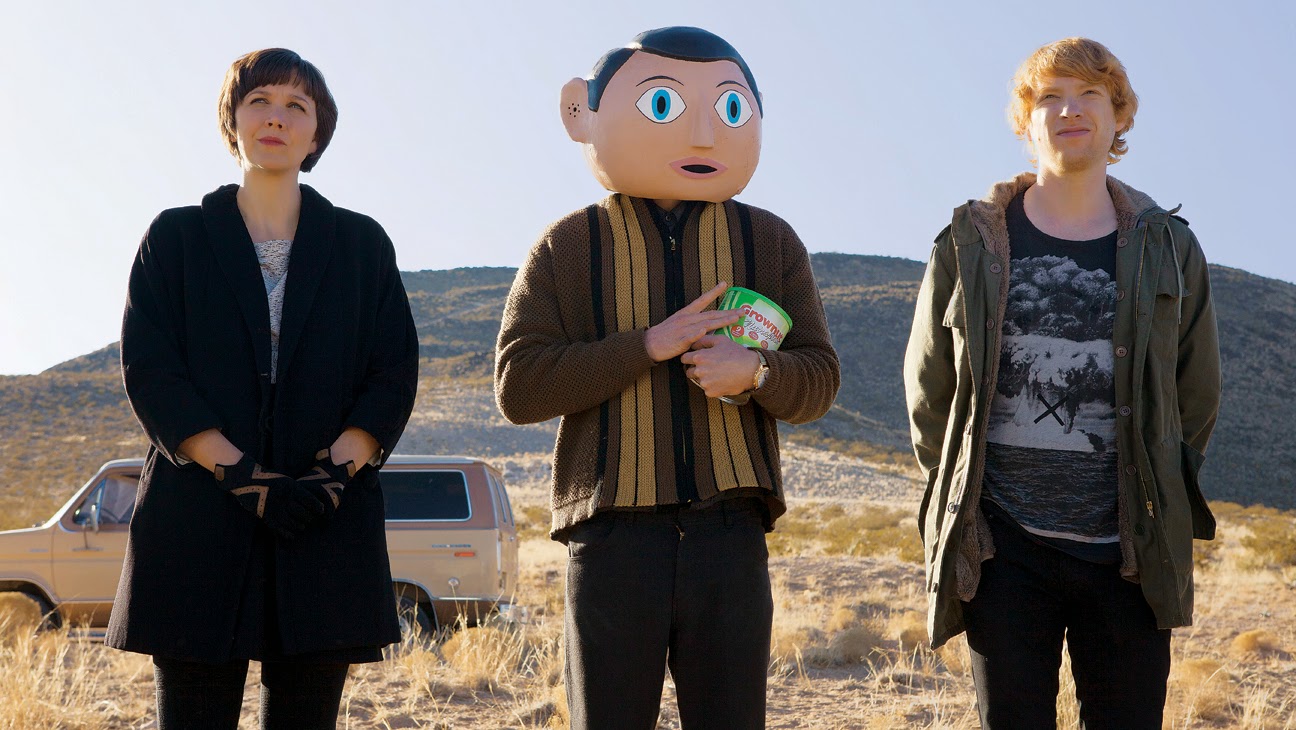
This bizarre story starts in a quiet beachside community in the United Kingdom. A young twenty-something lad named Jon, played by Domhnall Gleeson, walks the the shoreline, pad and pen in hand, jotting down the various things he sees in a desperate attempt to force inspiration for song lyrics. A woman jogs past him in a red coat. “Woman in a red coat jogging!” He hums to himself. A woman jogs past him in a blue coat. “Woman in a blue coat! Does she know the woman in a red coat!” Terrible just terrible. Upon chance occurrence he comes upon a man attempting to drown himself in the ocean. The paramedics are dragging him away to the ambulance when Jon strikes up a conversation with a few other people on the beach watching. They know the man. He was their keyboardist. They no longer have a keyboardist for their gig tonight. I play keyboard, says Jon. Okay, be at the stage door at 9pm. The group gets in their van and leaves.

Jon shows up at 9pm. He is instructed to play three chords and that’s it. The crowd is non-existent. One bandmate, a surly looking woman named Clara, played by Maggie Gyllenhaal, is playing a theremin of all things. And then there is Frank, played by Michael Fassbender. He walks onto the stage in a wetsuit and a big fake paper mache head. They start in on the first song. It sounds absolutely strange. Frank sings in a deep voice and makes muscular robotic stage moves. Clara’s theremin has an electric short and sparks fly. She becomes angry, pushes over her instrument and storms out cursing. The drummer and guitar player follow leaving only Frank standing perfectly still and staring intently at Jon. Well, maybe, you can’t tell because Frank has a big fake head on. Then Frank leaves the stage too. The entire thing lasts less than a minute. What an act!

There is a concept in stand-up comedy called the ‘Comedian’s comedian.’ This was generally not the most successful or even the funniest comedian on the scene, but it was the type of comedian that other comedians would come out to see because they were doing something really edgy, exciting, and new. And Frank’s band is that. They are on a completely different wavelength and could not care less about connecting with any sort of audience. Jon is invited the next day for something big. He is excited and is picked up by the band. First thing he notices: Frank still has his big fake head on. Apparently he never takes it off, ever. Second: they are not going to a big gig. They are going to a remote cabin in the Ireland wilderness to take as long as it takes to record an album. Jon tries to explain that he told his boring office job that he would be back by Monday. ‘okay,’ is the reaction. Jon stays.

The character of Frank is a fascinating masterwork of acting by Michael Fassbender. The journey of understanding him oscillates from thinking the man is insane to thinking he is a well meaning musically inclined wise and nice person to realizing he is both of those things. Fassbender plays 95% of the movie without any facial expressions but this hardly matters. His physicality and voicework is very expressive not only in his movements, which are of an excited robot variety, but also in his stillness. You do not need to see Frank’s face to understand when he happy, or inspired, or nervous, or really really scared. And sometimes he goes ahead and describes his facial expressions in order to be more helpful. Frank is not the main character of this story (that would be Jon) but it feels like he is the main character. It is an Oscar nomination worthy performance, though maybe it is too far out there to be seriously considered as such.

The main theme of the movie is the education of Jon’s view of musical expression. He is an ambitious young man who realizes the talent of Frank and his band and sets out to raise awareness of this band on his blog and Twitter feed. Jon sees the endpoint of all their work as a vehicle for rockstardom. Through viral videos of the band doing really weird shit in the woods he gets a cult following for Frank and a gig at the South by Southwest music festival. Everybody in the band hates the idea, but Frank is inclined to do it out of a trust he has placed in Jon. All these people want to like and love us, he innocently asks. Yes, explains Jon, they have already seen and liked and will love you. They go to South by Southwest and all goes to shit. What Jon does not realize is that everything Frank does is especially personal and he wears the head not as a self-promoting gimmick but because he is enormously shy to the point of real psychosis. His bandmates understand this and quit the band before the gig but Jon has to figure it out for himself and almost destroys Frank in the process.

Where does musical talent come from? Jon bemoans the fact that he did not have an abusive childhood or a mental illness that would have expanded his mind in artistic creative directions. No, he realizes in a great scene at the end of the movie. Frank grew up in a nice home with nice parents and was always musically inclined. If anything, his illness hinders his artistic expression. But Jon grew up in a nice house with nice parents too. Why doesn’t he have any musical talent?

Jon makes it up to Frank though, he gets him back together with his band and at the end of the movie they make a song together with Jon on the outside looking in again. Some of the lyrics of the song include the phrases, “It’s nice to see you. It's really nice to be here. I love you all.” It is not a rare thing to hear a musician say these words to a crowd, but when Frank does it has a real profundity to it. Frank really means it. And yes it matters that there is no audience and Frank sings it to his band. You can’t say ‘I love you’ to an audience of people you’ve never met before and mean it. There is something to that surely and it may just be the difference between mediocre and sublime expression. 


Thursday, August 14, 2014

Boyhood (3/5 Stars)


Another curiousity from Richard Linklater

The story within the movie ‘Boyhood’ is inextricably linked to the story of its making. The project was started in 2002 when director Richard Linklater cast the six-year-old Ellar Coltrane. He shot a few scenes of him opposite a fictional movie family: sister Lorelei Linklater (Richard’s daughter) and divocrced parents Patricia Arquette and Ethan Hawke. And then Richard waited two years old til Ellar was eight and he shot a few more scenes. He came back two years later and did it again. The movie was finally finished last year when Ellar turned eighteen.

So this movie is a curiosity that comes appropriately from Richard Linklater, Cinematic Laureate of Austin, Texas, and auteur of such quirky movies such as Slacker, Before Sunrise, Waking Life, and A Scanner Darkly. Boyhood takes it's rightful place besides though films. It is intensely interested in the people, the places they inhabit, and the ideas that they share. The most interesting thing about 'Boyood' is that it does not merely reflect the journey of Ellar Coltrane. Sure we see him literally grow before our eyes from a shy introspective boy to a curious almost philosophical teenager, but we also see the journey of his sister who grows up right alongside of him. And we see the journey of his mother who goes through several marriages, gets her master’s degree, gains at least thirty pounds and becomes less or more comfortable with how things have turned out. Perhaps most strikingly is the journey of the father, played by Ethan Hawke, who starts off as a friendly but impossibly irresponsible, chain-smoking, and fast-car-driving presence in Ellar's life. By the time the twelve years pass, however, he has a new wife and kid who make him go to church and drive a mini-van. The irony does not escape him and he treats the changes with good humor. He did not see them coming and neither did we but these things happen.

This movie is hailed as completely unique but that is not entirely the case. Something that closely resembles this type of story has already been done and is actually still happening. That would be the 7up Series of documentaries that started in 1964 when a BBC TV crew interviewed several seven-year-old kids and then came back every seven years since to reinterview them. The last one came out last year. It was titled 56 up. So far all the kids are still live. The documentary series is extraordinary in that it captures the march of time in a way transient movies can't quite capture no how much makeup they apply. More than any other movie or documentary I have ever watched, I became invested in the characters in the 7up series. In fact, at some point I no longer cared whether any of the new installments had any conflict or dramatic events in them. I sort of just wanted everyone to live carefree unstressful lives for as long a time as possible. 

This kind of feeling is almost captured in ‘Boyhood.’ The main difference is the fact that ‘Boyhood’ is a fictional conglomeration of what a normal childhood might be. The one thing the 7up Series routinely ignored and for good reasons is the complete absence of cultural/time related references. The interviewers asked the subjects about their lives. They didn’t ask them about what new music they were listening to or what they felt about the Prime Minister or the war the world was currently engaged in. In contrast, ‘Boyhood’ sometimes feels like an early version of a soon to be coming out VH1 TV Show called “I love the 2000s.” It starts off with Coldplay’s ‘Yellow’ a big hit in 2002 and every couple of scenes you have some other song from the recent past like Lady Gaga or Gotye. Ethan Hawke is into the politics and talks in various scenes about Bush v. Kerry and Obama v. McCain. This is not all that interesting stuff and at some points ‘Boyhood’ feels less like a story about a person and more of a nostalgia tour of the last decade. Not all the time though. There is an especially good scene where Ethan Hawke brings up Sarah Palin’s 17-year-old pregnant daughter, Bristol. He does this to segway into a talk about sex and contraception with his kids. That happens to be a far more interesting topic for him to explore than what he thinks of the Republican Party.

This is the odd movie, which is not so great because the movie is too brief. It is an epic story within the confines of a feature length film. Weirdly, the story may be hurt because it wasn’t exactly planned before they started shooting any of it. It is epic in scope but limited in reach and tone. The boy only has a few scenes at each age. Sometimes drama happens but the character does not make any dramatic choices about them. I remember being weird, angry, and utterly bored at times as a kid. Ellar Coltrane does not have these qualities. He comes off as almost ridiculously mature, chill, and cool for his age, especially given the series of alcoholic step-fathers he experiences. I don’t know, maybe that actually was the experience of most people and I’m the outlier. It would not surprise me. ‘Boyhood’ ends on a very slacker and chill Linklater note. The 18 year old talks about the oddness of the saying ‘Carpe Diem’ which is ‘Seize the Moment’ loosely translated. He reflects on it and muses that it seems that life is more like the opposite way around. That the Moment more often than not Seizes You because aren’t we always in the Moment? I mean think about it man. I think that may be true for this kid and perhaps for most people but I don't know, I couldn’t relate. 


Monday, August 4, 2014

The Guardians of the Galaxy (4/5 Stars)


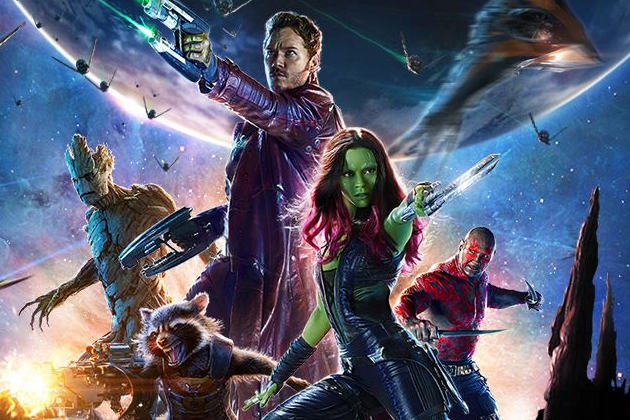
Our Hero, the Awesome Chris Pratt, lands his intergalactic spaceship on a desperate and dangerous alien landscape. He steps into a derelict and cavernous ancient cathedral overgrown with dangerous fauna. Chris Pratt puts on his Walkman and plays his “Awesome Mix Tape #1.” The song, played loud and funky is “Come and Get Your Love,” by Redbone. And to this tune, the opening credits of our movie come on the screen as Chris Pratt dances and shuffles through the many dangers of his archeological mission. That’s when I knew I was watching something new, something interesting, and most importantly something undeniably fun. And you know what, it was.  

Until now, I have not heard of the Marvel comic “Guardians of the Galaxy.” Apparently it is rather recent comic without much of a fan base. There are no recognizable characters. The team consists of a Firefly-esque band of misfits that have come together to do fun outlaw stuff, mostly salvage jobs. The leader is Peter Quill (Chris Pratt), a human who was abducted by aliens when he was a just a little kid in 1988. This particular back-story is a boon to people like me who are somewhat turned off by the complete arbitrariness of most way into the future science fiction. The most obvious perk of the story happening basically in current day even if we never see Earth is the soundtrack. It comes from the Walkman containing his Awesome Mix tape that young Peter was carrying when he was abducted. It has got Marvin Gaye, David Bowie, and even Blue Swede. These songs reflect good taste on the part of Peter’s mother who made the tape for him before she died of cancer. I was surprised and delighted that “Cherry Bomb” by The Runaways got an extended play over one of those getting-for-battle montages. It’s a killer song. Then there is the marvelous pair of digital creations Rocket Raccoon and Groot. They are originally a pair of bounty hunters. Rocket Raccoon is the product of a mad scientist who turned a raccoon into a living, breathing, sarcastic as all hell, and complete with a snarly Napoleaonic complex. Bradley Cooper voices Rocket Raccoon. Admittedly, I could not recognize him in the voice. Groot is, I guess, an Ent, a walking tree. Vin Diesel voices him in what can be safely be said is an underwritten role. All Groot can say is “I am Groot.” Although, he is a bit like Chewbacca in that apparently the Raccoon can interpret his connotations perfectly. These two characters are not muppet sideshows. They are so well conceived and artistically put together that after awhile I realized that I had forgotten that I wasn’t simply watching actual actors. We are at a point in movie technology where these characters are alive. It is an extraordinary to watch and given the progress I would think this might be the last time I comment on how well it is done. From now on, perhaps I’m going to judge these performances just how I would judge a human performance. On a very basic level what has been have achieved is a blurring of the distinction between the two. Joining the party late is the Pro Wrestler Dave Bautista as Drax. He does a very convincing job of being big and dumb and completely incapable of grasping metaphors. Finally there is Zoe Saldana painted dark green this time as a fierce warrior of some sort. She is the serious one of the bunch because you know she’s a woman.

The plot of this story is arbitrary and absurd and quite frankly really comparable to some truly awful movies like John Carter of Mars and the like. There are bunches of people with weird names in weirdly named places you’ve never heard of and they are trying to get this weapon that is going to kill everybody unless Peter Quill and the gang get it first. Motivations come and go easily for the people and not much makes sense in that annoying Science Fiction way you know where because it takes place in a far off place you don’t have to worry about making any of the technology realistic or plausible. But guess what? I did not care. I just did not care. Because what this movie does good it does awesomely great and I could forgive all the absurdity because the movie never really asked me to take it all that seriously. What it asked me to do was have fun and then it provided great music, good jokes, quirky characters, but above all abosolutely stunning things to look at.

The design of this movie is truly Oscar worthy effort. It is hard to assess who is exactly responsible for what. When you look up the crew on IMDB you are faced with the fact that hundreds of people have worked on the movie. But here are couple of names of the people in charge: Charles Wood of Production Design, Ray Chan of Art Direction, Alexandra Byrne of Costume Design, and whoever was in charge of makeup. There has not been a movie so vibrant and fun to look at since “The Fifth Element.” This movie makes use of a comic color palette. The prison jumpsuits are bright yellow. Several characters are of light blue and hot pink and orange hue.  My favorite design has to be the makeup of a character named Nebula (Karen Gillan). Now that is a sexy blue robot (I think she is a robot, maybe). If the makeup and hairstyling of this movie doesn’t win an Oscar I have no idea what I’m talking about. At one point I was looking forward to seeing new characters being introduced just to see what they looked like. What was better about Benecio Del Toro’s part in this movie? His performance or his white suit and hair?

This movie was directed by James Gunn and partially written by him too. I have not seen anything else he has done but given the size of these blockbusters, it is hard to say (and probably shouldn’t be said) that this is his movie. This is a corporate movie and as a corporate movie it has certain plusses and minuses. It does not, cannot have the personal touch that small movies have. But it does have the ability to apply lots of money for the employment of hundreds of artisans and designers. “Guardians of the Galaxy,” is a persuasive argument that summer tent-pole blockbusters can be worth the money spent to make it not just profit-wise but also in artistic merit. Yes, corporate movies can be quirky, original, and fun too. Attidude is all, i.e. the courage to play “Hooked on a Feeling” by Blue Swede in a science fiction movie and have faith that the audience is going to like it enough to ignore how the whole setup is completely absurd. Such courage in very expensive projects is rare but take a look, it exists. 


Thursday, July 31, 2014

A Most Wanted Man (4/5 Stars)


“A Most Wanted Man,’’ the last film of actor Philip Seymour Hoffman, is not a spy thriller. ‘Mission Impossible’ is a spy thriller. This is an entirely different animal. It is a spy procedural. Such an explanation is necessary because the movie concept is novel. A procedural is a type of movie that drums up its suspense by curtailing to the Aristotelian ideal of making the representation as real as possible. Among other things, they are great stories for the curious type of person who wants to learn how things work. The most common procedurals are police procedurals (‘True Detective’) and journalist procedurals (‘All the President’s Men’). I do not think I have ever seen a spy procedural. Spies are generally portraryed by the likes of James Bond, Jason Bourne, and Ethan Hunt and they spend far more time seducing, fighting, and stealing secrets than anything else. In this movie we have Philip Seymour Hoffman looking tired, disheveled, and overweight, going about the real business of a spy, that is to find informants through persuasions of incentive or coercion and slowly but surely work up the ladder. “It takes a minnow to catch a barracuda. A barracuda to catch a shark,” he explains. In this movie based on a Le Carre novel and directed with patience by Anton Corbijn we see exactly how it works. Don’t expect gunfights. It lacks in that respect, but as I’ve said, it should be interesting to those curious as to how things work.

The “Most Wanted Man” in the title refers to a Muslim refugee from Russia who shows up in the port of Hamburg, Germany. He may or may not be a terrorist. The Russians say he confessed but that was during a torturous investigation so take it with a grain of salt. He has come to Hamburg for a particular reason. He stands to gain an inheritance from the man who raped and impregnated his mother when she was fifteen. The inheritance is in the millions of dollars. What this refugee, perhaps terrorist, will do with that huge windfall of cash is of most concern to the several intelligence apparati in Hamburg, especially since the most wanted man considers the money unclean and doesn’t want to keep any of it. “You have nothing,” his lawyer (played by Rachel McAdams) reminds him. “I have God,” he explains.

This is an interesting movie for an American audience because it is not our jurisdiction the story takes place in. It takes place in Hamburg and the main spy played by Hoffman is German. The Americans are on the sidelines portrayed by Robin Wright, an intelligence agent stationed in the American embassy in Berlin. Robin Wright has achieved a gender bending feat in transitioning from romantic leads in her early career (The Princess Bride, Forrest Gump) to really dark and interesting character parts that have very little to do with being a woman (House of Cards, A Most Wanted Man). She has a great knack for showing up in a scene and immediately putting on the impression that she is not only better looking and more fashionable than you are but also more effective, capable, and informed. Then there is the late great Philip Seymour Hoffman who more effectively than any actor still alive creates vivid characters for the rest of us. Of great note is his German accent in this movie, which seems less like an exercise in diction but more of a character choice. That is to say it not only denotes the character as German but it also sounds like a tired bueruacrat caught between deadly extremists on one side and the assholes in charge on the other. The most effective scenes are the ones Wright and Hoffman have with each other. Hoffman tries to explain that he knows what he is doing and then there is Wright on the other side. Sure she is polite and hears Hoffman out, but also makes it clear that she doesn’t have to. She’s American and what America wants, America gets. Hoffman brings up that point himself in relation to the most wanted man. She says something about respecting German sovereignty and not acting to capture him on her own initiative. ‘That never stopped you before,’ says Hoffman. ‘We don’t do that anymore,’ smiles Wright. The subtext being of course, ‘unless we wanted to.’ The conclusion of the movie reminded me of watching the paranoid political thrillers of the 1970s. It’s a pessimistic view of American power to say the least.

Hoffman’s death affects the experience of this movie in the same way that Heath Ledger’s death affected watching ‘The Dark Knight.’ Hoffman here looks close to death. He is wan and sickly. He chain smokes. He is more overweight than any other point in his career. His character is disgraced. He has been demoted to Hamburg from Beirut where, through no fault of his own, the Americans blew his network and lot of people who trusted him were killed. As far as swan songs go, this is decent way to go out. It is appropriate for Philip Seymour Hoffman. Both the actor and the character end in a tragedy that only by hindsight seems possible because it is so maddeningly and infuriatingly unjustifiable. It was bullshit. He got a raw deal.

Rest in Peace.


Friday, July 11, 2014

22 Jump Street (4/5 Stars)


The same exact thing but bigger.

According to Urban Dictionary the term ‘meta’ refers to something, generally art, that is characteristically self-referential. The most cliché example ever is the writer who has writer’s blcok that ends up writing a story about a writer who has writer’s block. I have seen this movie plenty of times and it has taken up residence in the shameful corner of my movie critic heart. The reason for this is that the idea seems clever but it is not. Cleverness contains an element of originality and creativity. If the idea has already been done before it cannot be original or creative. There is a caveat to this of course and ’22 Jump Street’ is a particularly good example of it working (at least the first time). ’22 Jump Street’ admits that its meta-ness, i.e. the fact that it is a sequel to a movie that itself was a remake of an old TV show from the 1980s, is not clever.

This is made explicit in the form of the police chief, played by Nick Offerman (the great anti-government crusader Ron Swanson from ‘Parks and Recreation’), who starts off each movie with an explanation as to why this lame excuse of a mission exists at all.  In the first movie with his trademark grouchy annoyance he explained that the 21 Jump Street mission existed because nobody in the police department had any new ideas so they just keep on rehashing old things in hopes that people won’t notice. In ’22 Jump Street’ he explains that nobody cared about 21 Jump Street when they redid it but they got lucky with success, so the department invested a whole lot more money into 22 Jump Street under the stupid impression that maybe if they spent a lot more money they could get that much more success. This influx of new money spent on arbitary shit that has no connection to the success of the mission becomes a running joke in the movie as the sets and gadgets become much more elaborate than they really need to be and characters start drinking espressos for no other reason than because they are more expensive than coffee.

But even this kind of admittance gets kind of exhausting after awhile. Or at least it should be. This is the type of movie that makes fools of movie critics with all their general theories as to what should be better than other things. It’s like a way overpriced tech price that refuses to fall to earth. For my money the reason is that it is genuinely funny and even though it uses a lot of self-referential jokes about sequels, there are plenty of new good one-liners, some great physical comedy, and actual twists in the story that are not predictable. The makers are especially adept at throwing reality to the wind in order to make the whole thing more bright and colorful. For no particular reason the bad guy, Peter Stormare, has a pink backpack. I thought that was funny and applaud such initiative. In other words, this movie like the first one is a much better movie that it should be, and all of these jokes that make fun of the fact that you are watching something that should not have been made seem less like that a writer with writer’s block and more like a cry of help from some seriously competent people that could be doing much better things with their talents.

And they have. The two buddy cops, Jonah Hill and Channing Tatum are very good actors. Jonah Hill has just wrapped up his second Oscar nomination. Channing Tatum has become a Steven Soderbergh favorite. Ice Cube, once a gangster, is now firmly typecast on the other side of the law. He has done well in both cases. The two directors, Phil Lord and Chris Miller, have so far made a career of taking cynical ploys of studio executives and making actual art out of them. Their last movie was ‘The Lego Movie’ something I did not see but was also praised by critics. ’22 Jump Street’ was too. These movies makes one wish they branched out into an original story just to see what it would look like. I am convinced that they could deliver it if they were allowed to and the epilogue of this movie, at least to me, comes off as a desperate plea to the audience and the studio to do just that, i.e. please please please no ’23 Jump Street.’

I haven’t spent a lot of time talking about the movie itself, but then again I don’t have to. It is the same movie. There is a drug dealer on a school campus and the two cops have to find out where the connection is coming from. You saw this movie already! Most of the jokes are based off of that, just far more expensive this time. 

p.s. Rob Riggle’s jokes went too far again. Everything else was generally funny. My favorite had to be the weightlifting part. 

p.s.s. I failed at college. Well I learned a lot of stuff, but cinematically speaking I muffed it. 


Monday, June 23, 2014

Edge of Tomorrow (4/5 Stars)


or: All You Need is Kill!

Roger Ebert once caused an Internet firestorm by declaring that video games can never be art. Boy did he get hell for that. He had a point though and it was that video games because since they had rules, points, objectives, and an outcome that is preordained. Of course, this all denies the massive amount of artistry that generally goes around whatever is the actual game. For instance if you took out the game elements of a superior video game and kept the visual design, the story, and the characters, perhaps what you would be left with was art in the Roger Ebert definition. And what would such art look and feel like? Perhaps like the new Tom Cruise science fiction action flick, “Edge of Tomorrow” is such an example.      

Cinephiles would generally associate the concept of ‘Edge of Tomorrow’ with such great movies time-loop movies like ‘Groundhog Day’ and ‘Source Code,’ but the original manga comic book that this movie is based on, ‘All You Need is Kill!’ is unabashedly a lover of video games and it is possible to argue the movie has more in common with Super Mario than the former. The movie follows the exploits of Cage, played by Tom Cruise, as he is placed in the front lines of an invasion of Europe against an alien foe named the Mimics. Through a freak accident on the day of the invasion, Cage kills an Alpha Mimic and gains the ability to relive each day if and only if he is killed on that day. This is how the Mimics are winning the war in the first place. They can rewind the day of the battle until they learn exactly what the enemy will do. Once they know how the day goes they can plan accordingly the next time they play the game, I mean movie.

This is a video game. You die. You start over. You keep doing it until you get it right. The whole world is at stake. There is a particularly dangerous pitfall to this type of story in that it at some point should get boring if the whole thing just keeps on repeating. This problem is deftly avoided by the director, Doug Liman, the writer Christopher McQuarrie and another great action performance by Tom Cruise. The art in telling this story is knowing what parts to skip. After all, by the story’s logic everything is always the same; so each time Tom relives a day, and the movie suggests that number is in the thousands if not more, we are only shown some of it and most of the time none of it. There is a running joke in the movie where the audience is actually not entirely sure whether Cage has gotten this far into the day or not. Plenty of times you will see a scene for the first time before realizing that Cage has been there one hundred times before and knows exactly what will happen. Other times, he is continually surprised by the day’s developments. The movie keeps the audience out of the know as to what situation it is at most times in the movie and thus retains a sense of suspense as to what will happen further into the movie than one would think is possible.

Another ingredient that helps the movie ride along smoothly is the character of Rita, played by Emily Blunt. Rita’s nickname is “Full Metal Bitch.” She is the army’s best soldier having killed over 100 mimics in her first day of battle. How did she do that? Well, because what happened to Cage, happened to her and she was able to relive the same day over and over again. After Cage goes through the obligatory scenes of trying to explain things to disbelieving army personel it is with a sense of relief that when he gets to Rita, she knows exactly what is going on and sets about training Cage for combat immediately. Nothing really needs to be explained to her, although every day is completely new no matter what. So in plenty of scenes we see things for the first time through her eyes, even though Cage has been there before. In this way, the movie gets away with the former conceit of not needing to show the first time Cage sees something to the audience. In that case, we can follow Rita who knows as much as we do.

This is another great performance by Tom Cruise who, dare I say, is one of the most underappreciated actors of the last decade. It has been almost ten years since Tom Cruise had his Oprah Winfrey “meltdown,” which wasn’t really a meltdown but a crash collision between old media (the interview was 43 minutes long in front of the craziest audience of Tom Cruise fanatics the show could possibly shove together into the same room) and new media (the YouTube clip was about 16 seconds long and completely devoid of context). New media destroyed Tom Cruise’s image in a way that has made it impossible for him to do what made him one of the most admirable movie stars in the 80s and 90s, that is to say take on edgy roles in small ambitious movies like Born on the Fourth of July, Rain Man, Magnolia, Eyes Wide Shut, Vanilla Sky, etc. But what is extraordinary now is how he is using his image as a hated celebrity to his advantage in his current action hero bent. “Edge of Tomorrow,” is perhaps the best example of this so far. His character is introduced not as a soldier but a marketing spokesman for the army. He sits in TV stations and sells the strategy to the public. He is suave and charming and utterly superficial with that classic/cliché Tom Cruise smile. He is then called to the general’s office and informed that he will be part of the invading wave. Tom Cruise’s reaction is just utter conniving cowardice. This is a man who can go in front of TV cameras and with 100% certainty declare that they will win the battle but is going to do everything he possibly can to get out of actually fighting. If you think Tom Cruise is full of shit, you will enjoy like hell the first half hour of this movie. But that’s just the thing that is so extraordinary about Cruise. He seems to know everyone thinks he is full of shit and so is deliberately taking roles that exploit that image in the best way to tell whatever story he is trying to tell. Cruise is such a strange example of humanity. That this guy, an ardent believer of Scientology, one of the most ludicrous religions ever invented, can also side by side possess a brilliant ability to communicate with an audience is amazing to me. How is that kind of compartamentalization even possible? Anyway, another thing that is generally underappreciated is how well a physical performer Tom Cruise happens to be. This movie is stunt heavy and though I’m sure Cruise did not do all of his stunts, some he obviously done plenty of them and that particular type of skill takes a level of dedication and coordination most actors are simply incapable of. I wouldn’t go so far as to say his performance here deserves an Oscar Nomination like I said of his performance in “Mission Impossible IV: Ghost Protocol,” (a position I still hold to) but it is definitely worth noting. Try spreading the word about how good of an actor he still is because I miss the Tom Cruise that could, between larger blockbuster movies, help smaller stranger movies get made. I like this Tom Cruise too, yes, but I want my old Tom Cruise back as well. What I’m trying to say is I miss my Tom Cruise.

p.s. ‘All You Need is Kill’ is a much better title than ‘Edge of Tomorrow’