Search This Blog

Showing posts with label hamish linklater. Show all posts

Thursday, August 13, 2026

Widow's Bay: Season 1 (3/5 Stars)


Widow’s Bay, Season 1, starts off with a bang. Four especially good, indeed excellent, episodes of TV. So good in fact, that the rest of the season must only be explored as a cautionary tale. Whatever went wrong here, and we can guess and will guess as to the bureaucratic and structural reasons, should not be allowed to happen again to any other TV series.

Widow’s Bay takes place on an isolated New England isle, just like the setting of Jaws (1975) and Midnight Mass (2021). Indeed, while watching the first several episodes of this series, one is gripped with the anticipation that this series might make a perfect trifecta. It is helped in large part by the direction of Hiro Murai of Atlanta fame who helmed Episodes 1, 2, 3 and then 9 and 10. Hiro earns the comparison with the Coen Brothers with what he has achieved first in Atlanta, then the best parts of The Bear, and then here in Widow’s Bay. It shares the feeling with the best of the Coen Brothers’ movies that the world outside the frame holds more than what is in the frame. (Whereas inferior movies barely can hold what is currently in the frame. I spoke about this in depth in my review of Atlanta.)

We are presented with the mayor of a small island town (Matthew Rhys) who is desperately trying to boost the tourism trade and bring in fresh money from the mainland. Holding him back are the skeptical locals, including one downright hostile old coot (Stephen Root) who believes it would be irresponsible to bring any new people to the island as the place is and always has been cursed. Rounding out what will effectively be a three-person main cast is Kate O’Flynn as one of the Mayor’s administrative assistants. None of these actors are known for being comedians. (The biggest leap, Kate O’Flynn, is not known at all) But the surehandedness of the script, the keen direction of Mr. Murai, and the tone set by creator Kate Dippold, draw from them some excellent comedic performances. The first four episodes of Widow’s Bay are especially funny and increasingly scary.

They are also tight in space and time. Which perhaps unfairly promises the viewer that the rest of the episodes will be as perfectly constructed. Unfortunately, after what appears to be a storyline in which most, if not all, of the scenes matter, it then devolves into a series of stalling maneuvers until you get to the final episode where you realize with a sort of angst and dread that the story-lines might never resolve. A shame indeed that this very promising TV series might actually be transforming before our eyes into a commercialized TV series doomed to continue forever, elongated by its own popularity, until it gets so bad that no-one wants to watch it anymore.

For the life of me, I do not understand why we are in this predicament. This is a TV series on AppleTV+. It is a subscription service. There are no advertisers. Why is there pressure to have more material than is needed to tell the story? Why are there 10 episodes, when six would do just as well for the first season? The audience does not require nor need at least 10 episodes in any given season of a TV series. This is a strange holdover from broadcast TV series, which gave us the format as a necessity for advertisers. If the audience is footing the bill, there should be no pressure to give them more than what the story requires (wouldn’t it be cheaper to stop sooner rather than later). We draw the line at 3-hour movies. Why is anyone insisting on a 10-hour television series?

Much has been said about when a television series “jumps the shark”. This relates to an episode of Happy Days from the 70s (no, I’ve never seen it) when a character visits the beach, goes water-skiing, and just so happens to escape a shark attack. This was a TV show about a bunch of teenagers in high school or something. But after so many seasons, the writers were desperately looking for ways to up-the-game in order to keep the audience engaged.

If Widow’s Bay hasn’t had that exact moment yet, it is getting there. The thing is, the better a dramatic piece of story telling is, the earlier the “jump the shark” moment occurs. You simply cannot have dramatic revelations in every single episode before you start wondering why the characters don’t change.

And that is the second thing. For a comedic television series to have any legs, the characters can’t change. Seinfeld is a great example of this in practice. There was a rule that the characters “wouldn’t hug, wouldn’t learn”, because if they did either, then it wouldn’t make sense for them to continue to be funny in the same way. A series like Widow’s Bay which starts out both funny and dramatic needs to have a clear game plan, because the longer it goes on, the less funny and less dramatic it will be. Those elements will cannibalize each other. To put it another way, comedy comes from characters being ignorant and drama comes from realization. That arc only goes one way. Once the characters definitely know the island is cursed, no further comedy can be mined from a situation in which they do not know it yet.

(If a dramatic TV series eventually “jumps the shark”, a similar occurrence can happen to a comedic TV series when it eventually devolves into parody. That is, the unique storyline of the TV series plays itself out and then the writers start commenting on already existing pop culture because they are at a loss for original plots. Widow’s Bay may or may not have “jumped the shark”. It has definitely devolved into parody. This undoubtedly occurred in Episode 8, Your Baggage, in which Kate O’Flynn did her best Jamie Lee Curtis running and screaming down abandoned suburban streets being chased by a masked killer a la Halloween.)

And once the revelations occur, in particular the revelations in the father-son dynamic between Matthew Rhys and his teenage son, to work effectively, they demand resolution of the story. You can’t have a never-ending drama. After a while it loses its effectiveness and, worse yet, harms the memory of the earlier episodes. For as strong as Widow’s Bay started, by the ending of the last episode, it has itself a major problem that I doubt can be solved.

(By the way, I stopped watching Severance half way through the Second Season because they didn’t solve this same kind of problem. This issue may just be an AppleTV thing).

Here is my proposal for a remedy. The haunting of Widow’s Bay becomes publicly known, but instead of driving away tourists, they create a marketplace for the kind of tourist that seeks out haunted places. The main characters try their best to make people stay away and/or leave, but the harder they try, the more weird shit occurs and the more the island becomes famous and draws in more crowds.

In this way, the plight of Widow’s Bay can become a metaphor for the nightmare of success that many TV series find themselves in. Everyone wants to end the show, but they can’t.

Sunday, February 20, 2022

Midnight Mass (5/5 Stars)


The road to hell is paved with good intentions.

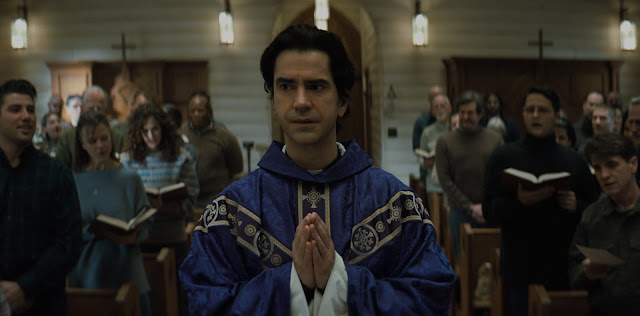
The small fishing town on Crockett Island is dying, literally and metaphorically. A few years back an oil spill occurred off the coast which ruined the local economy. The majority of locals left for better opportunity, the last of them did not even attempt to sell their house. They simply abandoned it. The population is now 127, those too old to move away, or haunted by such pasts that make living in a dying place seem a good penance for past sins. The local church, a Catholic diocese by the name of St. Patrick’s, is led by an octogenarian monsignor. We are told that he was becoming senile and wished to see the Holy Land before he passed, so the church pooled its resources and paid for his pilgrimage. We never meet the monsignor. Instead, a virile well-spoken young man (played by Hamish Linklater) steps off the boat. He is explains to the congregation that the old monsignor has taken ill and is resting in a mainland hospital. His name is Father Paul Hill (there is an important biblical connotation to the neame) and he will be here for only several weeks. He expects his time to take the community through Ash Wednesday, Lent, Holy Week, and then Easter, that sacred time of repentance and death, forgiveness and resurrection.

Midnight Mass is not a movie and I did not see it in a theater. Those two conditions are generally the prerequisite for a review on this blog. I am writing this review because, well, Midnight Mass is the best anything that I saw from 2021. It is a mini-series, eight one-hour episodes, that can be seen on Netflix. Ostensibly it is in the horror genre (and it should be), but let that fool you. It is arguably the best and most artful meditation on religious faith, religious zealotry, sin, forgiveness, and redemption. It is also as scary as death.

At eight hours, it is the correct length. The one-hour episodes take their time, exploring Crockett Island and its inhabitants in depth. The roles are an actor’s paradise. There is not one main character, but several, and each character has at least one great scene that should make all the other actors jealous for having missed being a part of it. The endings of each episodes are at the same time cliff-hangers that make one want to move on immediately to the next episode but also welcome respites that allow the viewer to pause, take stock of what they witnessed, and think on it. You should probably see it alone lest the experience be not ruined by less patient companions who may not be in the mood to watch a good movie.

I watched “Midnight Mass” entirely cold (that is knowing nothing of its plot) based on a review from Red Letter Media in which the reviewers made a sincere effort to not talk about the plot as well because they went in cold, had an incredible experience, and wanted to preserve the same for their audience. For that reason, I am going to be incredibly vague as well as to what happens. I won’t even tell you what the horror element is, though you may find yourself already familiar with it once you realized what it could be. All I will say is that I was surprised by how this element and its rules which I have seen in many contexts (including teen romcoms) fits so well into the theology of Catholicism, in particular those parts wherein the Church insists that it does not deal in metaphors. The Eucharist is my body. The wine is my blood. Drink of it and you will have eternal life. The Church teaches that this is not a metaphor. In this miniseries, it really isn’t.

Midnight Mass was written, directed, and created by Matt Flanagan. I have no previous knowledge of this artist. I looked him up and immediately understood why. He does almost exclusively horror television shows (The Haunting of Hill House for one) and I don’t really watch those. He has done some movies, like Ouiji 2, but I would never see that either. He mostly has done adaptations. Midnight Mass though is original and Mike Flanagan in interviews says that he has wanted to make it forever. It feels like that. It feels like a story someone has spent ten years thinking about. I recognized almost none of the actors here for the same reason. Apparently, Mike Flanagan uses the same actors a lot and these particular actors like Kate Seigel, Kristin Lehman, Samantha Sloyan, Igby Rigney, Rahul Kohli, Robert Longstreet are all in Mike Flanagan’s other TV series. I look forward to seeing more of them acting together. The two actors that I was familiar with were Zach Gilford who I remember from Friday Night Lights and Hamish Linklater, who I know from NYC’s Shakespeare in the Park (I have seen him in Twelfth Night, A Comedy of Errors, and as Benedict in Much Ado About Nothing. He is a great thespian).

It is impossible to tell what the Church would think about Midnight Mass and I hope it says very little, if anything at all. I’m sure there is plenty to be offended about here. At the same time, the Church should welcome great art that takes theology seriously. There is a cautionary history here when it comes to the responses of religious institutions to religious movies. The best example is Martin Scorsese’s The Last Temptation of Christ. Here was a serious movie made by a devout Catholic that took seriously certain aspects of theology, explored them, and in so doing, was probably heretical in some ways. The movie was met with controversy and picket lines. In response, Hollywood studios, wanting to duck controversy, stopped making movies with distinctly religious themes for several decades. In the recent pass, really only Mel Gibson and Martin Scorsese continue to make distinctly religious films. I do not know of any great controversy or furor over Midnight Mass (maybe because it is but a miniseries on a streaming platform) and I hope that lack of controversy persuades more producers to take chances on more movies and TV shows that have directly religious themes.

The horror genre is having its own resurrection. It is a sign of the health of the movie industry when good horror movies coming out. Arguably the best period in American movies took place in the 1970s and it was not a coincidence that period had many great horror movies (Jaws, Alien, The Exorcist, Halloween, Dawn of the Dead, the Texas Chainsaw Massacre, The Thing, Evil Dead). It is happening again. Good horror movies are a good trend in the business because these movies are generally made by young people with no money and deal with inherently risky subject matter. When good horror movies are being made in quantity it speaks to a wealth of opportunity for new artistic voices in the culture. The powers that be are taking chances on the youth and the youth are delivering with something new and profound experiences and giving. Midnight Mass is the best of them.

Monday, January 18, 2016

The Big Short (5/5 Stars)


This movie is an achievement on several fronts. First it achieves clarity in its subject. Second it achieves humor throughout. Third it has a strong moral. It takes considerable skill to do this given that the subject, the secondary mortgage market, is complicated and obscure and I can only hope my review is organized well enough to capture everything that needs to be praised.

The story comes from Michael Lewis’s nonfiction book, “The Big Short.” That book tells three completely separate stories about who profited from the subprime meltdown that cratered the global economy in 2008. Given that almost nobody figured out (or wanted to figure out) that everything was terrible before it was, the people that did are very interesting outsiders. The movie was adapted by Charles Randolph and Adam McKay. It was directed by Adam McKay.

One is Dr. Michael Burry (Christian Bale), an ex-brain surgeon hedge fund manager, who did something nobody else did. He read the underlying mortgage bonds. He spent a couple weeks doing so while barefoot in his office listening to deafness-inducing death metal. Then he did an extraordinarily audacious thing. In 2005, he invested 100 million dollars of his client’s money (against their wishes) in a financial instrument he requested the banks invent that bet against these bonds. It was a ballsy move given his own calculations had the bonds failing in the second quarter of 2007. How the movie treats this character is illuminating. They could have easily gone down the Benedict Cumberbatch route of making him arrogant and dismissive of all the ordinary people of the world. But as Michael Burry points out to his angry clients, “I don’t know how to be sarcastic. I can’t tell a joke. I know numbers.” He corresponds with the incredulous bankers he works with in a humble unassuming way. Everybody is either making fun of him or angry with him for the next couple years.

Second is Mark Baum (Steve Carell). We are introduced to him in an anger management support group. A troubled man is talking about how the world makes him angry. Mark Baum walks in late and immediately starts talking about himself. He is angry with Wall Street bankers and all the big guys beating up the small people. He casually pours himself a cup of coffee and sits down completely oblivious to the fact that he has interrupted the meeting. Then his phone rings. “I have to take this,” he remarks and leaves the room to take the call. Fucking Brilliant. The man is an asshole, but given that he hates Wall Street and spends the entire movie railing against corruption and fraud, he is our asshole. He has a team of angry people working for him including Danny Moses (Rafe Spall), Porter Collins (Hamish Linklater), and my favorite Vinnie Daniel (Jeremy Strong). This quartet form an angry hedge fund that is propositioned by an oily banker named Jared Vennett (Ryan Gosling). Vennett has heard of Michael Burry’s bet and wants to sell somebody else the same thing. Unfortunately nobody wants in on this bet. Except the Baum hedge fund guys who don’t trust bankers. There is a lot of yelling amongst these guys, most of it hilarious. And that is a very important thing as what Vennett is explaining to Baum and (also to us) is the secondary mortgage market, which is an absurdly obfuscated and complicated thing. The movie pulls out all the stops and breaks a lot of rules in order to explain how it works. Jared Vennett, the chief explainer, also serves as the movie’s narrator. At other times people just turn to the camera and make it a little clearer to the audience what exactly is happening on the screen. Then at other other times the movie employs Margot Robbie in a bubble bath, Selena Gomez at a blackjack table, and Anthony Bourdain making a Monday morning stew of old fish to explain the different tranches of a Collateralized Debt Obligation. It also helps that McKay sometimes substitutes for different financial terms the word “dogshit,” as in “these loans are dogshit,” as opposed to “non-performing." All of this saves a lot of time, which as McKay should know and amply demonstrates is the friend of comedy.

Third is the twenty-something partnership of Charlie Geller (John Magaro) and Jamie Shipley (Finn Witrock). They specialize in betting that bad things will happen (natural disasters and the like) given the theory that most people do not plan on terrible things to happen to them. They are introduced (about 45 minutes into the film) in a very endearing way. They want to go work for JP Morgan and have an interview that does not get past the lobby of the building. An intern (or at least a very young associate) meets them downstairs and points out that they have one billion (or something) less money than it takes to get an ISDA (described as the ticket to get to the big boys table). They feel stupid and rejected. So let us do a tally. We have our bullied nerd, our asshole, and our young nobody underdogs.

There is one more character but I’m going to intterupt my own review to talk about the ingenious way Adam McKay brings all of these characters together. They never meet each other, but they know about each other. Jared hears about Michael Burry’s bet at an afterwork bar. Charlie and Jamie pick up Jared’s prospectus in the lobby of JP Morgan. Except that is not how it happened. We see this happen but then Jared turns to the camera at the afterwork bar and tells us that he does not hang out with these people. He has fashion friends. Actually, Charlie tells us, he did not pick up the prospectus in the lobby. He heard it through a friend and Jamie found out about some other not very cinematic way. This is halfway brilliant by Adam McKay. First, how these characters hear about the other deals is not important to the story. In many nonfiction adaptations moviemakers do this sort of efficient blurring of the truth all the time. It saves time for the audience, this is understood, so it does not take away from anything for the characters to turn to us and let us know that we are seeing a movie convention. But only that would not be brilliant. It is brilliant because McKay takes this convention and admission and turns it into a setup for one of the greatest, hilarious, and cathartic payoffs in the movie. During a seminar Mark Baum interrupts a speaker on a stage (not during a Q and A session) with a question. The speaker answers and Mark interrupts him again to contradict him angrily. Then Mark’s phone rings, he answers it, announces to everyone that he has to take this and leaves the room. Then Jared, who is also in the room, turns to the camera and states, “That actually happened. Mark did that.” This joke would not have been possible if McKay had not been breaking the rules all the while. He needed to break the rules in order to tell the story efficiently. What makes this movie’s screenplay brilliant is how he uses all the broken rules (that are rules generally because they are distracting and take the audience out of the story) to do things that bring home jokes and cathartic points. The techniques that break the rules do not distract, they reinforce and make scenes better. Adam McKay and Charles Randolph deserve the Oscar for Best Adapted Screenplay.

So Charlie and Jamie are rejected but they have a trick card. They have befriended an ex-banker in their hometown named Ben Rickart (Brad Pitt with a beartd). Underscoring how bullshit the system is, this guy uses his connections with a big bank to get the necessary ISDA that they would not have been able to get based on their underlying merit.

So now everything is set up and explained and the rest of the movie is payoff. It is generally funny up until a point and then the movie hits us with several very moral scenes. My favorite (and there are plenty to pick from) comes at a point where Charlie and Jamie make several great bets and are very excited about it. They are dancing in the lobby of a Las Vegas convention center and Ben Rickart angrily tells them to stop. “Do you realize what you just did? You bet against the U.S. economy. If it turns out well for you it hurts everybody else. One tick upward in the unemployment rate is a hundred thousand people out of work. This is what I hate about banking. It takes human beings and turns them into numbers in a spreadsheet. Just don’t fucking dance.”

There are several moments like this in the movie and they all work very well. It may come as some surprise that this is the first dramatic movie Adam McKay has ever made. He is known for the best of the Will Ferrell comedies (Anchorman, Talladega Nights, Step-Brothers, and The Other Guys). It is fun now to watch other movie critic revise what they think of the guy now that he has made a truly great movie that is not a comedy. (Not me. I have always thought Talladega Nights was a perfect movie). I hope McKay makes other movies that are not completely comedies. He obviously cares deeply about people and has the skill and talent to take complicated problems and break them down in digestible parts. He also has a comedic director's skill in caricature. This comes into play most readily in his satirical treatment of secondary characters. I especially love how the woman at the ratings agency (a fine Melissa Leo) has come back from an eye exam and is wearing thick sunglasses. And the coup de grace has to be the SEC girl who is in Vegas at the secondary mortgage market convention with the sole purpose of shacking up with a guy with Goldman Sachs in order to get on the ground floor of that bank once her couple years at the agency are up.

I have studied this subject quite a bit and have only this to add. Everything this movie shows about the banking industry is correct and their angry attitude is entirely called for. Having said that, it does not follow that the homeowners (who this movie does not hold under their satirical light) are entirely blameless. Many took out loans for houses they could not afford. Some people took out two or three mortgages and a line of credit on their property. These people deserved to lose their homes. I bring this up not to contradict this movie but to impress upon the reader that one does not need to take sides between ordinary people and banks in this crisis. It is entirely possible and I would posit that it is completely true that everybody is guilty and the true injustice is not that ordinary people suffered but that the big banks and the people who worked for them did not. Of course if one had to decide who is guiltier, it would tip towards the banks. After all, they were professionals who told everyone that they knew what they were doing.


One of my favorite scenes is when Charlie and Jamie sneak into Lehman Brothers after it has collapsed. And they walk around the deserted trading floor with its infantile Red Bull can pyramids. It was not how Charlie imagined it would be. “What did you expect?” asks Jamie. Charlie reflects a moment before adding, “I thought adults worked here.”