Search This Blog

Showing posts with label domhnall gleeson. Show all posts

Monday, December 30, 2019

Star Wars: The Rise of Skywalker (2/5 Stars)


In my review of Star Wars Episode VIII: The Last Jedi, I stated that the quality of Episode VIII would rely on how Episode IX resolved the interesting questions that were raised. I found especially intriguing the idea that Rey would not be related to any of the other main characters, this usually being a prerequisite for importance in a Star Wars movie. The idea posited was that the Force is self-balancing. In this way, a being that was either very light or very dark would naturally bring about their opposite at some other place in the universe. With this understanding, Luke Skywalker felt it prudent to leave behind the force altogether in order to not further provoke more Sith Lords.

It turns out none of this matters or even happened, which kind of renders both Episode VIII and Episode IX pointless, which in turn renders Episode VII pointless too. To watch this new trilogy is to watch the most expensive interplay between bad improvisors in the history of movies. At the very least, as things were being made up as they went along, the contributors could have abided by the first and only important rule of improvisation, “Yes And…” That is if you are to not have a plan, the very least you can do is not undercut your fellow collaborators. This basic concept is lost on the director of the Episode VII and Episode IX J.J. Abrams and the director of VIII, Rian Johnson.

For certain movies, a warning against spoilers is warranted. “Parasite” is a good example. Its plot twists are nonobvious and are brought about with Hitchcockian suspense that is quite pleasurable to experience in the moment. For other movies, warnings against spoilers behaves more like a marketing tool. By begging reviewers to not allow spoilers, the mega corporations involved keep away from the audience certain unimaginative details that would be complete let-downs if revealed.

For instance, Rey is not a total nobody as presented in Episode VIII. Actually, she is the granddaughter of Emperor Palpatine from “Return of the Jedi”. What a let-down. That sound is the most interesting development in Episode VIII hitting the bottom of the dust-bin. What is more disappointing is the reason why Rey is a Palpatine. It seems entirely do with the decision to hew as closely to the structure and development of the plot of “Return of the Jedi” as possible. Looking back, I don’t see why I expected anything less. After all, Director J.J. Abrams did the same thing with Episode VII, making that movie’s plot an almost retread of Episode IV: A New Hope and Director Rian Johnson did the same thing with Episode VIII, making that movie’s plot structure a retread of Episode V: The Empire Strikes Back.

It should be noted that Director J.J. Abrams is once more complicit in the murder of billions of people. With an amazing lack of originality, a weapon that destroys planets has been developed by the bad guys. Mr. Abrams once more shows no hesitation at all in using this weapon, incinerating a planet as an afterthought and not particularly caring about treating the aftermath with the sort of respect that should be called for amongst such an extraordinary loss of life. The movie, like all Disney movies, is PG-13, because there is not a hint of sex involved anywhere. Even Poe, played by Oscar Isaac, the Han Solo-ish character, is not getting lucky anytime soon. A sad development given that he is instrumental in saving the galaxy by the end of the movie.

There are certain things about this movie that do not come remotely close to making sense. However, it is hard to talk about them in a critical manner because the movie moves so fast from plot point to plot point that it hardly matters what has just happened. “Look Something Shiny and New,” is the name of the game here. When the original Star Wars trilogy came out, the critics wailed about its reliance on special effects and lack of character development. What glory days those were, when characters engaged each other in half a minute-long conversations and military tactics, however limited, were considered. In Episode IV, the main characters land a ship in the Death Star and by subterfuge, loosely defined, rescued the princess. Here, the main characters land a ship in an enemy star destroyer and the first thing they do is come out guns blazing as if three people with blasters could take down a gigantic ship by brute force. The original trilogy at least gave the audience certain outs for unlikely scenarios. To experience this trilogy without rolling your eyes you must be a total idiot.

The ending bespeaks a recent trend in the ever-escalating stupidity of movie villains. Like the army of the undead in “Game of Thrones”, the evil forces here are both impossibly powerful and also can be take down with the capture of a single target. I would posit that fair fights that are resolved by strategy are more interesting that lopsided battles won by technicalities. But this idea is lost on the makers of Star Wars.

There is a bright spot in this movie and that is the basically good acting of Adam Driver as Kylo Ren and Daisy Ridley as Rey. This is helped by a storyline that gives these characters things to do and emotions to develop. The same cannot be said for the characters of Poe, played by Oscar Isaac, or Finn, played by John Boyega. They do not do anything in this movie but run around from plot point to plot point. From the promise of Episode VII, it is rather disappointing that Poe and Finn do not ultimately have interesting story arcs. However, at least these characters had the promise of an interesting story arc. There are several characters in this trilogy who were introduced and then promptly forgotten. Rosie, a seemingly important character in Episode VIII hardly shows up in Episode IX (Maybe the focus groups found that the world was not ready for a Black-Asian romance). Benicio Del Toro from Episode VIII does not appear at all in IX. Domnhall Gleeson has a fate that suggests he wasn’t willing to work for more than a week. Keri Russell literally phones it in, perhaps only showing up to work for one day to dub the lines for her bemasked minor character. Several other characters are introduced in this episode seemingly for the limited purpose of introducing new series on Disney+. But is there actually a plan to make these series or are these scenes just bait for the focus groups where the real decisions would be made? If that series starring Lando Calrissian does not come to fruition, Episode IX will harbor an utterly pointless scene in a few years’ time.

There is a way to plan out a franchise and that way was ably demonstrated by Marvel over the past decade. Not every movie in the Marvel franchise is a must-see-most-important-installment-of-the-franchise movie. Most movies focus on a single character which in coordination with other smaller movies build into the bigger spectacle movies every four or five years. Star Wars has not done this. The sad thing is that it probably could have. What really helped Marvel was its library of over fifty years of comic book storylines that the movies could pick and choose plots from. Star Wars has a library substantially similar to this: four decades of books written by professional fans and blessed as canon by George Lucas. None of this material was considered for Episodes VII, VIII, or IX. Why?

Corporate cynicism comes to mind. The new trilogy is the same thing as the old, but with better special effects and a more diverse cast. Why take a risk making something new, when you can repackage the old as a presentation to international audiences unfamiliar with the old movies. The global marketplace is where the real movie is made. My appetite for Star Wars has officially been sated. I do not plan on seeing any further of these movies in theaters. 

Sunday, January 28, 2018

The Last Jedi (4/5 Stars)


The merit of “The Last Jedi” will be reassessed when the third movie of the new trinity comes out. There are several interesting developments in this movie. The question is whether they are going to lead anywhere. I feel like I have been in this place before. I am reminded of the middle seasons of LOST and “the Girl who Kicked the Hornet’s Nest.” These were incomplete but intriguing stories. However the later installments could not fill in the holes. This might be the sad fate of “the Last Jedi” too.

For those who have seen “The Empire Strikes Back” many times, the structure of “The Last Jedi” should seem very familiar. Like “The Empire Strikes Back” most of the characters are fleeing the bad guys while one person is engaged in Jedi training. This happens in “The Last Jedi”. Poe, Finn, and the last of the rebellion are fleeing General Hux’s large battle fleet while Rey seek Jedi training with Luke Skywalker. There is a difference however that renders uneven the first half of the movie. Unlike “The Empire Strikes Back” the fleeing characters have no respite from the pursuing forces, like say hiding out in an asteroid field. Thus, it seems like the time period in which the movie takes place is much shorter than the previous film. Although technically this may seem like it would make the movie more exciting, it also makes less sense. After all, Rey’s Jedi training seems to be a week or a month long at the most, whereas it seemed like Luke Skywalker had at least a year in “The Empire Strikes Back.” The movie then would seem to be wielding a rather liberal view of how a person with force abilities would be able to attain the abilities of a Jedi master. There is a decent if not completely satisfying explanation to this and it is one of the more interesting features of this installment.

Like “The Empire Strikes Back”, “The Last Jedi” expands the audience’s understanding of the Force (this is bound to create seas of unrest amongst fans who like religious zealots already believe they know all there is to know about the Force). As Luke Skywalker seems to be explaining it, the Force is not something individuals attain. It is a force that exists within the very fabric of the universe. It has two sides, dark and light, but neither are its natural state, which is a balance. If a Jedi or Sith were to use the Force, the Force would create an opposite to render balance to the universe. A person who wants to use the Force for good, may end up making things worse because to use the light side of the Force is to create a Sith who uses the dark side. Perhaps then the wise thing to do is to not use the Force at all, which is why Luke Skywalker closed himself off from it and exiled himself to the furthest part of the galaxy. Because the only ones using the Force in the world at the time of “The Last Jedi” are the Dark Sith Lord Snoke and the Sith Lord Kylo Ren, a very strong opposite has emerged in Rey, which may be the reason why her training is so very brief. Maybe.

It is hard to tell where a more nuanced understanding of the Force will lead a franchise that is so ingrained in the notion of a fight between good and evil. This episode seems to be deliberately muddying the waters of such a black and white vision. The most interesting and confusing character is Kylo Ren (played by Adam Driver) who seems to be oscillating somewhere between the light and dark side of the force, not exactly sure of which path to follow. Where he ends up and whether it makes sense will decide whether this trilogy is a good one.

The least interesting person in the first film, Rey (played by Daisy Ridley) also became more nuanced and interesting in this one. As I mentioned in my review of “The Force Awakens” the Star Wars movies are generally guilty of blockbuster narcissism in which large events are dictated by a few familial connections. However, it is revealed in this movie that Rey does not have a connection with anyone. If Kylo Ren is to be believed, she is a nobody from nowhere. I love that. That is great. It unties Rey from any kind of pre-ordained fate. Kylo Ren seems to feel like he should be a Sith because his grandfather was Darth Vader. However, Rey could probably be whatever she ultimately decides to be. It is impossible for me to tell how her arc in the last film will go.

The “Star Wars” franchise still propels its weird relationship with violence. “The Last Jedi” in particular seems to consider the futility of violence while showing as much of it as possible. The majority of characters introduced in the “The Force Awakens” met violent deaths by the end of “The Last Jedi”. For those looking between the lines, this has the tendency to render the lighthearted moments of these movies in a rude light. Some of the battles feel like World War I suicide missions. At one point Poe Dameron (played by Oscar Isaac) decides that it is best to retreat than keep moving forward. He does this after most of his comrades in arms have been blown to smithereens. A decent leader would probably have made the retreat decision before sending most of the army to its death. Furthermore, because there is no policy discussion that would enable the viewer to tell the difference between the good guys and the bad guys, the war may as well be about the colors of their uniforms. In any case, I felt several times in this movie that the good guys should have probably just given up. That may have been the point of this movie, which will be expanded further in the last one. Or the last of the trilogy may simply feature a battle in which the good guys win (like “The Return of the Jedi”). That would be the obvious thing to do, but it would also render stupid all the interesting points that were made in “The Last Jedi.” Like I said before, much is hinging on how all of this is resolved.

Saturday, October 28, 2017

Mother! (3/5 Stars)


The last two movies of writer/director Darren Aronofsky, “Noah” and now “Mother! Present a point of view that is rarely posited. Believers of God generally think of the deity in an absolutely positive light, whether as fully good or at least fully just. Whereas non-believers don’t have an opinion about God (though they may hold a generally negative of organized religion) because they don’t believe that the deity exists to have an opinion about. Darren Aronofsky, at least in his last two films, believes in God, and finds the deity lacking. For example, in “Noah, God decides to kill almost everybody on Earth. Some characters in that movie were quite articulate as to the unfairness of it all. If there was a such thing, that movie and this new one would be heretical works.

“Mother!” is an extending and ever-developing metaphor of all the crimes ever committed against Women/Nature. I myself did not quite grasp the overall metaphor until about two thirds of the way through and upon reflection noticed I missed many things early on. Then again, I went into this movie blind. Just reading that its a metaphor will likely help you catch on to the biblical parallels earlier. “Mother!” has received a Cinemascore of F which should give a hint as to what an unpleasant experience this movie can be. However, an unpleasant movie does not necessarily a bad movie. “Mother!” is technically proficient, well-acted, and has more things to say in ten minutes than most movies have in their running time. I cannot say I liked “Mother!”, but when I exited the theater I had a feeling that reminded me of the feeling I had when I exited the theater after watching Charlie Kaufman’s “Synecdoche, New York.” It is an intense proceeding.

The movie takes place entirely in a fixer-upper mansion in a picturesque landscape. Here Jennifer Lawrence, doing her best impression of a Renaissance Madonna, works on renovations while her older husband, played by Javier Bardem, tries to get out of a writing block. Nobody actually has names as who they are and what they represent seem to more or less explicitly change over time.

The movie can be broken into three parts: the first is about the neuroses and concerns of a married couple trying to decide when and if to have a child, the second is about fame and what happens to a couple when one of them starts spreading their love in a not exclusive fashion, the third is quite explicitly about God and Mother Nature. In the background, making things complicated and then throwing the whole world into squalor and chaos are the humans. The movie takes a dim view of the humans, and through this dim of view of the humans, places the ultimate blame for the troubles on God, who made them in his image. The only innocent here is Women/Nature. At least that is what I believe this movie is about. Aronofsky does not feel the need to be explanatory. I think that wound in the floor is Original Sin, but there is no way to know for certain. Javier Bardem it should be noted is quite good as God. Not sure how that sort of thing is pulled off, but he does it.


I can’t recommend this movie to anyone who wants to see a movie with anyone else. You are going to have to see this one alone. It’s not a good time. However, it will make you think. It is quite literally a challenging movie. I for one never considered what Mary, mother of Jesus, may have felt about God giving up his only son through martyrdom for our sins. I mean it’s not like God asked Mary for permission or even her opinion on the matter.

Saturday, February 20, 2016

Brooklyn (4/5 Stars)


Winter movies are generally awards fare and thus tend to gravitate toward the dramatic. The two movies I saw before this one were “The Revenant” and “Room” the two most intense movies of the year. I was ripe then to see “Brooklyn” an adorable movie about nice people in pretty places.

Nick Hornby adapted “Brooklyn” from the book by Colm Toibin about a young Irish woman who immigrates to America. Nick Hornby, well known for his novels about young men (Fever Pitch, High Fidelity, About a Boy) has made his last three projects on adapted screenplays of novels about young women (An Education, Wild, and now Brooklyn). It is a pleasant development and does its little job in trying to fill the yawning chasm in the modern movie marketplace for stories about women. His skill in drawing women is evident in the fact that the lead actress in each of his movies has gone on to score an Oscar nomination. Saoirse Ronan, who plays the lead this time, Ellis, is no exception.

Ellis leaves Ireland for economic opportunity. At home there is no job better than part time cashier. In America, she has the opportunity to develop. There are many people helping her. Her family in Ireland is supportive. In NYC, a kindly Irish Catholic priest (played by Jim Broadbent) helps her get a home in a boarding house, a job in a fancy Manhattan department store, and night classes for accounting. Such are the benefits of being Irish and immigrating to America in the 1950s as opposed to the 1850s. She is standing on the shoulders of 100 years of past immigrants who are kin to help her out. About the worst that happens to her is a bout of homesickness, which is cute because it only happens when nice people miss nice people.

Of special mention is the boarding house and the nightly dinners there. At the head of the table is Mrs. Keogh (Julie Walters) who prides herself on being strict and proper but betrays an absolute glee in spending her nights around the table with several twenty-something girls. She and the other girls, Patty (Emily Brett Rickards), Diana (Eve Macklin), and Shelia (Nora-Jane Noone), pull off something rather rare in movies. We have all seen characters that are funny without knowing it and characters that make wisecracks meant obviously for the consumption of a movie audience. But it is rare to feel like a fly on the wall in a place where there are several obviously witty people genuinely having a good time talking to each other. That is what is going on in these boarding room dining room scenes and it is a delight to watch them. I want to be there.

The Irish community in Brooklyn goes so far in helping Ellis that they actually facilitate her love life as well. She meets an Italian named Tony at a church dance. They start dating and Tony is a swell guy. He proposes something that he feels might be too fast and it turns out to be dinner with his family.


This leads to the only real conflict in the movie. At some point Ellis goes back to Ireland. She is walking around her dowdy small town with her education (which swiftly lands her a good job) and her glamorous NYC style (she stands out to say the least) and quickly attracts the small town’s most eligible bachelor, Jim Farrell (Domnhall Gleeson, again.) So now there is a love triangle but each guy is great so the audience isn’t really sweating it. I liked this movie. If you ever wanted a safe evening where nobody anywhere would be offended by anything and it also would be a decent movie, than this one is recommended.

Saturday, January 30, 2016

The Revenant (5/5 Stars)


This much is true: In 1823 on Captain Henry’s expedition up the Missouri River, Hugh Glass was attacked by a bear. He was severely wounded. His compatriots could not carry him all the way back to the fort. Two young men, Bridger (18) and Fitzgerald (23) stayed behind to wait for help as the rest went ahead. Bridger and Fitzgerald abandoned Hugh Glass without food or supplies. Hugh Glass crawled and stumbled the some 200 miles back to the fort alone.

This much is also true: Right around the time Director Alejandro Innaritu and Cinematographer Emmanuel Lubezki were accepting their respective Oscars for Birdman, an on location film shoot was going on in the frigid winter of Wyoming or South America or some other godforsaken place. The conditions were so terrible that they were starting to leak into the press Apocalypse Now style. “The Revenant” was that movie and watching the movie, it looks like hell froze over on the film shoot. I do not know if this movie will join “Apocalypse Now” and “Fitzcarraldo” in the legendary realms of ridiculously hard film shoots but the affect in the theater is akin to those movies. In other words, this movie does the original true story right. It feels like Leonardo Dicaprio (Hugh Glass) was attacked by a bear, abandoned by his compatriots, and ended up crawling two hundred miles to safety through blizzards and Indian attacks. It is an intense awesome movie.

A main star of the movie (and what separates it from all other Westerns) is the cinematography of Emmanuel Lubezki. He is well known for two things. First are his long takes. There are plenty in this movie but I hardly recognized or paid attention to them. When watching his previous movies like Gravity and Birdman, the long takes were part of the excitement. They are less so here as Lubezki uses them plenty but does seem to feel as if he needs to use them exclusively. That is to say when it makes story sense to not keep on the same shot, he doesn’t. Second is simply the look of the movie that seems to only occur in movie shot by him. For the past decade he has perfected this beautiful look in movies such as The New World, The Tree of Life, Gravity, Birdman. It must be hard to do because it looks so great and yet he seems to be the only one doing it. “The Revenant” was shot entirely in winter using only natural light. The result is a movie that does not look like any other movie. It is a ghostly haunted visual effect of denotes the hardness and coldness of life at that time. Lubezki rightly was awarded the Oscar for the past two years. He may very well win again this year and he would deserve it. He is in the prime of a spurt of aritistic genius.

Leonardo Dicaprio may very well win his first Oscar this year and he too would deserve it. This actor I believe has achieved a certain Meryl Streep-ness or Philip Seymour Hoffman-ness that makes it seem that he is perfect for every role he finds himself in. The secret is a full on commitment to the role and if there ever was anyone committed to a role it is Dicaprio here. Here he is wrestling a bear, swimming through icy rivers, eating raw meat, and fighting hand to hand with Indians. His last role was “The Wolf of Wall Street.” It takes a special actor to be the right choice for both roles.

Playing his antagonist, Fitzgerald, is an actor that was made for rugged terrain, the art house muscle man Tom Hardy. The movie does a good job of setting up his villainy. He has worked painstakingly for the last six months only for an Indian attack to steal all of the wealth of the expedition. He was half-scalped earlier in his life (he has a scar that makes him partly bald) and so does not particularly like or more importantly trust Hugh Glass’s half Pawnee son. He is a desperate angry man. Between the two is Captain Henry played by Domnhall Gleeson, who is good looking enough to be a man with money but odd looking enough to belong in the 19th century. This guy is everywhere this year and impressively pulls off many different characters.

I am playing with the idea of drawing up a syllabus of American History through movies and “The Revenant” is one of those movies I would love to have in it. What makes it better in historical terms that any old western is the unflinching way it shows the elements and the noble/savage way it treats Native Americans. This is particularly important because we have a tendency to look at history in black and white terms. But that is not how this movie treats the Akirawa tribe. It humanizes them and gives them appropriate motivations but it also does not hide the fact that they are extremely dangerous and have their own tribal prejudices. It also portrays them as losers in their struggle as is noted by a scene in which Fitzgerald and Bridger walk through the remnants of a massacre of an Indian village. This too is important.  Lastly, what other movie do you know takes place in 1823. No other movie. Exactly. 

Saturday, January 23, 2016

Star Wars: The Force Awakens (4/5 Stars)


It looks like I won’t be skipping my annual ritual (Godzilla, Abysmal State of Movie Ratings, The Avengers, War Horse) of discussing the idiocy of movie ratings and how they affect onscreen violence. I saw this movie in December so this review counts for 2015.

But first of all, the movie does not suck. It is not great and in a smart and safe way does not particularly try to be. That is all right by me. I felt it put the franchise on solid footing and that (many more) future installments will have the room to be more creative and daring if they feel like it.

The movie looks great in the way it should look great. That is to say that it is has all the best cameras and digital effects of today but stays true to many of the technological tropes of the 1970s that distinguished the original Star Wars films. When characters walk into a bar, the aliens are not digital creations. Like the Mos Eisley Tavern in the original they are composed of real life frabric and costuming. And the 1970s clunky computer graphics that everybody uses in the movie are seamlessly transmitted into a 21st century blockbuster. It is actually much better than I thought was possible. The movie looks great in the correct way. Good job team J.J. Abrams.

The movie introduces two new lead characters and is so good at doing it that the 30-year gap between movies may turn out to be a blessing year in disguise. The first is Rey (played by Daisy Ridley), a poor orphan on the outpost planet of Jakku. She is a stoic scavenger that hunts for parts in the nearby crash-landed and abandoned Imperial Star Destoyer. The second is Finn (played by John Boyega) a stormtrooper who deserts his post after witnessing the brutality of the Imperial system. On his first mission he is told to kill innocent villagers and chooses not to follow orders. Knowing he will be severely punished for not toeing the line, he rekidnaps the newly captured Rebel pilot, Poe Dameron (Oscar Isaac) to help him escape away.

Rey and Finn are respectively a woman and a black guy. The movie has determined to include everybody. As a white guy I am going to have to be content with Oscar Isaac, who is awesome and I am content with him. Thankfully the movie does not seem to particularly care about Finn being black. However it does insist on several jokes about Rey being a strong woman. These aren’t bad as much as I’ve already heard them before. My favorite though has to be when Rey and Finn are being chased and an explosion near Finn knocks him out. He wakes up and asks Rey, who is standing over him, if she is all right.

 The rest of the new people are a casting director’s dream of interesting people. Adam Driver (of all people) is the new Sith Lord, Kylo Ren. He is a bit of pretty boy and that is one of the relatively more daring twists in this installment. It works by the way. Kylo’s evil counterpart, General Hux, is played by Domhnall Gleeson. Domhnall is my 2015 nominee for Best Year (Ex Machina, Brooklyn, The Force Awakens, The Revenant). Then there is Lupita Nyongo (12 Years a Slave) and Gwendoline Christie (Game of Thrones) who provide voices for their respective characters. None of these actors are all that famous but if you consistently watch good movies, you know of them, because they have distinct voices and memorable faces. They are not a marketing executive’s generalized lowest common denominator pick of what would appeal to most people at the same time (like say the many superheros played by Chris). Nobody in this movie is like that (well maybe Daisy Ridley if we can safely say that being a woman is no longer a handicap anymore). That is kind of amazing in and of itself and makes the movie (and any future installments) that much more interesting to watch.  

Past castmembers are also back but in supporting roles. Luke Skywalker’s absence is a major plot point. I suspect Mark Hamill will have a much larger role in the next movies. Princess Leia is now General Leia and she too has not so big a part though I suspect she may have a larger part in a future movie as well. (There was some controversy over how Carrie Fisher looks. It is not that she has not aged well. It is that she has had enough work done on her face that she no longer looks like a natural aged progression of Princess Leia. It would not have been a big deal if she had wrinkles. She’s old. She should have wrinkles. It is worth noting this in a review because her appearance is unnatural enough to be distracting.) Of the original cast members this movie belongs to Han Solo (and Chewbacca).

Han Solo’s presence and in particular his cool/frustrated dynamic with the always over his head but optimistic anyway Finn provides much of the movie’s fun. There is a good deal of it and provided many of my favorite parts. At one point several of Han Solo’s aggrieved trade partners come after the smuggler and Finn in an effort to save Solo accidentally releases his cargo of extremely dangerous alien predators. And now everyone might die. That was a hoot.

Also rather fun and the defining characteristic of the Star Wars franchise is the aggrandizement of the individual. Other movies are content enough with having the guy next door achieve superpowers, go on an adventure, and save the day/win the hot girl. In Star Wars, all this happens but on a galactic scale! That is to say instead of just competing with several billion people on Earth for the mantle of most special, the characters in Star Wars are supposedly contending with trillions. And the major players in this extraordinarily multidinous amount of life are somehow related by blood. The scope of Star Wars very very big and the people who actually matter are very very few. Try not to think about it too much or the whole thing may seem rather silly. Just enjoy it like when characters somehow infiltrate a gigantic base and somehow know where everything is and somehow never get caught or seen by the many patrols. It’s like when you were five and you played war games or hide and seek except this is with a budget of several hundred million dollars.

Having said that there was something that really nagged me while watching this movie. Take Finn’s story. The fact that he is a disgraced stormtrooper has the effect of humanizing the storm troopers. But, that does not stop him (or anyone else) from killing a lot of stormtroopers in this movie with very little hesitation. And that is just the death you see outright. This movie destroys planets. Not a planet like the original Star Wars. The mean General Hux destroys five planets with his Planet Death Star thingy. That is an extraordinary amount of death right? I mean that is like tens of billions of people. But what is the reaction to this? In the first Star Wars, Ben Kenobi felt a tremor in the force and had to sit down or whatever. In this movie, there does not seem to be any grieving period at all. The planets are not named, no main characters die, and so it is not that big of a deal. As far as I can tell J.J. Abrams with his penchant for destroying entire planets (he has done so before, see Star Trek) must have officially surpassed Roland Emmerich for the motion picture director with the most blood on his hands.

And all of this in a PG-13 movie. How can tens of billions of people die in a movie and it retain its PG-13 status? Counterintuitively the reason it can is because nobody cares about these people. The deaths happen out in the distance of space to nameless people we do not know who have no connection to the people in the story we do know. This is counterintuitive because movie ratings are supposedly about morality and it is pretty universal in all systems of morals that human life is important and equivalent to all other human life. But this is not how it is in movies. In Star Wars: The Force Awakens, we are prompted to care far more about the death of a main character than we are for the tens of billions of people who have died during the course of the film. And anybody who has a mask or helmet on? Thier life isn’t worth shit and their untimely deaths at various times are occasions for laughs or thrills. The MPAA gives a movie an R rating on the basis of blood not death or injury. But what is the ultimate effect of this? Basically any death that isn’t taken seriously (because all violent death requires blood) is okay to show to children. But should children not be aware that violence causes men to suffer and bleed? Should they be told that if they don’t see a person’s face than that person’s death is trivial? And if a person or very many people died in some far off place, should it be related as no big deal?


Such are the idiocies of the present policy and whatever it’s supposed ambitions to promote morality are, I argue that they do the opposite. And I expect I will make the same argument again sometime in the next year.

Sunday, August 24, 2014

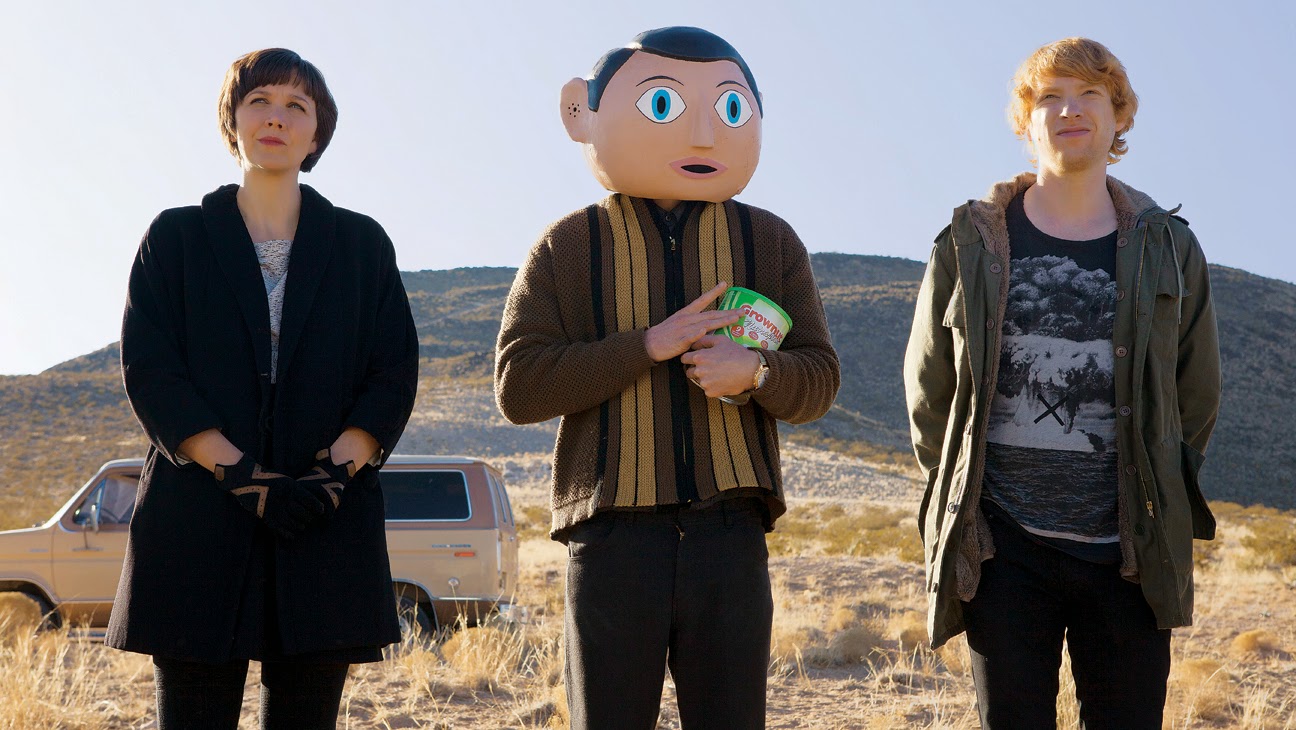
Frank (4/5 Stars)


This bizarre story starts in a quiet beachside community in the United Kingdom. A young twenty-something lad named Jon, played by Domhnall Gleeson, walks the the shoreline, pad and pen in hand, jotting down the various things he sees in a desperate attempt to force inspiration for song lyrics. A woman jogs past him in a red coat. “Woman in a red coat jogging!” He hums to himself. A woman jogs past him in a blue coat. “Woman in a blue coat! Does she know the woman in a red coat!” Terrible just terrible. Upon chance occurrence he comes upon a man attempting to drown himself in the ocean. The paramedics are dragging him away to the ambulance when Jon strikes up a conversation with a few other people on the beach watching. They know the man. He was their keyboardist. They no longer have a keyboardist for their gig tonight. I play keyboard, says Jon. Okay, be at the stage door at 9pm. The group gets in their van and leaves.

Jon shows up at 9pm. He is instructed to play three chords and that’s it. The crowd is non-existent. One bandmate, a surly looking woman named Clara, played by Maggie Gyllenhaal, is playing a theremin of all things. And then there is Frank, played by Michael Fassbender. He walks onto the stage in a wetsuit and a big fake paper mache head. They start in on the first song. It sounds absolutely strange. Frank sings in a deep voice and makes muscular robotic stage moves. Clara’s theremin has an electric short and sparks fly. She becomes angry, pushes over her instrument and storms out cursing. The drummer and guitar player follow leaving only Frank standing perfectly still and staring intently at Jon. Well, maybe, you can’t tell because Frank has a big fake head on. Then Frank leaves the stage too. The entire thing lasts less than a minute. What an act!

There is a concept in stand-up comedy called the ‘Comedian’s comedian.’ This was generally not the most successful or even the funniest comedian on the scene, but it was the type of comedian that other comedians would come out to see because they were doing something really edgy, exciting, and new. And Frank’s band is that. They are on a completely different wavelength and could not care less about connecting with any sort of audience. Jon is invited the next day for something big. He is excited and is picked up by the band. First thing he notices: Frank still has his big fake head on. Apparently he never takes it off, ever. Second: they are not going to a big gig. They are going to a remote cabin in the Ireland wilderness to take as long as it takes to record an album. Jon tries to explain that he told his boring office job that he would be back by Monday. ‘okay,’ is the reaction. Jon stays.

The character of Frank is a fascinating masterwork of acting by Michael Fassbender. The journey of understanding him oscillates from thinking the man is insane to thinking he is a well meaning musically inclined wise and nice person to realizing he is both of those things. Fassbender plays 95% of the movie without any facial expressions but this hardly matters. His physicality and voicework is very expressive not only in his movements, which are of an excited robot variety, but also in his stillness. You do not need to see Frank’s face to understand when he happy, or inspired, or nervous, or really really scared. And sometimes he goes ahead and describes his facial expressions in order to be more helpful. Frank is not the main character of this story (that would be Jon) but it feels like he is the main character. It is an Oscar nomination worthy performance, though maybe it is too far out there to be seriously considered as such.

The main theme of the movie is the education of Jon’s view of musical expression. He is an ambitious young man who realizes the talent of Frank and his band and sets out to raise awareness of this band on his blog and Twitter feed. Jon sees the endpoint of all their work as a vehicle for rockstardom. Through viral videos of the band doing really weird shit in the woods he gets a cult following for Frank and a gig at the South by Southwest music festival. Everybody in the band hates the idea, but Frank is inclined to do it out of a trust he has placed in Jon. All these people want to like and love us, he innocently asks. Yes, explains Jon, they have already seen and liked and will love you. They go to South by Southwest and all goes to shit. What Jon does not realize is that everything Frank does is especially personal and he wears the head not as a self-promoting gimmick but because he is enormously shy to the point of real psychosis. His bandmates understand this and quit the band before the gig but Jon has to figure it out for himself and almost destroys Frank in the process.

Where does musical talent come from? Jon bemoans the fact that he did not have an abusive childhood or a mental illness that would have expanded his mind in artistic creative directions. No, he realizes in a great scene at the end of the movie. Frank grew up in a nice home with nice parents and was always musically inclined. If anything, his illness hinders his artistic expression. But Jon grew up in a nice house with nice parents too. Why doesn’t he have any musical talent?

Jon makes it up to Frank though, he gets him back together with his band and at the end of the movie they make a song together with Jon on the outside looking in again. Some of the lyrics of the song include the phrases, “It’s nice to see you. It's really nice to be here. I love you all.” It is not a rare thing to hear a musician say these words to a crowd, but when Frank does it has a real profundity to it. Frank really means it. And yes it matters that there is no audience and Frank sings it to his band. You can’t say ‘I love you’ to an audience of people you’ve never met before and mean it. There is something to that surely and it may just be the difference between mediocre and sublime expression.