Search This Blog

Showing posts with label michael fassbender. Show all posts

Thursday, December 28, 2023

The Killer (3/5 Stars)


I wonder who the narrator is speaking to in Director David Fincher’s latest movie The Killer. Usually a voiceover is directed towards the audience, but here the character involved, an assassin played by Michael Fassbender, is not the type of person who would choose to have an audience. Perhaps what we are witnessing is an internal monologue. Perhaps The Killer is talking to himself. 


Perhaps David Fincher is talking to himself here. The Killer is a competent and slick thriller, directed with competence and acted with proficiency, but it is not a crowd pleaser and doesn’t try to be. It follows an assassin whose philosophy does not inspire sympathy and whose outlook does not change in any distinct way. There is no character development in this movie. 


The plot is simple. The assassin botches an assignment. Then, because of his mistake, his agent attacks his hideout in order to “avoid blowback”. Presumably the agent, a lawyer played by Charles Parnell, wanted to kill the assassin, but the second set of killers never have a chance because they don’t attack the hideout while the assassin is home. Instead of waiting, they go ahead and ransack his place and beat up his girl. And then they leave for some reason. Maybe they all thought that the assassin would just go into hiding for the rest of his life.


The assassin doesn’t go into hiding. Instead, he methodically kills everyone involved one-by-one. Is this really necessary? It doesn’t appear that it is. It doesn’t even appear to be revenge. It is presumed in the movie that the attack on his hideout is to be expected since he screwed up the hit. Or if it is revenge, it is totally disproportionate. (What did the taxi driver ever do?) Then, after killing a lot of people, the assassin does not kill a particular character. That basically confirms this movie’s complete lack of any normal sense of justice. The happy ending was not satisfying to me.


 The Killer is well made as all David Fincher movies tend to be. There are colorful locations and at least one intense physical fight. But really, the movie is a lark. It exists but does not need to. I’m not sure it adds all that much to the crowded genre about professional assassins.


Saturday, June 3, 2017

Alien: Covenant (2/5 Stars)


In what is becoming an “Alien” franchise tradition, a subsequent installment cannibalizes a superior predecessor. I don’t mean that the sequel is inferior or simply does the same thing in an inferior way, I mean that is actually undercuts the pleasure of watching a previous movie. This happened the first time in Alien 3, when in between “Aliens” and “Alien 3” the movie actually killed off important characters that the viewer had come to know and very much like. “Alien: Covenant” does the same thing, killing off the main female lead of “Prometheus,” Elizabeth Shaw, played by Noomi Rapace. The ironic thing about the “Alien” franchises is that one of its major themes is corporate disregard for human life in the face of profit, and the main culprit of these in-between movie killings is most likely the waning stardom of previous main characters. At least that is what seems to be the main impetus behind the lack of Noomi Rapace here. In 2012 came out, Noomi Rapace, coming off the iconic “Girl with the Dragon Tattoo” trilogy, was a the zenith of her star power. In 2017 she has become largely absent whereas Michael Fassbender, the other survivor from “Prometheus,” is still around. So “Alien: Covenant” kills off Noomi Rapace even before the movie starts and became the Michael Fassbender show. It is notable that this is the first canonical Alien installment that does not feature a strong female lead.

The problems start there and keep going. I am going to limit myself to just a few complaints, but not before noting that this movie was directed by Ridley Scott who directed both the original “Alien” and “Prometheus.” I merely point this out to state that he should know how to make a better movie than this one.

A large problem with blockbusters nowadays is that they use digital effects too much. Digital effects have their place, and that is when the filmmakers cannot make the thing they want to show without digital effects, like say a large crowd, or a landscape, or another world. When digital effects are used to make something really small and close, they should not be used at all. The filmmakers should just make the thing they want to be represented. Compare the baby-alien chest bursting scenes in the original 1979 “Alien” and the one this year in “Alien: Covenant.” Even though a span of thirty-eight years of continual special effects evolution has occurred, the 1979 version is more believable, more visceral, and more effective. It’s that way because they made a puppet out of real material and performed the operation physically. The same scene in “Alien: Covenant” looks like a digital recreation. It’s detailed but the audience can tell the difference. There is no financial reason to do it this way. In fact, a puppet is probably cheaper.

This movie breaks all the rules of the Alien. For it to be a believable story, the rules having been set down explicitly need to stay there. Here is a short list of broken rules in “Alien: Covenant.” One: Aliens can be killed by bullets from guns. Two: The Alien gestates in the stomach and bursts through the chest (as opposed to say, through the upper back vertebrae, which is novel but doesn’t make any sense). Three: The Alien needs time (maybe a couple of weeks) to impregnate the host, grow inside it, burst out of it, go into the wilderness and come back fully formed. In this movie, that whole process happens in a couple of hours.

Mr. Scott perhaps broke these rules because he felt the audience may have been impatient. Well, the first “Alien” movie was great because he took his time to establish the rules and follow them, which made them visceral and effective. If he couldn’t find a way to do it here, he should have gone back to the drawing board. After, the end product is an “Alien” movie that doesn’t have believable Aliens in it.


As far as the philosophical underpinnings of this movie, I am disappointed to relate that it did not follow through on the promises “Prometheus” made in what it was trying to accomplish here. I feel like “Prometheus” got thrown under the bus quite frankly. I’m not happy with this movie. Two Michael Fassbenders did not make it all okay.

Saturday, October 31, 2015

Steve Jobs (3/5 Stars)


Steve Jobs, an unconventional biopic about one of the founders of Apple, was written for the screen by the great Aaron Sorkin (The Social Network), directed by the great Danny Boyle (Slumdog Millionaire), and stars the great Michael Fassbender (Hunger, Shame) as the titular tech mogul. It is not a great movie and it seems to be mostly Aaron Sorkin’s fault. Let’s jump into it right away.

Jumping into it right away is the first big problem. Sorkin has structured his movie unconventionally to say the least. The movie is divided into three acts, each act being the hour before a product release. In 1984 it is the Macintosh computer, in 1987 it is the Next computer, and in 1996 it is the iMac. The hour before the house is full of chanting fanboys is a very nerve-wracking busybody time. Steve goes around being a total dick to everybody else in the story. In the first act he must have the Macintosh say “hello.” There is a system error and the technical people in the background cannot make it work. Who cares, they posit. It is two seconds in an hour and a half presentation. Steve does not take many perfectly reasonable explanations for an answer and at one point threatens a subordinate with public humiliation. He also gets angry when they can’t turn off the fire exit lights during the presentation. He also refuses to grant his co-founder Steve Wozniak (Seth Rogen, interesting casting choice) a favor in mentioning the Apple2 team, seemingly because he does not personally approve of the product even though it is the company’s only bestseller. I have no doubt that all of these things actually happened. But that does not mean it is good movie making to dwell on these things. Or to put it a better way, it is not good movie making to only dwell on the aggravating things that happen before a public presentation. Why am I watching a biopic on Steve Jobs? Is it to dwell on the perfidies and sins of a very successful and famous man? Or is it to gain some greater understanding of why he was successful warts and all? This movie shows the warts but it doesn’t show or explain the greatness. The result is a main character that engenders no sympathy. We get hints at why his products are successful. At one point he says he got rid of the Newton hand held device because of its stylus. It does not utilize all of the digits on one’s hand, he explains. Unfortunately this is a throw away line and the enlightenment ends there. I want to know how he got to that realization. What explains why he had that insight? Once that is established he can be as much of an asshole as he apparently was and the movie will still work. But here, I’m just watching an asshole period. I don’t want to do that.

It fills very odd to say that Danny Boyle should not have been chosen to direct a particular movie, but there you go. Again the problem starts with the movie’s structure. It takes place in basically real time in only three places. If that sounds like the structure of a play instead of a movie, that’s because it is the structure of a play. Before each presentation Steve has a moment with four people, his technical engineer (Michael Stuhlberg), his estranged girlfriend and daughter, Steve Wozniak, and the CEO Jeff Scully (Jeff Daniels). In these conversations the characters speak as if they are in a play. What do I mean by that? In a play, because the writer does not have the ability to easily leave the scene and go to a completely different place, the writer makes the characters speak at great length about what happened in the past and how they feel about it. People in plays do not speak the way people do because the audience would not understand what is going on. This generally does not work in movies because the writer can go wherever he wants to go. Movies are not confined by space and time. So it does not make sense when the characters give exposition that everybody in the scene already knows. This happens frequently and leads to several characters saying several times inane things like “I already know that” and “didn’t we already have this argument?” A line that really takes the cake happens near the end where Steve Jobs having gone through the four torments for a third time wonders aloud if he has to see three ghosts before every presentation he does. That’s sort of funny but it is not good funny. The only reason Steve Jobs sees three ghosts is because Aaron Sorkin wrote the movie that way. This joke is the equivalent of somebody choosing to wear an idiotic shirt, pointing to it, and saying ‘who wears a shirt like this? What an idiot.” In essence it is the admission of clumsy writing and I’m glad Sorkin can laugh at himself but I would rather he did not write so clumsily.

But the greater probem with play writing is that it does not conform to the attention span of a movie audience. As Charlie Kaufman once said, “Theater is live. Movies are dead.” The immediate presence of a human being in front of you is more exciting than seeing one on the screen. How many times have you seen a three-hour play that felt like an hour and a half movie? Because of that, characters in plays can play speak (talking at length about the past and their feelings) without the audience growing tired of it. It generally does not work in movies because it gets tedious. Because movies can show instead of tell this is what they generally do. There are ways around this. A famous one is the Sorkin walk-and-talk but I had not really seen it pulled off until I watched “Birdman” and that was with an extraordinary directorial effort. The characters playspeak but it still works because the entire movie is in one continuos shot and that lends an immediate presence to the action. But “Steve Jobs” is not made in that way. It is made in the purely cinematic way that Danny Boyle generally directs his movies. It does not fit the way it needs to fit. That is what I mean when I say Danny Boyle is badly cast.


The movie has plenty of good stuff in it. The talent is just not focused on what will make the movie work as a whole. You have got a bunch of great people working at odds with one another. The silver lining is that the stuff that does not work is generally innovative. That means the astute filmmaker can watch this movie and have a good idea of why certain choices do not work. They may also have a hint at a good movie that was lost. Take the performance of Michael Fassbender. Notice how the character of Steve Jobs is noticeably softened (somewhat) and friendlier in the third act. What happened between the multiple failures of the first and second act and the ultimate triumph of the third act? It seems like the character changed and stopped being such an asshole. Perhaps that transformation would make a good movie someday. More conventional sure but better. 

Sunday, August 24, 2014

Frank (4/5 Stars)


This bizarre story starts in a quiet beachside community in the United Kingdom. A young twenty-something lad named Jon, played by Domhnall Gleeson, walks the the shoreline, pad and pen in hand, jotting down the various things he sees in a desperate attempt to force inspiration for song lyrics. A woman jogs past him in a red coat. “Woman in a red coat jogging!” He hums to himself. A woman jogs past him in a blue coat. “Woman in a blue coat! Does she know the woman in a red coat!” Terrible just terrible. Upon chance occurrence he comes upon a man attempting to drown himself in the ocean. The paramedics are dragging him away to the ambulance when Jon strikes up a conversation with a few other people on the beach watching. They know the man. He was their keyboardist. They no longer have a keyboardist for their gig tonight. I play keyboard, says Jon. Okay, be at the stage door at 9pm. The group gets in their van and leaves.

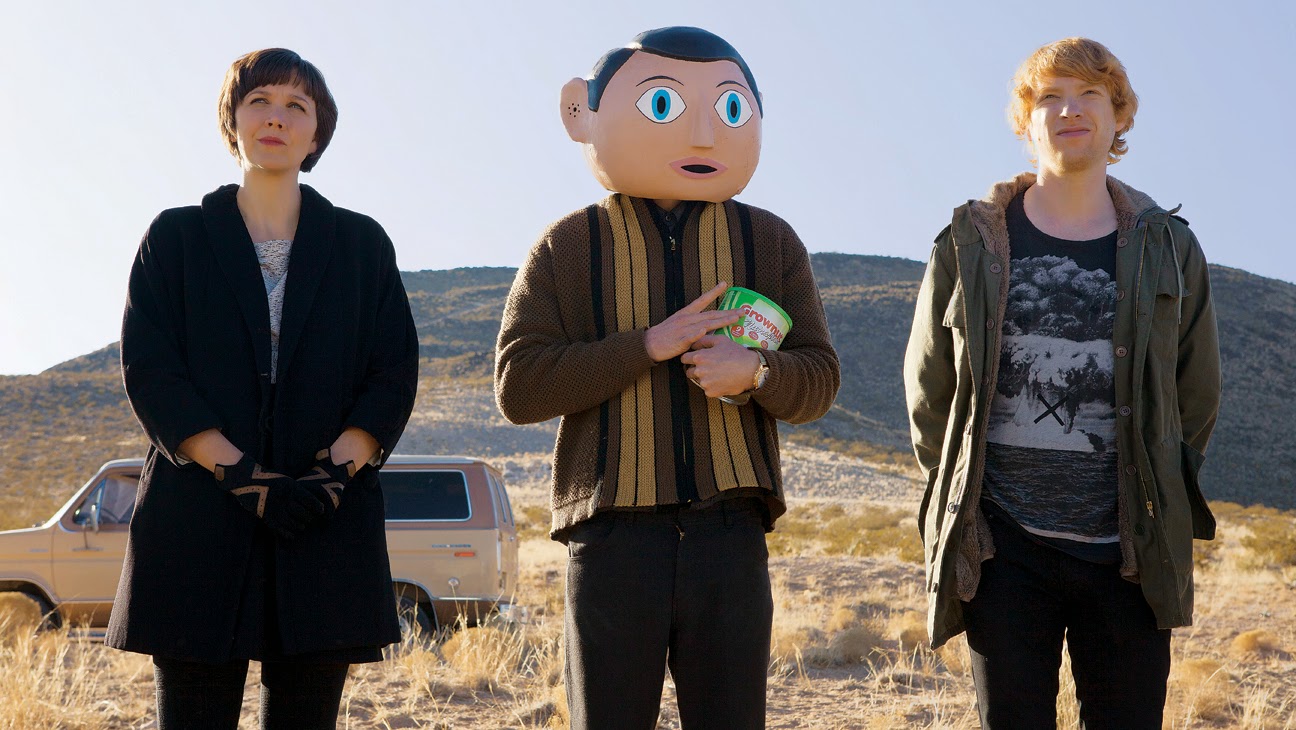
Jon shows up at 9pm. He is instructed to play three chords and that’s it. The crowd is non-existent. One bandmate, a surly looking woman named Clara, played by Maggie Gyllenhaal, is playing a theremin of all things. And then there is Frank, played by Michael Fassbender. He walks onto the stage in a wetsuit and a big fake paper mache head. They start in on the first song. It sounds absolutely strange. Frank sings in a deep voice and makes muscular robotic stage moves. Clara’s theremin has an electric short and sparks fly. She becomes angry, pushes over her instrument and storms out cursing. The drummer and guitar player follow leaving only Frank standing perfectly still and staring intently at Jon. Well, maybe, you can’t tell because Frank has a big fake head on. Then Frank leaves the stage too. The entire thing lasts less than a minute. What an act!

There is a concept in stand-up comedy called the ‘Comedian’s comedian.’ This was generally not the most successful or even the funniest comedian on the scene, but it was the type of comedian that other comedians would come out to see because they were doing something really edgy, exciting, and new. And Frank’s band is that. They are on a completely different wavelength and could not care less about connecting with any sort of audience. Jon is invited the next day for something big. He is excited and is picked up by the band. First thing he notices: Frank still has his big fake head on. Apparently he never takes it off, ever. Second: they are not going to a big gig. They are going to a remote cabin in the Ireland wilderness to take as long as it takes to record an album. Jon tries to explain that he told his boring office job that he would be back by Monday. ‘okay,’ is the reaction. Jon stays.

The character of Frank is a fascinating masterwork of acting by Michael Fassbender. The journey of understanding him oscillates from thinking the man is insane to thinking he is a well meaning musically inclined wise and nice person to realizing he is both of those things. Fassbender plays 95% of the movie without any facial expressions but this hardly matters. His physicality and voicework is very expressive not only in his movements, which are of an excited robot variety, but also in his stillness. You do not need to see Frank’s face to understand when he happy, or inspired, or nervous, or really really scared. And sometimes he goes ahead and describes his facial expressions in order to be more helpful. Frank is not the main character of this story (that would be Jon) but it feels like he is the main character. It is an Oscar nomination worthy performance, though maybe it is too far out there to be seriously considered as such.

The main theme of the movie is the education of Jon’s view of musical expression. He is an ambitious young man who realizes the talent of Frank and his band and sets out to raise awareness of this band on his blog and Twitter feed. Jon sees the endpoint of all their work as a vehicle for rockstardom. Through viral videos of the band doing really weird shit in the woods he gets a cult following for Frank and a gig at the South by Southwest music festival. Everybody in the band hates the idea, but Frank is inclined to do it out of a trust he has placed in Jon. All these people want to like and love us, he innocently asks. Yes, explains Jon, they have already seen and liked and will love you. They go to South by Southwest and all goes to shit. What Jon does not realize is that everything Frank does is especially personal and he wears the head not as a self-promoting gimmick but because he is enormously shy to the point of real psychosis. His bandmates understand this and quit the band before the gig but Jon has to figure it out for himself and almost destroys Frank in the process.

Where does musical talent come from? Jon bemoans the fact that he did not have an abusive childhood or a mental illness that would have expanded his mind in artistic creative directions. No, he realizes in a great scene at the end of the movie. Frank grew up in a nice home with nice parents and was always musically inclined. If anything, his illness hinders his artistic expression. But Jon grew up in a nice house with nice parents too. Why doesn’t he have any musical talent?

Jon makes it up to Frank though, he gets him back together with his band and at the end of the movie they make a song together with Jon on the outside looking in again. Some of the lyrics of the song include the phrases, “It’s nice to see you. It's really nice to be here. I love you all.” It is not a rare thing to hear a musician say these words to a crowd, but when Frank does it has a real profundity to it. Frank really means it. And yes it matters that there is no audience and Frank sings it to his band. You can’t say ‘I love you’ to an audience of people you’ve never met before and mean it. There is something to that surely and it may just be the difference between mediocre and sublime expression. 


Friday, June 20, 2014

X-Men: Days of Future Past (5/5 Stars)


The Great 20th Century Mythos

X-Men: Days of Future Past is the seventh X-Men film and like nobody has ever said before, the sevent movie finds the series really hitting its stride. It is made special not only because on its own particulars but also because it feeds off the goodwill of several previous good films and because it seems to completely ignore (as if it didn’t even exist) the worst movie in the series, “X-Men: The Last Stand.” I actually wrote a review for X-Men: The Last Stand in 2006. Here is what I wrote then, “This movie, the third installment of the X-Men series, literally killed the franchise. I mean seriously, everyone's dead.”

What an astute observation, Max, because in that movie several very main characters died amongst them Cyclops, Jean Gray, and Professor Xavier. So many died in fact that the next several movies either focused solely on Wolverine while he was not part of the X-Men or took a trip back in time to when everybody was still alive. Now ten years after that fateful movie, Bryan Singer, the original director of the very good first two X-Men films, has presented the audience with a bit of revisionist history. “Days of Future Past,” simply pretends that “The Last Stand” never took place. There is Professor Xavier still alive and breathing as if he wasn’t torn to a million pieces ten years ago. Does anybody care? The answer: a resounding no. “The Last Stand” has faded like the general multitude of inferior movies into the world’s collective amnesia unmourned. This is a hopeful thing. I think we can all think of a couple of movies in our favorite series that were just plain bad and should never have existed in the first place. And now “The Last Stand,” doesn’t. Thank you Bryan Singer.

The Last Stand’s inferiority stemmed from its assembly line of mutants and lack of depth. It had plenty of special effects but had no moral weight. It broke the promise of the X-Men series made when Bryan Singer decided to open the first X-Men movie in Auschwitz during the Holocaust. Magneto, as a young child, realizes his powers for the first time at the moment his parents are taken away to the gas chambers. He reaches out to his parents and the metal concentration camp gates between them twist and bend to his budding mutant power of magnetism.  That scene is strong serious stuff and it is also acts a promise that the following movies will be good enough to deserve such drama because if they turn out to not be very good movies it is a dishonor to the memory of the Holocaust.

“Days of Future Past” makes good on that promise. That even though it is a action blockbuster with plenty of special effects and extraordinary mutant powers, it is also a sober metaphor for intolerance whether it be racial, religious, or class. The mutants are beset with persecution by the outside world for their differences. They are viewed as dangerous threats to humanity. Professor Xavier, in a wheelchair like FDR, has a mentality of Martin Luther King Jr. and works pragmatically to heal the divisiveness of the world. Magneto, using terms that parallel Malcolm X, speaks of doing whatever is necessary to achieve protection for mutants even if that means violence with humans. Mutants line up on either side, some attending and teaching at Professor X’s academy and others arming themselves and joining Magneto’s army. Take away all the boyish dazzle of a comic book blockbuster and you have a great 20th century mythos tackling the most important questions of the last 100 years. How do we live peacefully with people who are different from us?
Of course this is a boyish comic book blockbuster so we also get to have lots of fun as well. There are outlandish spectacles based on mutant powers, big action pieces, and at least one Nixon impersonator. But at its heart ‘X-Men’ is great because it is a series that focuses on character. The mutations work like all great science fiction as an exploration into what regular people would do faced with extraordinary decisions. A person has character and now they are presented with these powers usually upon puberty that expose them to a hostile world. Almost none of the powers are welcomed. In the first movie, Rogue realized her mutant power of power absorption by almost killing her boyfriend with a kiss. Wolverine’s power of regeneration basically makes him immortal, not necessarily a good thing.

Because the characters are so strong and the movie is so big, we are treated to some of the best actors in the world all in the same movie. The movie covers two time periods. One in the future where a Sentinel army with mutant powers are covering the world in epic darkness and one in the past (1973) when the events that brought on the bleak future come to pass. This actually brings together the cast from the first two X-Men movies and the last X-Men movie that took place in 1963. Patrick Stewart and Ian McKellan, giants of great dramatic parts, are the elderly Professor X and Magneto now facing extinction and united in remorse of past choices. With the help of Kitty Pryde (Ellen Page) they send Wolverine (Hugh Jackman) to the past to stop an assination. It has to be Wolverine because he is the only one that could survive such a trip. His mission is to pull together the young Professor X (James McAvoy) and Magneto (Michael Fassbender) at a time when could not have been further apart to stop Mystique (Jennifer Lawrence) from assassinating a scientist named Bolivar Trask (Peter Dinklage) whose work would lead to the Sentinels.

Michael Fassbender, Jennifer Lawrence, and Peter Dinklage are some of the most interesting actors to watch on screen for the past five years. They exude screen presence, i.e. the ability to draw your eyes to their part of the screen by simply being there. Mystique larger role in the story comes from perhaps the rising star of Jennifer Lawrence in general who has become in recent years the largest female star in Hollywood not only by being annually nominated for Oscars (winning one) but also by being a box office heavyweight with the “Hunger Games” series. Perhaps no actress since Sigourney Weaver in the 1980s had this kind of streak and I’m pretty sure it is okay to say Jennifer Lawrence has eclipsed even that example. Unlike many other actresses that have their day and fade away, J-Rentz has a dangerous edge to her. In fact, I don’t remember the last time she played someone who wasn’t desperate or veering off in some wild direction. Like Meryl Streep, she seems to have monopolized most of the great roles in her age group and some outside of it. Her normal state is a skin of blue scales, cat eyes, and wild red hair. Her mutant power is her ability to transform into the likeness of anyone she sees. This makes her perfect for anarchy and at heart Mystique is an anarchist.  

One last thing needs to be about Peter Dinklage but not necessarily about him. Peter Dinklage is a little person but is in this movie playing a character that was not a little person in the comic books. That is to say, the part did not call for a little person to play it but Peter Dinklage got the part anyway. Moreover, upon the presence of the Peter Dinklage in the movie there is not the ubiquitous quip or joke or surprised reaction of another character that generally coincides with the presence of a little person in a movie. Peter Dinklage is simply in this movie as this character, period. As far as I know, that is the first time it has ever happened in a movie before. I remember watching the DVD commentary of the “Manchurian Candidate.” The director, John Frankenheimer, was especially proud of this army psychiatrist that was not written as a black person, but for which he decided to cast a black person in the role anyway. Nobody in the movie pays any attention to the man’s race. Frankenheimer said he was proud because never in a Hollywood movie had a black person been cast in a role that wasn’t specifically black. I think Bryan Singer can be proud of casting Peter Dinklage and yes it fits perfectly into the X-Men mythos of tolerance for those of us who are different. 


Friday, November 8, 2013

12 Years a Slave (5/5 Stars)


“It was unearthly, and the men were—No, they were not inhuman. Well, you know, that was the worst of it—this suspicion of their not being inhuman.”
- Joseph Conrad, Hearts of Darkness

In Joseph Conrad’s Hearts of Darkness, a young British officer travels up the Congolese river to seek out a renegade Colonel named Kurtz. Africa, and this especially undeveloped part of it, was an entirely different world to the educated officer. It is a given in both the story’s authorial voice and in the character itself that the British with all their clothes and technology are superior to the hunter-gatherer savages of Africa. But as the officer contemplates the natives upon seeing them at the start of his journey he is overtaken with a strange discomfort. It isn’t a discomfort born from a sense of racism. No, on the contrary, he recognizes that there is no difference between him and the “savages.” They are obviously of the same species. And this brief acknowledgement of the native’s humanity unnerves him.   

12 Years a Slave, is the third feature by Director Steve McQueen having previously made Hunger and Shame, both collaborations with actor Michael Fassbender. Fassbender in a DVD Bonus feature once referred to McQueen as a man of great empathy. McQueen’s movies are a witness to the truth of that statement. One of the things that make 12 Years a Slave especially remarkable is its treatment of the white characters who are not portrayed as 100% nasty but are allowed brief moments like the one given to the British officer in Conrad’s Hearts of Darkness where they recognize the humanity of those they consider inferior. Apparently this is true not only of McQueen’s adaptation of Solomon Northup’s autobiography 12 Years a Slave, but of the novel itself. Solomon, born a free man in New York, kidnapped, and sold into slavery, repeatedly put himself in the shoes of his slave masters in his account of the ordeal. (I have said before that Django Unchained treated its slave-owners like the Nazis in Indiana Jones. Here I would argue that 12 Years a Slave treats its slave-owners like the Nazis in Schindler’s List, particularly the Ralph Fiennes character, Amon Goeth) Counter intuitively, this does not make the slave owners look better. In fact, it makes them look far worse. In law, it would be the difference between crimes committed knowingly (like murder) as opposed to unknowingly (mere manslaughter). A character like Leonardo Dicaprio’s deluded and indulgent plantation owner in Django Unchained is not shown making moral choices. He considers only one way of doing things. Here, though, the slave-owners can sense what is morally correct if only in that Huck Finn way of feeling ‘something not quite right in the pit of my stomach.’ Then given the choice of whether or not to recognize the humanity that they sense, they choose not to do it. Their behavior comes off as especially cruel, unnatural, and evil. After all, even if they lived by the moral code of the South, Solomon Northup still deserved to be set free. All he had to do to be released was get a letter to his family back home telling them where he was so they could find him and show the local sheriff his free papers. Even in the South this was all the law needed. What stood in the way was the insidious nature of slavery; an institution that oppresses the slave but also warps the moral constitution of the master. It makes cowards of good men as well as enabling the worst impulses of the evil ones.

Is there anything that Michael Fassbender would not do for Steve McQueen? It is a relationship between actor and director that can only be rivaled by the 70s relationship between De Niro and Scorsese. These are all especially hard performances and it speaks to the enormous amount of trust that Fassbender has in McQueen that he is willing to do them. Fassbender in 12 Years a Slave is taking on one of the most notorious of slave-owners, Edwin Epps, in this role. In a world of systematic cruelty, he somehow stood out as being notably more cruel than usual. One of things that 12 Years a Slave portrays that Django Unchained conveniently sidestepped is the subject of widespread rape. (Not to say Django Unchained was not a brave movie, it just seemed that rape was one too many things to consider. And thus Dicaprio lives with his sister, not a wife.) Rape would be one thing, but as Malcolm X liked to point out, most slave-owners were married. And boy how would you feel as a wife if your husband continually raped his slaves? Could you really bring yourself to think the adultery did not count because the women your husband repeatedly raped were black? And thus is set up the most horrific love triangle in the history of cinema between Master Epps, his wife played by Sarah Paulson, and the slave he is in love with Patsy played by newcomer Lupita Nyong’o.

Patsy is perhaps one of the more remarkable slaves in the world, picking an average rate of 500 pounds of cotton a day. Most men in the field pick around 200 pounds. This among other obvious things captures the attention of Epps, who absolutely hates himself for finding her attractive. He rewards her abilities by continually raping and beating her. His wife, fully aware of his philandering, demands that Epps sell her. He will not do so. The wife, who has no power herself in this ridgidly patriarchal society, responds by making Patsy’s life even more of a living hell. Among other things, she denies her soap for cleaning, cuts her rations, and throws a bottle of hard liquor at her face from point blank range. What can Patsy do about this? Commit suicide? That literally seems to be her only and best option.   

I think it would make sense to go ahead and include 12 Years a Slave within the genre of survival movie that is being exceedingly well represented this year with such movies as Gravity, Captain Phillips, and All is Lost. McQueen’s presentation of slavery Solomon Northup's situation absolutely akin to it. There is an extraordinary scene of Northup, played by Chiwetel Ejiofor, being almost lynched by an overseer named Tibault, played by Paul Dano, after a mild disagreement. The lynching is in mid-swing when a second overseer stops Tibault not because, you know, it’s murder, but because Northup is property of a different man named Ford, played by Benedict Cumberbatch. Mr. Ford is summoned to make the decision himself. Meanwhile Northup waits all day on his tippy-toes, hands still fastened behind his back, neck still hanging in the noose. In the background all the other slaves go about their business, the situation being that if anybody helped Northup they might be killed as well. Northup may as well be in the middle of the ocean like Old Man Redford or up in space like Sandra Bullock. There is no human community bound by law and order here. All is savage, brutal, and uncaring. 

“Why don’t the black people just rise up and kill the whites?” asks Dicaprio in Django Unchained. Perhaps the fate of one of the newly kidnapped slaves, played by Michael K. Williams, in an ingenious choice of casting, may illustrate the answer to that. Michael K. Williams, best known as one of the more badass characters in TV history, Omar from The Wire, brings up the idea of revolt. He is killed within the space of a couple of minutes. If Omar would last only half a scene, how do you think you would fare? 


Saturday, June 9, 2012

Prometheus (5/5 Stars)


A worthy addition to the franchise

It is the year 2089 and a couple of archaeologists excavate a cave in Scotland. They find a cave painting of a large humanoid pointing at what looks like five stars. The same mural had been found in the ancient murals of the Egyptians, Sumerians, Mayans, and Babylonians as well. These civilizations had little to no contact with each other. What’s more, the five stars can actually be found in the nighttime sky. One of these stars is very similar to Earth’s sun and orbiting it is a large gas planet with a moon very similar to Earth. Is it a message? A warning? An invitation for man to meet its makers? Five years later, the Weyland Corporation sponsors a spaceship named Prometheus and its crew of engineers and scientists to make an investigatory trip to that far off galaxy. They find almost exactly what they are looking for: an ancient pyramid with the long forgotten carvings of a humanoid species of alien. But they also find a not very well intentioned something else living inside. Then people start dying.

The look and the feel of the movie should be instantly recognizable for those familiar with the “Alien” franchise. The font for the title is the same, the style of futurisitic technology and set design is the same, and the director, Ridley Scott, was actually the director of the first “Alien” movie (but none of the others. This was way back in 1979). The plot (humans investigate, find hostile aliens, people start dying, the corporate agents act amorally, and more people die) is fundamentally the same as the first several movies, but differs in all the correct ways. There are new thrills, new themes, and new developments in what happens to who and when. I'm being vague on purpose. This is one of those movies where the less I say about the plot, the better experience the reader will have when they see it. So let me just say that the movie is similar enough to the original movies that they make sense being in this franchise but different enough that you will still actually be shocked when you should be. Or in other words, you can enjoy this movie without having seen any of the others and having seen the other movies won’t diminish the experience of this one. This is a quality (the ability to expand on the themes and look of previous movies without violating basic copyright laws) that marks all great sequels and prequels and what makes “Prometheus” a worthy addition to the “Alien” franchise.

No actors from previous installments of the franchise are present in “Prometheus,” but that does not stop this movie from having one of the best ensemble casts in any movie this year. None of these actors are A-List, but to the cinephile in the audience, it is a hugely heavyweight collection of intelligent badassery. First off, playing the ship’s captain is Idris Elba (aka “Stringer Bell” from “The Wire.”) This guy must be a good 6’4” composed entirely of muscle yet still would not look the least out of place in glasses reading a book on quantum mechanics. Not an easy thing to do. Then there is the corporate overseer played by Charlize Theron (aka the “Monster”), who has recently accomplished the feat of being in her late thirties and more stunningly beautiful than she has ever been. Charlize certainly doesn’t need help being tall, but that doesn’t stop her character from wearing five-inch power high-heels, a touch that along with an icy glare gives her screen presence an effect similar to, well, I can’t think of any other woman but Sigourney Weaver. Next is the new golden-boy of serious cinema, Michael Fassbender, who you may be most familiar as the young “Magneto” in the latest X-Men movie. Fassbender has a face and build that makes him perfect for playing a super intelligent and amoral android.  There’s a great scene when he watches his favorite movie, “Lawrence of Arabia,” and the resemblance is uncanny. He has the same intense gaze of a young Peter O’Toole.

Finally there is Noomi Rapace (aka the original and actually Swedish “Girl with the Dragon Tattoo”) playing the archeaologist. She is noticeably softer than Lizbeth Salandar but the events she goes through are just as traumatic if not more so. I always hesitate to say an actor/actress is brave because you know in the end, it is all just pretending. But for a select few I will pull out that adjective. Christian Bale is one and also Noomi Rapace. It is hard to judge a science fiction performance come Oscar time because the great ones generally require actions in situations that have never been done before (in contrast a performance in a movie adapted from Shakespeare is perhaps the easiest to judge) but as you reflect on this movie, ask yourself this question about that particular scene you must know I am talking about: Who else could have done it better, or better yet, who else could have even done it? (And don’t say Rooney Mara unless you want to piss me off.) For the fourth time in as many movies as I have seen her in, I believe Noomi Rapace deserves an Oscar Nomination. Perhaps the best compliment I can give this movie however has to do with the fact that Sigourney Weaver is not missed. That’s huge because Weaver is arguably the best female action heroine to ever grace the movie screen. But here I am saying it: Rapace and Theron, more than make up for the absence. There is some serious intelligent badass female empowerment going on here. Ridley Scott never seems to disappoint in that area. 

The main flaw in this movie is that it asks several big questions like: Where do we come from? Who are our makers? What do they think of how we turned out? and then does not answer any of them. This does not bother me that much though because these questions really do not have any decent answers and when a movie tries to provide these answers it is always unsatisfactory anyways (see 6th season of “Lost,” the “Matrix” sequels). There is a moment in this movie when the maker has the opportunity to say something and instead just starts being violent. What could it have said? I have no idea. It could have been cool if he had said the correct thing whatever that is. He does not say anything and that is a shame, but I’m not about to fault the writers for not knowing what the meaning of life is. Asking the questions is good enough for me. 


Saturday, December 24, 2011

A Dangerous Method (4/5 Stars)


I wonder how Carl Jung would react to this movie if he were still around to see it. There are some very private moments portrayed here. At one point the movie goes so far as to follow Jung and one of his patients into the bedroom for that most basic ritual of sadomasochistic sexual behavior. Part of me would think that Jung would be mortified that this would be up on a huge screen for everybody to see. But then another part of me reminds the other part of what exactly Jung was involved in. There is a fine comic moment in the film when Professor Sigmund Freud has Carl Jung over for dinner and politely explains to him that he should feel absolutely free to discuss anything and everything at the table. And there sitting at the table are all of Freud’s children, the majority of which are at or near very impressionable ages. This is based on a true anecdote. Freud’s children did indeed sit through many a dinner conversation that focused explicitly on sex, psychotic compulsions, and all sorts of other taboo conversational topics. So that part of me would not be surprised if Carl Jung would, instead of being totally embarrassed, actually take the stage at the end of the movie and ask the audience point blank what exactly they thought about it and please feel free to focus in on the kinky stuff.

The “dangerous” method refers to such behavior. Instead of repressing thoughts and conversation about sex, taboo, psychotic compulsions and the like, go ahead and talk about it and try to be as specific as possible as to why you feel and think the way you do. Such a therapeutic method was first suggested by Freud, but according to the movie was never experimented by him. Carl Jung apparently was the first and the patient he first tried it on was a young Russian woman named Sabina who came to his hospital in fits of hysteria. Jung puts her in a chair, sits behind her (presumably so she can’t see his reactions to her craziness and feel to shamed to speak more of it), and quietly asks her questions that would be very impolite in any regular conversation. Does it work? Yes, it seems to, at least in the sense that it grants the sort of relief one may feel after solving a complex riddle. The problem is still there, but at least now we know what it is. This movie work on the audience in the same way. We are presented with a person that is crazy. The seemingly random shrieks and fits are confusing and frightening. But we observe and listen and slowly achieve an understanding. Suddenly the person makes sense, her actions become predictable, and the fear and uneasiness that accompanied us dissipates. We feel relief.  The best of movies like psychoanalysis strive for that ecstatic “Aha!” moment. There is one such moment in this movie and if Keira Knightley gets a nomination for her performance (which is not unlikely), it will probably be that moment people are recognizing her for. (It should be said that bad movies work in the exact opposite way. Think of movies where the basic laws of physics are ignored, the characters act like aliens, or the repetitive use of cliché is foisted upon the audience. A sense of unease fills the viewer. I sometimes find myself getting mad.) 

Carl Jung and Sigmund Freud are played by Michael Fassbinder and Viggo Mortenson respectively. Now here are two actors with Presence. They are perfect choices for playing intellectual heavyweights. I’ve praised Mortenson before (see review of “Eastern Promises”) but I have yet had the chance of writing about Fassbinder as he has only this year started to take on starring roles. Most people probably know him as Magneto in this summer’s “X-Men: First Class.” I remember him being very striking in that as well. There is something very solid about his face/person/body. I think he would make a perfect Roman Emperor or at least a marble statue of one. The scenes with Freud and Jung talking, whether in agreement or in disagreement, are always stimulating and make the movies best scenes. In fact, some of the best lines are supposedly taken directly from the letters they wrote each other. Those two could really turn a phrase and when they meant the words to hurt, the phrases could be especially piercing. It is a disappointment then that this movie treats Freud as a truly supporting character. The main storyline is the affair between the married Jung and his patient Sabina. When Freud enters the picture, he serves that storyline. His character lacks his own conflict or overarching ambition. It is spoken by Freud that he has many enemies to himself, his profession, and psychology in general, but these enemies are not shown or battled with. Freud is seen either through Jung’s or Sabina’s experience or not at all.

There is plenty of psychological talk about egos and sex instincts and the death instincts and the like. Some of it you may find familiar. Other topics not so much. The movie does a commendable job of not holding discussions back to a standard level of education. This may make some of the conversations inaccessible to understanding but not unentertaining. All the characters are especially intelligent and the screenplay puts up no obstacles to them expressing themselves at the peak of their intelligence. If you are a huge psychology buff, this movie will not disappoint. If like me, you know some things and not others, and are not entirely sure of the accuracy or usefulness of the whole thing, it is at least never annoying. In some ways it is rather comic. Psychology then (and now) is very new. Freud admits as much and goes on to say that he is probably wrong about everything being about sex and surely theories will be revised when more research is done. In the meantime he is just describing his scientific experiences as he observes them. I especially liked a conversation in which Jung describes one of Sabina’s childhood recollections about a preferable way to defecate. Freud nods his head and diagnoses her as anal-retentive and predicts that she is probably also especially fastidious, clean, organized, and the like. No, says Jung, actually she is quite the opposite. Hmm, says Freud, oh well maybe it’s a Russian thing. (Freud is very subtly funny in this movie. In real life he apparently was subtly funny as well. I am a huge fan of his book on jokes. When I write of comedy on this blog, it is mainly his ideas that I am espousing.)

Of course the basic problem with psychology is not that it is incorrect but that it has a tendency to be too vague and broad to be incorrect. It is not hard to find sexual motives or childhood neuroses as a part of any action we take. They are there. But that doesn't mean that it is the only reason why people do things. Really there are probably a thousand reasons why people do things and those only include the reasons we can think of. And that still ignores the possibility that people may indeed not have a reason for doing things. I am reminded of an anecdote from the comedian Louis C.K. about how he loaded the dishwasher one night and then didn’t turn on the wash. His wife scolded him and asked, “Why did you do that?” Louis relates to the audience, “Why did I do that? Do you understand what that question assumes? That I had a reason for not putting on the wash, like I had a thought process about it. Like I didn’t because I wanted to be a total dick and piss her off, which would really be the only reason not to run the dishwasher. Why can’t I just be stupid? Why didn’t I put the wash on? Because I am a total dumbass, that’s why.” I think this possibility is something rather thoughtful people like Jung, Freud, or Sabina tend to not think about, and I think it is because they spend so much time thinking about why people do things that they forget that most people do not think as much as they do about why they do things. They probably don't get laid enough either. 


Sunday, October 24, 2010

Inglourious Basterds (3/5 Stars) August 29, 2009

Shutup Nerd! 


Writer/Director Quentin Tarantino returns to the silver screen this time with a World War II film. It’s only been two years since his last film ‘Death Proof.’ That’s a record for shortest hiatus for this notoriously unprolific director. He has only directed six films in a span of eighteen years. Headlining the advertising campaign of this film is Brad Pitt as a the non-Jewish leader of a band of renegade Jewish American soldiers called the ‘Inglourious Basterds’ who specialize in killing Nazis behind enemy lines. The ‘Inglourious Basterds’ is the German high command gave them. Apparently the correct spelling was lost in translation. In truth though the Basterds only comprise a third of the movie’s screen time. The other storylines feature an evil Nazi (redundant isn’t it?) officer known as the ‘Jew Hunter,’ played deliciously by Christopher Waltz, a Jewish girl named Shosanna who has escaped the ‘Jew Hunter’ and is now the owner of a cinema in Paris, and a British spy that goes on a mission to blow up the movie premiere of Goebbels newest cinematic propaganda masterpiece ‘A Nation’s Pride” at the same movie theater. These storylines are each successfully started off in their own separate chapters in the first half of the movie. Then they hang about too long, go off in weird directions, and ultimately fail to intertwine themselves into one effective overall story. Does this movie deserve three stars? Technically no, it’s got a lot of good stuff in it, more than some four star movies. But I feel inclined to give it such a bad rating because I feel it could have been a masterpiece had the Director not been arrogant enough to think that he could break basic rules of pace, suspense, and logic without suspecting that it would hurt the overall picture and confuse and bore the audience. (In other words, it annoyed me on a gut level). Why didn’t he think that? Well I bet it’s because Tarantino thinks that every line of dialogue he writes (typos included) is gold and that people will have an infinite tolerance for self-referential ‘aint I cool’ speech. They don’t. That’s why nobody went to see ‘Death Proof.’ You think the guy would have gotten an ounce of humility from that colossal failure. Now there is nothing wrong with long extended scenes of dialogue itself, Tarantino himself proved that in previous movies and in this one. But they are delicate things and must be cared for in a certain way or else they belong in the deleted scenes menu of a Special Edition DVD set. To fully explain what I mean, I will compare and contrast Tarantino, the masterful movie writer/director, and Tarantino, the stubborn, indulgent prick that has sabotaged every good idea he has had since he made ‘Pulp Fiction.’ Conveniently I can use examples of both of these Tarantinos in this movie alone, although I will also use some examples from what unfortunately looks like will be his one and only masterpiece, ‘Pulp Fiction.’ 

Let’s take a look at the first chapter in this movie: Once upon a time in Nazi-Occupied France. It opens on a farmhouse in the French countryside. A man is chopping wood when he sees a Nazi car driving up. The Nazis arrive; the officer played by Christopher Waltz gets out. He asks to talk to the man. They are talking in French. Both are very polite. The man invites the officer into the house. Therein he introduces his daughters and offers the officer a glass of wine. The officer noticing that this is a dairy farm asks for a glass of milk instead. One of the daughters pours him a glass. We watch him drink the whole thing. Then the officer suggests the man ask his daughters to leave for the conversation they will have. The man does so and the daughters leave. After they have left the officer asks the man if he knows who he is. The man tells him. The officer asks the man if he knows his nickname. The man says he does. The officer’s nickname is “Jew Hunter.” The officer inquires as to the whereabouts of one of the Jewish families in the county that is unaccounted for. The man says he has heard a rumor that they are in Spain and that the previous Nazi officer assigned to the county had already searched his house. The officer smiles and is very amiable. Then he asks the man if they can switch the conversation from French to English as he is not so good at the latter. They do so. Then the officer goes into the reason why he is called the “Jew Hunter.” He gives a very Anti-Semitic explanation of the difference between the Germans, who are like Hawks, and the Jews, who are like Rats. The man asks if he can smoke his pipe. It is a small corncob pipe. The officer explains that he got his nickname because he was especially good at thinking like a rat and mentions that he thinks the qualities of a rat are quite admirable in some ways. At this moment, after it seems like they have been talking for quite awhile, the camera moves and it is revealed that the man has been hiding the Jewish family under his floorboards the entire time. The officer than remarks that he finds it amazing what the Jews will do when they have abandoned any sense of decency. The man is starting to look nervous. Then the officer asks if he can smoke and takes out a comically large pipe. Not missing a beat the officer tells the man that a person who tells him what he needs to know will not suffer a whit whereas a man who has to make him search will suffer dire consequences to not only himself but his family. At this point the man seems very perturbed. Then the officer asks the man flatly whether he has Jews underneath his floorboards. The man, with a single tear running down his face, quietly admits it. The officer than remarks that since he has not heard any sounds underneath it is quite evident that the Jews do not understand English and asks the man not to give away the fact that three Nazi soldiers are entering the house instead of his three daughters. As the officer, in very polite and charming French, tells the man that he won’t search the house and says goodbye, he motions to his soldiers to shoot at the floor. They do so. All the Jews are shot and killed except one girl who escapes. We are then treated to a very iconic shot of a beautiful girl running for her life across the fields of the French countryside. We are told her name is Shosanna. The chapter ends.

Okay, this scene is a bit of a masterpiece. But why? It’s all about momentum and payoff. We start out very small, just two guys talking. One affable and evil, the other is good and unmoving. We don’t entirely know what there are talking about. The audience is confused on several levels. We don’t know why the officer is talking to this particular person, we aren’t used to cheerful Nazis, we don’t get why all the attention is being paid to milk and pipes, we don’t know quite what the officer is getting about when he’s talking about rats and hawks, and we don’t understand why he’s taking his sweet ass time. Every one of these questions is answered in a dramatic and satisfying way. The officer is talking to the man because he is hiding Jews, he’s talking about rats because he knows the Jews are in the floorboards and he’s an anti-semitic basterd, he’s being affable and charming in French and then switches to English because he gets a kick out of not only killing Jews but playing one last psychological trick on them before doing so (my favorite part. I have never seen language used as a dramatic twist in a movie before, caught me completely by surprise), the milk and pipe is meant to intimidate the man, and he’s taking his sweet ass time because he gets a sociopathic kick out of wearing down the man to the point where he betrays himself. Tarantino could have just written that the Nazi goes into the house, searches the floorboards and kills the Jews. He did it this way because 1) It gives the audience an idea of just how smart and cunning the main bad guy in the story is and 2) the purely evil and sociopathic way he goes about doing it reminds us of how much we really really hate Nazis. Plus this gives us great empathy for the girl who escapes. So now the story has set up the really bad guy and the damsel in distress. And now the audience is chomping at the bit to be introduced to the heroes of our story, which is what the next chapter is all about. 

My main point is that extended scenes of dialogue need to add up to something, and that something needs to be a sufficient climax to make the extended dialogue worth listening to. When the scene is exceptionally long, there needs to payoff to the early dialogue and the climax needs to be really big. ‘Pulp Fiction’ is rife with these exceptional scenes. In the first story we treated to carpool talk between two hit men about quarter pounders in Paris. This dialogue pays off in the big climax of that story when one of the hit men brings it back up again before he executes a man in incredibly dramatic fashion as he quotes the bible. In the second story we are treated to extended dialogue about an unseen character, which supposedly gave the boss’s wife a foot massage and was thrown out of a three-story window. The payoff comes after the wife overdoses on one of the hitman’s heroin and the hitman has to somehow save her life or risk being killed by his boss. The story ends with an unforgettable scene in which John Travolta has to pierce her heart with the largest needle you’ve ever seen, which itself is a payoff for a prior discussion about a woman’s fetish with piercing. That woman happens to be in the room and her reaction to it is ‘cool.’ Why? because she and the audience has just witnessed the ultimate piercing. I could go on but suffice to say that every long period of just talking in ‘Pulp Fiction’ is punctuated with an unforgettable scene in which things are revealed, logical choices are made, and incredible shit happens. The two parts are inseparable. They justify each other. You cannot have one without the other, especially if jokes aren’t being told. For example of a movie which is all payoff and no build up I give you Tarantino’s ‘Kill Bill’ which features a lot of shit happening but lacks the sense of realism that gives the characters any logical motivation. In the end you can admire how Bill gets Killed but you don’t really care whether Bill gets Killed or not. For an example of a movie which is all build up and no payoff I give you Tarantino’s ‘Death Proof’ which features a group of girls talking for so long about completely irrelevant things that when the climatic car chase finally does happen it is underwhelming and quite forgettable. 

The first three chapters of ‘Inglourious Basterds’ follows the ‘Pulp Fiction’ model in which a great deal of dialogue is capped off with a satisfying ending whether it’s Brad Pitt carving a Nazi insignia into a Nazi’s head or Shosanna encountering the Nazi who killed her family and is now in charge of security for the movie premiere. Then the movie veers off into a scene a la ‘Death Proof’ about a British spies mission. This is the first mistake because we are treated to yet another substantial chunk of time introducing another character when Tarantino had already done this three times before. The hour mark is not the time for another ten-minute introduction. Anyway the spy is briefed by Mike Myers for a long time (they go into some depth about German cinema) and then sent to rendevous with the Basterds and a German Actress who will give him a briefing about his mission to blow up the cinema. The Actress agrees to meet them in a basement bar in some French city. The scene opens with her playing a card game with a bunch of German soldiers where a person writes a famous person on the card, puts it up to their head, and asks questions to figure out who he is. We see them play out a game of this and are given the background of one of the Nazi soldier’s family. Then the basterds walk in and the Actress excuses herself. Before she can brief them though one of the soldiers asks for her autograph. She does so but the guy hangs around longer. The British spy finally tells him to piss off because, you know, he wants the info for the plan and the soldier is stopping the actress (and the movie!) from doing so. You think that would be the end of it, but the soldier is disturbed by the spy’s accent. This is followed by a lengthy discussion about where the spy would get that particular accent. A German officer joins the discussion after a bit and more words about it are batted around. Finally after some discussion the German actress convinces the officer that the spy is from a German town no one has ever heard from. The officer seemingly satisfied, sits down with them and makes them play another round of the previously mentioned game. At this moment I groaned with boredom because the momentum of the story had effectively killed itself. Not only had the movie gone for I don’t know how long with any payoff or climatic scene, but it had completely forgotten about the several interesting characters it had introduced beforehand. The scene ends with a very forgettable shootout in which basically everyone in the room dies, including the British spy, which the movie had just painstakingly introduced for the last half hour. A great deal of time has passed and very little of what we just sat through was paid off. 

The movie ends at the movie premiere with a spectacle al a ‘Kill Bill’ in which we are treated to some very pretty death and destruction that has very little logical buildup to it. What happens is that the ‘Basterds’ go ahead with the British spy’s mission without him even though they speak no German and they’ve apparently lost half of their band (no explanation is given for the absence of about half of the basterds from the second half of the movie). They get into the premiere as the Italian escorts of the German Actress. They’re plan is laughably shallow. None of the basterds know Italian and Brad Pitt doesn’t even bother to change his thick hillbilly accent. Alongside their plot to blow up the theater is Shosanna’s plan to burn the entire place down. Christopher Waltz happens to be the Nazi in charge of security, an especially important job since the German high command is present at the premiere. You would think with a set up like that we would see a great battle of strategy or some suspense as to how the entire thing would play out. Too bad, the Nazis lose so easily it’s like watching a Chuck Norris movie. Now mind you I don’t give a damn about historical accuracy and take a good deal of pleasure out of watching Nazis die horrible deaths. but to me, watching battles in movies is like watching sports on TV. I would rather see my favorite football team win it in overtime than to see them trounce the opposing team by 50-0. It is just far more enjoyable. 

The thing is, Tarantino didn’t have any time to put much thought into the climatic scene because he had already wasted so much time with the previous storyline about the British spy that didn’t go anywhere. What he should have done is cut the British spy out all together and focused in depth on a Dirty Dozen style plan that would have put to use the entire squad of basterds (he only uses four in the movie). He also could have connected the basterds and the Shossana storylines somehow, something that didn’t happen in the movie. Shossana doesn’t even get a revenge scene with Waltz at the end that pays off her two previous very suspenseful encounters with him. And wouldn’t it have been cool if Tarantino had Hitler pick a fight with Brad Pitt and had them duel it out with swords and fists. I’m just saying. 

Another thing I have to mention is that Tarantino’s nerdy love for movies is creeping into his films in disturbing ways. He even stops the plot at one point to have an unseen narrator explain to us how some type of film stock is especially flammable. Also the idea that Jewish Vengeance would take place in a movie theater (Because you know there’s a lot of Jews in Hollywood) only makes sense if you don’t notice the more obvious motivation, namely that Tarantino probably had an orgasm when he found a way to put a movie theater into his film. That way he could have the characters drop names from antiquated and long forgotten movies! The movie ends with a line that would only work if you agreed with it. I don’t and I think it’s perhaps the most arrogant ‘look at me,’ line I’ve ever witnessed in a movie. 

Roger Ebert has declared this the best movie of the year and has said that a person needs to watch it several times to get its greatness. I will see it again because I admire and respect Roger Ebert. But I reserve the right to think of movies that need to be seen twice the same way I think of jokes that need to be explained. Badly told.