Search This Blog

Monday, May 30, 2022

The Northman (5/5 Stars)


If there ever was a movie that I hoped would make its money back and a whole lot more, it would be "The Northman". This is writer/director Robert Eggers' first medium sized budget movie. His previous movies, "The Witch" and "The Lighthouse" were small independent films. What made these movies special was the attention Robert Eggers paid to historical detail. In particular the dialogue stood out. "The Witch" took place in 17th Century Puritan New England. "The Lighthouse" took place on some non-descript 18th century British Isle. Robert Eggers not only took the time and study to unearth the way people back then would talk, but he also had enough faith in his audience to grasp all the temporally foreign words and phrases. The movies are insular and specific, they feel like you have been fully immersed in another place and time. This generally makes a good movie but almost never one that makes a lot of money. So when I heard that a studio had given Eggers a lot of movie with understanding that this would be an Eggers film, not the latest installment of a franchise, I knew that with would be a potential cinematic moment. And it is. "The Northman" is the most unique action blockbuster since "Mad Max: Fury Road". You haven't seen anything quite like it.

Or maybe you have a dozen times. There is plenty of originality in the movie: the culture and lore of Vikings is explored in depth in all its pre-Christian savagery and weirdness. but the plot should be instantly recognizable and for good reason. The story being adapted is the medieval Viking saga of Amleth, a prince whose father kings is murdered by his uncle who then marries his mother. Yes, this is the same saga that William Shakespeare adapted and modernized (in the year 1600) for his stage play Hamlet. It is well that the plot should be familiar because almost nothing else is likely to be recognizable. The Vikings were the white man's last gasp of tribal barbarity before Christianity fully covered the continent and made its inhabitants, in ideal if not in deed, a loving people. For those white people interested in the triumph of the will, it is fitting that they would look to the Vikings for inspiration. Their culture is not for the faint of heart. Having said that, I believe we can all understand the basic instinct for a prince to avenge the death of his father.

There is a level of energy about this movie that is on some level of badass. We get to witness a Vikign coming of age ritual wherein Young Amleth joins his father King Aurvandil War-Raven (Ethan Hawke, doing well) and the town shaman (Willem Dafoe) in some Viking version of a Native American sweat lodge. We get to witness the pre-battle fireside rituals of the berserkers in which they obtain their trancelike rage. We get to witness an actual Berserker raid in which unarmored Nordic men terrorize and butcher a hapless Rus village. We get to witness a Viking proto sport called Knattleikr (translates as "ball game") in which men with clubs try to hit a pole with a ball while also hitting each other until one is left standing. We get to watch a swordfight in a Volcano. This is exhilarating stuff, and amazingly, historically accurate.

 Amleth is played by Alexader Skarsgaard, a very tall and muscular Nordic actor. I got some real Arnold Schwarzenegger in Conan the Barbarian vibes from him. The love interest of Amleth is Olga, a slave from the Rus village he attacked. She is a cunning survivor played by Anya Taylor-Joy. Eggers fans will remember her from The Witch. She has a face and presence that belongs in movies about the distant past. Other familiar faces show up: there is Willem Dafoe from The Lighthouse and Ralph Ineson and Kate Dickie is minor roles. An actor new to Eggers and exceptionally suited to his type of material is Nicole Kidman who plays Amleth's Queen Mother. There is a subtext in Hamlet that is hinted at in some adaptations. That subtext is brought out in full in The Northman in an exceptional scene that twists the story right round.

It is disheartening that "The Northman" had an underwhelming record at the box office. Hopefully the VOD marketplace will make up for it. I very much want artists like Robert Eggers to be successful, not just for their sake, but for other artists like them. It is hard to make movies about the distant past. If these movies are made at all, there seems to be this overwhelming urge to twist the motivations of the characters in some inauthentic way so that it will not offend modern sensibilities. Viking culture is not so different from other pre-Christian cultures. In particular, I believe it has much similarity with polynesian culture. Both peoples were seafaring (and thus exceptionally tall people), had warrior classes, and volcanoes. But imagine if you wanted to make a movie like "The Northman" about a non-white group of people. I'm not sure it would be allowed (Mel Gibson's Apocalypto is the exception that proves the rule). However, if artists like Robert Eggers made money, I don't see why there couldn't also be an artist who has an idea for a badass movie about the Maori. I would love to see that. Right now, all we have is Disney's Moana. 


Sunday, April 24, 2022

OSCARS 2022

I had a few things to say about the 2022 Oscars, although at this point, most of it has already been said a thousand times over. So I won't say anything about Will Smith and make a general complaint about something else entirely.

I have a big problem with the choice of "CODA" as Best Picture. It is not a problem with the movie. I have no opinion of the movie. I have not seen it. That is my complaint. The movie is hard to see. CODA exists entirely on Apple+ TV. It was never in any theaters and you cannot rent it on DVD, on YouTube, on Amazon, or anywhere else. There is only one place to see it, and you need a annual Apple+ subscription.

Way way back in the day, the Academy had this rule that all movies in contention for the Oscars needed a theatrical run. This theatrical run was limited but ostensibly, it meant that if you were looking for a movie, you could see it (if you lived in NYC or LA). If you didn't live in NYC or LA, at the least you could wait for the VHS/DVD release and see the movie. Those days are over and not coming back. I'm not saying we need to bring back that particular rule, but the idea behind the rule was sound: that is a celebrated movie should be able to be seen. You should be able to buy a ticket to or rent the thing. There needs to be some new rule that mandates all Oscar nominees should be available somewhere other than a closed streaming subscription service. If the Oscars are good for anything, it is to give suggestions to the audience as to what people who make movies think are good movies to see. If the movies cannot be seen, the Oscars truly are pointless, a vapid stew of pretension where rich and beautiful people complain about inequality in designer dresses. 

Here are my picks for 2022. The best that can be said about 2022 is that it was a better year than 2021, which was the worst ever. I have excised the categories for Animated film and Foreign Language film, perhaps permanently as they seem to be kids' table categories, and have added a category for Stunt Direction, an integral part of many movies which has been overlooked for way too long of a time. 


Best Adapted Screenplay

Dune

Drive My Car

The Green Knight

House of Gucci

The Power of the Dog


Best Original Screenplay

The French Dispatch

A Hero

Licorice Pizza

Midnight Mass

Red Rocket


Best Production Design

Dune

The French Dispatch

The Green Knight

Spencer

The Tragedy of Macbeth


Best Costume Design

Dune

House of Gucci

Last Night in Soho

Nightmare Alley

Spencer


Best Makeup and Hairstyling

Dune

The Eyes of Tammy Faye

The House of Gucci

The Green Knight

The Suicide Squad


Best Supporting Actress

Brenda Deiss - Red Rocket

Kirsten Dunst - The Power of the Dog

Vera Farmiga - The Many Saints of Newark

Meryl Streep - Don't Look Up

Marisa Tomei - Spider-Man: No Way home


Best Supporting Actor

Matt Damon - The Last Duel

David Dastmalchian - The Suicide Squad

Ethan Darbone - Red Rocket

Hamish Linklater - Midnight Mass

Jeffrey Wright - The French Dispatch


Best Actress

Jessica Chastain - The Eyes of Tammy Faye

Lady Gaga - House of Gucci

Alana Haim - Licorice Pizza

Frances McDormand - The Tragedy of MacBeth


Best Actor

Nicolas Cage - Pig

Benedict Cumberbatch - The Power of the Dog

Adam Driver - House of Gucci

Simon Rex - Red Rocket

Denzel Washington - The Tragedy of Macbeth


Best Use of a Song in a Movie

“Nearer My God to Thee” – Midnight Mass

“The Battle Hymn of the Republic” – The Eyes of Tammy Faye

“In the Heights” – In the Heights

“L’Ultima Volta” – The French Dispatch

Gym Dance “Mambo” - West Side Story


https://www.youtube.com/watch?v=9xtkGKeccLI


Best Use of Cultural Appropriation

The Green Knight – Dev Patel

Midnight Mass – Catholicism and Vampires

The French Dispatch – The French Dispatch of the Kansas Evening Sun

Licorice Pizza – waterbeds, sushi bars, licorice pizza, L.A., the movies, Haim, hustlers

West Side Story – “America”


Best Visual Effects

Black Widow

The Suicide Squad

No Time to Die

Dune

Spider-Man: No Way Home


Best Stunt Direction

Black Widow

The Suicide Squad

No Time to Die

Dune

Red Notice


Best Film Editing

No Time to Die

Dune

The French Dispatch

The Power of the Dog

Red Rocket


Best Sound

Dune

No Time to Die

The Power of the Dog

The Green Knight

West Side Story


Best Cinematography

The Tragedy of Macbeth

Red Rocket

The Power of the Dog

The French Dispatch

The Green Knight


Best Director

The Green Knight – David Lowery

Dune – Denis Villeneuve

The French Dispatch – Wes Anderson

The Power of the Dog – Janet Campion

Red Rocket – Sean Baker


Best Picture

Pig

The Green Knight

Midnight Mass

Dune

The French Dispatch

The Power of the Dog

Licorice Pizza

Red Rocket

The Tragedy of Macbeth

A Hero

Saturday, March 12, 2022

Bad Luck Banging or Loony Porn (3/5 Stars)


 A few years ago (2019) Romania produced a documentary called Collective that was nominated for two Oscars, for best International Feature Film and Best Documentary Feature. It was one of those documentaries that does not find its greatness in art but in journalism. It chronicled a story of corruption on an absurd level. A fire broke out in a nightclub in Bucharest instantly killing twenty-seven people and hospitalizing 180 more with severe burns. Of those 180, 37 inexplicably die in hospital burn wards. It turns out local corruption resulted in hospitals purchasing diluted and/or fake disinfectants. The documentary chronicles the efforts of a reformer who attempts to fix this system against corrupt lobbyists and disinformation propagated by the local media. By the end of the movie, he has been voted out of office and witnesses a man that is legally barred from managing a hospital appointed to replace him. He has a phone conversation with his father who wonders why he is still living in Romania. There is nothing for you here.

“Bad Luck Banging or Loony Porn” is the comedic equivalent of that sober documentary. It chronicles a humiliating day in the life of Emi (Katia Pascariu), a teacher at a private high school who faces removal once a sex tape she made with her husband leaks on the internet. It is unclear exactly how the video got there, either her husband uploaded it or a computer repair man did it, but it is out there now and every time she succeeds in getting it removed on one website, it keeps popping up somewhere else. Meanwhile, there is a COVID-19 pandemic gripping the country that is pervasive in every scene. What do I mean by that? Well, everyone in the movie wears masks and socially distances in every scene. This movie leans into the pandemic like no other movie has so far in this new time. It adds levels of absurdity and frustration onto every scene. If younger generations ever ask not what happened in 2020-2021, but how it felt to live in 2020-2021, this would be perfect movie to show them.

The movie is divided into three parts. The first part involves Emi walking around town, doing errands on her way to parent-teacher conference. She walks past incompetent city administration, rude people, and the general annoyances of living. The second part involves a slide show dictionary of Romanian words. The writer director Radu Jude presents words like “Justice” or “Peace” or something like that and shows the hypocrisy of the world as a demonstration of what those words mean. It is an exercise in cynicism on the level of Jonathan Swift or Kurt Vonnegut. These two parts are disposable. The third part is indispensable.

The third part is the parent-teacher conference. It takes place in a courtyard with all participants wearing face masks and in folding chairs six feet distanced between each other. They all watch the porn video (because not everyone has seen it yet and they need to know what they are discussing) before the enter into the discussion as to whether Emi should be fired. The arguments for and against are both familiar and ridiculous, go on dumb tangents via clueless participants like all public assemblies do, and is equal parts infuriating and hilarious. One can write a thesis on what all these points of view are really about. Given that Emi was having sex with her husband and did not distribute the video herself, it is hard to say what moral boundary she crossed. The argument that makes the most sense against Emi is that the school is supposed to be prestigious and the video is humiliating, so to keep Emi at the school is to share in the humiliation. That is, the parents want their kids to rise in society and don’t want Emi unduly harming that rise. In her defense, Emi has much to say about education and whether she is a competent educator, but whether she is a good teacher seems to be besides the point to these parents. Their kids are here at this expensive school to make connections and get ahead, not to learn things. Katia Pascariu is particularly good at evoking a sense of her soul deadening as she is forced to listen to this bullshit, not the easiest thing to do in a pandemic when half of your face is masked and there is nothing you can use but your eyes. Life may be shit in Romania, but hey, at least the arts are flourishing.


Sunday, February 20, 2022

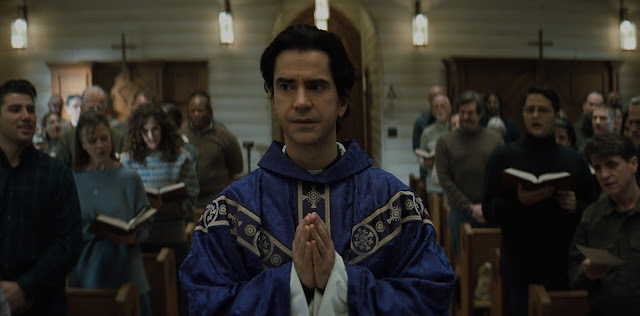
Midnight Mass (5/5 Stars)


The road to hell is paved with good intentions.

The small fishing town on Crockett Island is dying, literally and metaphorically. A few years back an oil spill occurred off the coast which ruined the local economy. The majority of locals left for better opportunity, the last of them did not even attempt to sell their house. They simply abandoned it. The population is now 127, those too old to move away, or haunted by such pasts that make living in a dying place seem a good penance for past sins. The local church, a Catholic diocese by the name of St. Patrick’s, is led by an octogenarian monsignor. We are told that he was becoming senile and wished to see the Holy Land before he passed, so the church pooled its resources and paid for his pilgrimage. We never meet the monsignor. Instead, a virile well-spoken young man (played by Hamish Linklater) steps off the boat. He is explains to the congregation that the old monsignor has taken ill and is resting in a mainland hospital. His name is Father Paul Hill (there is an important biblical connotation to the neame) and he will be here for only several weeks. He expects his time to take the community through Ash Wednesday, Lent, Holy Week, and then Easter, that sacred time of repentance and death, forgiveness and resurrection.

Midnight Mass is not a movie and I did not see it in a theater. Those two conditions are generally the prerequisite for a review on this blog. I am writing this review because, well, Midnight Mass is the best anything that I saw from 2021. It is a mini-series, eight one-hour episodes, that can be seen on Netflix. Ostensibly it is in the horror genre (and it should be), but let that fool you. It is arguably the best and most artful meditation on religious faith, religious zealotry, sin, forgiveness, and redemption. It is also as scary as death.

At eight hours, it is the correct length. The one-hour episodes take their time, exploring Crockett Island and its inhabitants in depth. The roles are an actor’s paradise. There is not one main character, but several, and each character has at least one great scene that should make all the other actors jealous for having missed being a part of it. The endings of each episodes are at the same time cliff-hangers that make one want to move on immediately to the next episode but also welcome respites that allow the viewer to pause, take stock of what they witnessed, and think on it. You should probably see it alone lest the experience be not ruined by less patient companions who may not be in the mood to watch a good movie.

I watched “Midnight Mass” entirely cold (that is knowing nothing of its plot) based on a review from Red Letter Media in which the reviewers made a sincere effort to not talk about the plot as well because they went in cold, had an incredible experience, and wanted to preserve the same for their audience. For that reason, I am going to be incredibly vague as well as to what happens. I won’t even tell you what the horror element is, though you may find yourself already familiar with it once you realized what it could be. All I will say is that I was surprised by how this element and its rules which I have seen in many contexts (including teen romcoms) fits so well into the theology of Catholicism, in particular those parts wherein the Church insists that it does not deal in metaphors. The Eucharist is my body. The wine is my blood. Drink of it and you will have eternal life. The Church teaches that this is not a metaphor. In this miniseries, it really isn’t.

Midnight Mass was written, directed, and created by Matt Flanagan. I have no previous knowledge of this artist. I looked him up and immediately understood why. He does almost exclusively horror television shows (The Haunting of Hill House for one) and I don’t really watch those. He has done some movies, like Ouiji 2, but I would never see that either. He mostly has done adaptations. Midnight Mass though is original and Mike Flanagan in interviews says that he has wanted to make it forever. It feels like that. It feels like a story someone has spent ten years thinking about. I recognized almost none of the actors here for the same reason. Apparently, Mike Flanagan uses the same actors a lot and these particular actors like Kate Seigel, Kristin Lehman, Samantha Sloyan, Igby Rigney, Rahul Kohli, Robert Longstreet are all in Mike Flanagan’s other TV series. I look forward to seeing more of them acting together. The two actors that I was familiar with were Zach Gilford who I remember from Friday Night Lights and Hamish Linklater, who I know from NYC’s Shakespeare in the Park (I have seen him in Twelfth Night, A Comedy of Errors, and as Benedict in Much Ado About Nothing. He is a great thespian).

It is impossible to tell what the Church would think about Midnight Mass and I hope it says very little, if anything at all. I’m sure there is plenty to be offended about here. At the same time, the Church should welcome great art that takes theology seriously. There is a cautionary history here when it comes to the responses of religious institutions to religious movies. The best example is Martin Scorsese’s The Last Temptation of Christ. Here was a serious movie made by a devout Catholic that took seriously certain aspects of theology, explored them, and in so doing, was probably heretical in some ways. The movie was met with controversy and picket lines. In response, Hollywood studios, wanting to duck controversy, stopped making movies with distinctly religious themes for several decades. In the recent pass, really only Mel Gibson and Martin Scorsese continue to make distinctly religious films. I do not know of any great controversy or furor over Midnight Mass (maybe because it is but a miniseries on a streaming platform) and I hope that lack of controversy persuades more producers to take chances on more movies and TV shows that have directly religious themes.

The horror genre is having its own resurrection. It is a sign of the health of the movie industry when good horror movies coming out. Arguably the best period in American movies took place in the 1970s and it was not a coincidence that period had many great horror movies (Jaws, Alien, The Exorcist, Halloween, Dawn of the Dead, the Texas Chainsaw Massacre, The Thing, Evil Dead). It is happening again. Good horror movies are a good trend in the business because these movies are generally made by young people with no money and deal with inherently risky subject matter. When good horror movies are being made in quantity it speaks to a wealth of opportunity for new artistic voices in the culture. The powers that be are taking chances on the youth and the youth are delivering with something new and profound experiences and giving. Midnight Mass is the best of them.

Saturday, February 12, 2022

Spider-Man: No Way Home (4/5 Stars)


Making that sweet sweet corporate lemonade.

Right at the top, we should talk about the writing of this movie. Our screenwriters are Christ McKenna and Erik Sommers known for some of the best episodes of Community, the first two Marvel Spider-Man movies and the Jumanji reboot. What these two excel at is synthesis and adaptation, the ability to take existing material and turn its seeming limitations into features. The intellectual property of Spider-Man is in a unique place in the realms of moviedom due to the odd financial position of its corporate parentage. Way back in the day before Marvel created its own universe with Iron Man (2008), it was licensing its characters to other movie studies. Its most popular character, Spider-Man, was licensed to Sony, whose first movies in the deal included the Sam Raimi trilogy in the early 2000s that featured Tobey Maguire as Spider-Man and such villains as the Green Goblin (Willem Dafoe), Doctor Octopus (Alfred Molina), and the Sandman (Thomas Haden Church). These were enormously popular movies, but as soon as Raimi and Maguire seemed to be done with the franchise, Sony rebooted it with Andrew Garfield in the title role, Marc Webb directing, and such villains as Rhys Ihfans as the Lizard and Jamie Foxx as Electro. That is, Sony didn’t continue the story, they restarted it. In the first Andrew Garfield movie, Peter Parker is bitten by a radioactive spider etc.

Why? Well two reasons. First, Sony’s contract with Marvel allowed it exclusive rights to make Spider-Man movies just as long as they made at least one Spider-Man movie every five years. Second, Spider-Man’s defining feature is that he is an endearing teenager going through everything for the first time. These two factors combine in Peter Parker getting bitten by a spider in a new blockbuster movie every ten years or so. In 2018, someone at Sony had the great idea of meeting their corporate largess in story-form head on. The resulting animated movie was Spiderman: Into the Spiderverse, which explained the multitude of variations of Peter Parker’s story over the years with the pseudoscientific application of a physics theory called the multiverse. The idea being that there are a multitude of universes and that there is a Spider-Man for each of them ranging from the traditional Peter Parker-Spiderman to Miles Morales as Spiderman (Peter Parker, but black) to Gwen Stacy as Spiderwoman to Peter Porker as Spider-Ham (a spider that was bitten by a radioactive pig) etc. This worked so well, that Marvel used the multiverse as a plot red herring in Spider-Man: Far From Home, and now in Spider-Man: No Way Home fully engages with it. There is indeed a multiverse and it includes all the villains from the Sony franchises of the last twenty years and...all the Spider-mans.

The last sentence was kept well underwraps by Sony and Marvel the past year with much credit to them. I expect now that everyone has seen this movie, it isn’t much of a spoiler anymore. Anyway back to the writing. With great ability, the screenwriters have sorted out the last twenty years of Spider anthology and put together a movie that makes it seem like the whole thing was planned from the very start. Even more so, they end this movie on a note that allows the whole thing to start all over again in the hands of Sony. It is an especially adept way to maintain and extend a giant money making machine. Chris McKenna and Erik Somners deserve to get paid a lot of money.

For the obvious reason, this movie lacks the originality of the previous movies. Like Infinity War and Endgame it feels more like the culmination of plenty of other movies, not something stand alone. It’s a nostalgia tour and one’s appreciation of it would likely be increased or decreased by one’s appreciation of the older movies. For myself, I only saw the Raimi trilogy and the latest Marvel movies (the ones with Tom Holland as Spider-Man) to the exclusion of the Andrew Garfield movies. I’ve become a little more interested than not interested at all in the Garfield movies now.

To illustrate the enduring appeal of Spider-Man one needs only to briefly summarize the plot. Peter Parker has been outed as Spider-Man by Mysterio and is now the subject of intense press speculation. Since Peter is just a humble kid, he would rather not have his private life and that of his sweet Aunt May (Marisa Tomei) and girlfriend MJ (Zendaya) intruded upon. So he goes to Dr. Strange (Benedict Cumberbatch) and asks him for a spell that will make the entire universe forget that Peter Parker is Spider-Man. The spell goes haywire and instead of everyone forgetting that Peter is Spider-Man, people from other universes who know that Peter Parker is Spider-Man are pulled into this one, namely villains from past movies. So now we have the same villains from the Raimi and Webb movies in this one and because Marvel is made of money, you get the same actors coming back too. In an inferior movie, this would result in a simple plot of Spider-Man fighting and defeating five villains instead of one. But here, the story takes a really nice, dare I say, cute turn. Once Peter Parker realizes what all of these villains have in common, in the previous movies they all die fighting Spider-Man, he goes out of his way to try to help them. Why, because he has the ability to do so and as Aunt May says in this movie (and this is the first time it is said in a Tom Holland movie), “with great power comes great responsibility.”

That line is as effective as ever and the context in which it is spoken (different yet the same) speaks to the seeming timelessness of the Spider-Man story. For me at least, it has not yet become cliché, instead I got chills. I made this point before in a different Spider-Man movie review and I think I’ll make it again. As Llewyn Davis said, If it isn’t new and it never gets old, it’s a folk song. The same applies to Spider-Man.

Saturday, January 29, 2022

Red Rocket (5/5 Stars)


I once heard an ex-police officer discourse on the types of people he would encounter in a normal course of his rounds. He related that most people, when being approached by an officer of the law, woul just shut up and do what they are told. Then there were not so bright people who would have hostile reactions, and usually that did not end so well with them. Then there was this one particular type of person, neither hostile nor compliant and regardless of their level of obvious guilt, could always be counted on to try to talk themselves out of their situation for far longer than any civilian. These guys, and all of them are guys, were pimps and their stamina for bullshitting was and is notorious and unsurpassed.

We don’t know anything about Mikey Saber (played by Simon Rex) when he shows up at his ex-wife’s house in Galveston, Texas one hot summer afternoon. He’s just this guy with no luggage, no money, and bruises on his face. But, boy does he have a lot to say. Neither his ex-wife, Lexi (played by Bree Elrod) or her mother Lil (played by Brenda Deiss) want anything to do with him. They tell him to go away something like ten times over the course of a five minute conversation. But he keeps talking and talking and talking and by the end of it, he’s inside taking a shower and sleeping on the couch (commando style). He just needs a place to crash for a little bit. If you’ve lived long enough, you’ll recognize this guy. He has nothing and he won’t stop bragging about it. No prospects but a lot of plans. He’s that guy.

The writer/director of “Red Rocket” is one of the best around, Sean Baker. I was so impressed by two movies of his, “Tangerine” and “The Florida Project”, that I searched for and saw every movie he has ever made. They are all very good especially in light of that fact that he has no money. His first film, “Take Out” is about as good a movie can be with a budget of $3,000 (yes, I double checked that amazing figure). Sean Baker specializes in movies about people on the margins of society, a lot of them involved in the sex industry, but his movies aren’t exposes, sob stories, or indictments. They are simply stories about these people. His movie “Starlet” was centered on a pornographic actress and although she interacted with characters from the industry, the main plot was her relationship with an elderly woman she met at a garage sale who liked to play bingo. The main plot was so normal that it could have been found in any independent film. What made it so unlike any other movie though is that halfway through the movie, the main character performs an explicit sex scene in a room with a camera crew, as if Sean Baker’s cinematic mission is to demonstrate that the people you see delivering your food (“Take Out”), selling counterfeit bags on Canal Street (“Prince of Broadway”), streetwalking (“Tangerine”) have full lives outside the narrow interactions they have with the mainstream.

Mikey Saber we learn is a veteran male porn star. This, he explains, is why he has a twenty year gap in the resume he is submitting to various local businesses. Mikey’s job search is getting anywhere so he looks up the woman he used to sell weed to like twenty years ago. She is suspicious, but gives him a bag to see what he can do with it. The movie does a smart thing by having every character dislike Mikey without explaining why. In response, the audience’s natural inclination is to feel like Mikey is being treated unfairly, and since Mikey has charm, we become seduced (to an extent). After all, Mikey is actively trying to make it back on his feet. He mows the lawn, is nice enough, and once his marijuana business starts blooming, he starts paying rent. Then he starts saying and doing things that slowly throw up a bunch of red flags. Then a few other things happen and now we have a better idea of why noone wanted Mikey back in town. There is an eminently satisfying third act, that like all great third acts, feels both unpredictable and inevitable. The storytelling craft involved is so professional that you are surprised it could exist in a movie that has such an indie down-to-earth feel to it, that is until you remember that Sean Baker made this movie and that he always brings the story home in the clutch.

This movie is a great demonstration between empathy and sympathy. As Roger Ebert once put it, movie’s are empathy machines. They place the viewer in the shoes of different people in different situations and make them feel how they feel. But, this is not to say that it makes the viewer agree with the choices of different people. That would be sympathy. All empathy does is explain different points of view. Sean Baker handles all the scenes in this movie with empathy, that is he provides the viewer a clear understanding of what is going on with the characters, but he doesn’t sermonize and he doesn’t have a lot of weird camera angles and a musical score to suggest how you should feel about it. In particular, Mikey Saber, while crashing on the couch of his ex-wife, strikes up an affair with a teenager who works at a local coffee and donut shop. There is a twenty year age difference here. Your normal movie would proactively let the viewer know that it disapproves. “Red Rocket” doesn’t do that. It just shows it to you and let’s you figure out how you feel about it. All of Baker’s movies are kind of incredible like that. The movie has a point of view, but it keeps in hidden, in order to better entertain you. (That is, once a movie shows its ideological viewpoint, it becomes a predictable exercise in propaganda. Propaganda as Oliver Stone once quipped, is boring because it takes all conflict out of a story, much like how a professional sports game becomes boring once it becomes a blowout.)

If there is one criticism I may throw at Sean Baker, it is an unfair one. When I watch the early films of other great directors, you can discover hitherto unknown great performances by then unknown actors that later became respected stars. You don’t get that with Sean because twenty years in, he does not reuse actors and still casts complete unknowns in all his movies. Two of the best performances here (Ethan Darbone as Lonnie and Brenda Deiss as Lil) are from non-actors. None of the actual actors have ever been in a Sean Baker film before. (Having said that, in her film debut as Ms. Phan, the great deadpan owner of the donut shop, is none other than Shih-Ching Tsou, Baker’s co-producer on every single one of his films since “Take Out”. I’m not sure what she does, but clearly, she deserves a lot of credit). Mikey Saber is played by Simon Rex, who is a long time MTV Disc Jockey with the stage name of “Dirt Nasty” and whose film credits include “Scary Movie 4” “Superhero Movie” and “Scary Movie 5”. His performance is so good that I wouldn’t be surprised he got nominated for an Academy Award. And either that means he was a diamond in the rough that no-one noticed for twenty years, or perhaps, with the right material and crew, acting isn’t that hard. The only recurring actor in Sean Baker’s movies is Karren Karagulian, who has several main roles in Sean Baker’s earlier movies “Prince of Broadway”, “Starlet”, and “Tangerine” (He’s the married-with-children Armenian immigrant taxi-driver who prefers transgender prostitutes). But Karren only has cameos in Baker’s last two films and will never blow up to movie stardom because, well, he’s looks like a normal Armenian man. Look, if Baker did reuse actors maybe his movies wouldn’t feel so raw and real all the time. So the criticism is unfair. I’ll take what I can get.


Sunday, January 2, 2022

Nightmare Alley (3/5 Stars)


“Nightmare Alley” was directed by Guillermo del Toro (Pan’s Labyrinth, The Shape of Water) and adapted from a novel that had earlier been made into a movie in the 1940s (I haven’t seen it). Ostensibly it is a horror film, but it felt more like the devolving efforts of Tim Burton, that is, much competent and loving attention is paid to the macabre look of the film, the creepiness of carnivals, the moodiness of 1930s-1940s noir style and fashion, but not so much to the underlying emotional landscape. In other words, Nightmare Alley looks like it might be scary, but it isn’t.

The movie looks very good on paper. It has a large talented cast including Bradley Cooper and Rooney Mara in romantic leads, Cate Blanchett as a psychiatrist/femme fatale, Willem Dafoe as an unscrupulous carnival operator. In supporting roles are Toni Collette, Richard Jenkins, Ron Perlman, and David Strathairn. It has great production design and costumes and in general, looks really good. The writing is at its most interesting when carnival techniques are explored. In particular, the David Strathairn character is a mentalist, that is a person who can read other people’s minds (and perhaps communicate with ghosts). Mentalists cannot actually read minds, but like magic in general, sometimes the technique and artistry of how they appear to do so is just as interesting or even more so than the act demanded to be believed. Stanton Carlisle (Bradley Cooper) shows up to the carnival as a no-name drifter. He does odd jobs until he becomes involved with Pete (David Strathairn) and his wife Zeena the Seer (Toni Collette). Soon they begin to teach him the art of mentalism. These details, and later scenes in which Stanton Carlisle performs a mentalist show in front of a well-heeled audience in Chicago, are the best in the movie.

What seems to be the problem is that the movie has no hook. As such, the plot progresses without anticipation and/or suspense. We are presented with Stanton Carlisle, a man with no background, and must take him as he is. As he is a poor drifter, my first inclination is to want him to gain a living. Stanton Carlisle starts learning and performing mentalism, first in an emergency situation and then as real bona fide act. The movie appears to frown upon this, with a character or two making vague suggestions that he don’t get into the ghost part of the business. My first inclination is that I support him in his new venture. Stanton woos a fellow circus performer Molly Cahill (Rooney Mara) and proposes that they ditch the carnival and move their mentalism show to Chicago where they will make lots more money and live in a nice hotel. The movie appears to frown upon this. Bruno, the strongman in the carnival, (Ron Perlman), tells Stanton to stop being so friendly with the girl and that he is watching him. My first inclination is that Molly works for a carnival. She should take this opportunity to make more money with Bradley Cooper, who is nice enough, good-looking and ambitious.

It is hard to say, but I’m not sure the movie was aiming at my first inclinations. I think Guillermo del Toro wanted instead some sense of growing dread that the whole thing wouldn’t turn out so good. If this is the case, I think he miscast Bradley Cooper, who wasn’t giving off “bad guy” vibes at all. Moreover, when things do go wrong, they don’t quite seem to have the proper motivation. Like, I don’t understand what Dr. Lillith Rader’s (Cate Blanchett) motivations are, or why Stanton, if he is assuming she is untrustworthy, would trust her so blindly. I also didn’t get why Stanton starts drinking whiskey after swearing that he never touches the stuff, or after all the inevitable bad things happen, why Stanton doesn’t just start over. I mean, isn’t he at the end of the movie exactly where he was at the beginning. Why are there no options? Why doesn’t he just move his mentalist act to Canada? Perhaps there are explanations but I did not pick up on them.

The movie seems to want to say something about a certain set piece of a carnival show: the geek. This is a guy that goes in front of everyone and bites the heads off of chickens. The geek we see is unkempt, dirty, and wild. I thought for certain he may have a mental disability. Instead, it is explained that he is an alcoholic that Clem Hoatley (Willem Dafoe) surreptiously got hooked on heroine. (If this is the case though, why can’t the geek speak a language. Here his ability to communicate is limited to grunts and screams.) In this way, the movie appears to be saying that even Stanton Carlisle. who once successfully swore off drink, worked hard, wooed a beautiful girl, and performed as a perfectly fine mentalist, could subsequently become so degraded by life as to become a carnival geek. I’m sorry, I don’t buy that, which ultimately means, that I didn’t get the whole point of this movie. Oh well, they can’t all be winners.


Monday, November 29, 2021

The French Dispatch (5/5 Stars)


The masterpiece train keeps on rolling. That makes four in a row from Wes Anderson and the machine, an ever expanding cast of remarkable actors, production designers led by Adam Stockhausen, musicians led by Alexandre Desplat, costumes by Milena Canonero, etc etc. This time, Mr. Anderson, writer/director, spins an appetizer and three course meal of the fictional Ennui-sur-Blase, France in the form of a travelogue and three stories of the French Dispatch, a fictional satellite production of the fictional Liberty, Kansas Evening Sun.

This movie is delightful. I came to that conclusion about two minutes into the feature when the movie takes about a twenty seconds to film a French waiter stocking a tray with an assortment of apertifs, confections, and hors-d’oeurvres for delivery to Arthur Howitzer, Jr. (played by Bill Murray), editor of the title production. Like Wes Anderson’s best work, there is a loving attention to the detail here that most movies lack the ability to attempt.

The French Dispatch is in a newspaper but is not really news. It tells offbeat stories about curious people. It is a pleasant diversion about a small corner of the world that nobody in Kansas would likely visit. I believe that would be the whole point. There are many small things in life that lack formal importance, but as an antidote to the daily grind, are essential to living well. This idea is voiced with beautiful particularity in the third story by writer Roebuck Wright (played by Jeffrey Wright) when he is asked why he devotes so much space in his articles to the experience of dining. If you could have dinner with one person, living or dead, who would you choose? You could do much worse than a curated evening with Wes Anderson. (Actually you can choose this, but without the Wes, he curated a version of pullman dining on a British Train. https://www.belmond.com/trains/europe/uk/belmond-british-pullman/search-results. Tickets are around $600, give or take).

The danger of the Wes Anderson experience, as evident in his first fifteen years of making movies, is that his upper class tastes can come off as tone deaf or snooty. He has by and large avoided this pitfall in his last four great movies by focusing not on the rich people, but the servants, artisans, (dogs) that cater to them. It is a delicate balancing act to be sure. Since Wes Anderson is so very much rich himself (I highly suspect), to speak for the poor could easily come off as presumptuous and contrived. He avoids this by showing an unsurpassed appreciation for the artistry, whether it be a lobby boy attending to his duties in a hotel, a boy scout troupe leader searching for his charges, or a dog looking out for his master. Wes Anderson merely supposes, rightly I believe, that the people who curate his experiences care about their art in a manner that is separate and apart from the status of the ultimate consumer. Do such people like the celebrated police chef Nescaffier (played by Steve Park, yes that Steve Park from Coen Brothers’ movies like Fargo and A Serious Man), exist. They must. If they didn’t, how could there be so much beauty in the world?

To consider Wes Anderson’s movies chronologically, is to witness a writer-director become increasingly competent and confident in not only his distinct cinematic voice but the very tools of cinema. The French Dispatch is notable in its sheer amount of sets and cinematography techniques. To take one example, the first story, is a news article by J.K.L Berenson (played by Tilda Swinton) that turns into a lecture, which narrates a story of a psychotic inmate named Moses Rosenthaler (played by Benicio Del Toro) who might be a genius of modern art. The lecture is in color, but the story with Moses is in black and white, until of course, it isn’t. That is, Wes Anderson is not just using black and white because he wants to be artsy, he is doing it to make important scenes in the story “pop” with color. There are several of these moments in this movie whether it be a first glimpse of a fresco, the taste of a delicious apertif, or the blue eyes of Saorise Ronan, and the effect is undeniable. The realm of moviedom has not seen an artist with such innovative control of film, as a medium, since Oliver Stone was at the height of his creative powers in the early nineties (see JFK and Natural Born Killers). Add to this is Wes Anderson’s interesting use of foreign languages (In the second story, that concerns itself with insufferably woke university students, all the boys speak English, and the girls speak French with subtitles. To be clear, they are all speaking French, Wes is just being interesting) and his absolute refusal to shoot anything resembling a conventional action scene (a prison riot is shown in freeze frame, a car chase turns into a cartoon).

But more than anything, what is particularly impressive about The French Dispatch is the writing. The movie’s screenplay, which Wes Anderson wrote by himself, is based on four fictional articles by four fictional writers with four different styles. Each story, though all written by Wes, leaves a distinct impression of a unique artistic voice, each one a very good writer in their own regard. I ask you, could there possibly be a movie this year that is more “written” than the The French Dispatch. Have you ever seen a movie, more “literary”. Can we just give him his first Oscar ever for Best Original Screenplay right now?

If there is a criticism to be directed at this movie, it is that there is too much of it, at least in one sitting. I think this movie, or something like it, would make a very good TV show. That is, since each story could stand on its own, you could split the movie up into 30 minutes segments like say Documentary Now, thereby giving the audience a chance to catch its breath between stories. The French Dispatch is an appetizer and three entrees in a row. We need more time to comfortably digest. After all, I haven’t even mentioned Adrian Brody’s brilliant dissection of the economics of modern art, or Timothee Chalamet’s hair, or the fact that I got to see Lea Seydoux naked (worth the ticket price by itself).