Search This Blog

Showing posts with label chris pratt. Show all posts

Saturday, June 30, 2018

The Avengers: Infinity War (5/5 Stars)


The last time a movie franchise achieved something akin to what Avengers: Infinity War accomplishes had to be The Lord of the Rings. That epic multi-Oscar winning movie was itself the third installment of a cohesive and perfectly realized trilogy of movies based on revered source material. Avengers: Infinity War leap-frogs that accomplishment. This movie is the culmination not of a trilogy but a universe of interconnected movies that spans nineteen films. Perhaps the HBO series Game of Thrones is the closest thing, but that TV series is still not of the same scale nor found in so many variations as the Marvel franchises that have climaxed into Infinity War. No, there really is nothing quite like Avengers: Infinity War in the history of movies.

Avengers: Infinity War has seventeen credited writers. It has two directors, Anthony and Joe Russo. It tells a story that attempts to involve all of Marvel’s outstanding franchises. These include:

Iron Man: Robert Downey Jr. (Tony Stark/Iron Man); Gwyneth Paltrow (Pepper Pots); Don Cheadle (James Rhodes/War Machine), Samuel L. Jackson (himself)
Thor: Chris Hemsworth (Thor); Tom Hiddleston (Loki); Idris Elba (Heimdall); Mark Ruffalo (Bruce Banner/Hulk); Peter Dinkalge (Eitri)
Captain America: Chris Evans (Steve Rogers/Captain America); Scarlett Johansson (Natasha Romanoff/Black Widow); Paul Bettany (Vision); Elizabeth Olsen (Wanda Maximoff/Scarlet Witch); Anthony Mackie (Sam Wilson/Falcon); Sebastian Stan (Bucky Barnes/Winter Soldier)
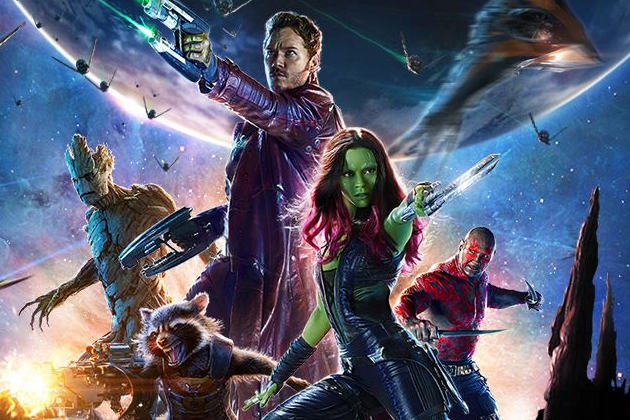
Guardians of the Galaxy: Chris Pratt (Peter Quill/Star-Lord); Zoe Saldana (Gamora); Karen Gillan (Nebula); Pom Klementieff (Mantis); Dave Bautista (Drax); Vin Diesel (Groot); Bradley Cooper (Rocket); Josh Brolin (Thanos)
Dr. Strange: Benedict Cumberbatch (Doctor Strange); Benedict Wong (Wong)
Spider-Man: Tom Holland (Peter Parker/Spider-Man)
Black Panther: Chadwick Boseman (T’Challa/Black Panther); Danai Gurira (Okoye); Letitia Wright (Shuri)

Any of these franchises can and have carried a great movie on their own. (In particular, since 2013 Marvel has made a stretch of great movies including Guardians of the Galaxy, Captain America: Civil War, Dr. Strange, Spider-Man: Homecoming, Thor:Ragnarok, and Black Panther). So one of the great obstacles Infinity War had to overcome is how to fit all the above in the same movie giving each and every character their own moment to shine. Amazingly, this is done. All of the above share this movie in equal heft and have their own moments to shine. I’m not sure how seventeen writers and two directors go about doing something like that, but its time to start handing out Oscars.

What may to be the hardest thing to accomplish is how consistently funny the movie is. I say this because there are two big things fighting against it. The first is that the main villain, Thanos (played by Josh Brolin) is trying and succeeding throughout the movie to kill off half of the universe. It is heavy stuff and is taken quite seriously, not least by Thanos. Two important characters from the Thor franchise, Loki and Heimdall, die in the first fifteen minutes. Another important character from the Guardians of the Galaxy franchise dies at the half-way point. At the end, well, it seems like half the characters die. I won’t tell you which half, that would be a spoiler. The second is that this is an action-heavy blockbuster and huge spectacles and jokes generally do not generally complement each other. A good example of blockbuster spectacles and laughs working is the first Ghostbusters movie. A good example of blockbuster spectacles and laughs not working is the Ghostbusters remake. But in Infinity Wars, every joke lands. Dr. Strange is funny, Thor is funny, Star-Lord and Drax are funny, Spider-man is funny. Some characters are generally funnier than others. For instance Captain America and Black Panther were never particularly humorous, but almost everyone has their moments. There is also the added pleasure of seeing various characters interacting for the first time. At one point Thor meets up with the Guardians of the Galaxy. Bruce Banner has a scientific conversation with Shuri in Wakaanda. Dr. Strange and Tony Stark have this dialogue upon meeting.

Tony Stark: Nice cape. What's your job, again?
Dr. Strange: Protecting your reality, douchebag.

Infinity War is supposedly only the first of a two part movie, the other coming out next year. In that case, it is hard to judge the overall story at this point. But really, given how well this movie did what it set out to do, how could it be bad? Marvel is at its peak and the movies it has been making deserve to start getting serious recognition and not just for special effects. I expect Black Panther will run away with a serious amount of Oscars next year. Perhaps the year after Infinity War 2 will take the ultimate prize. As far as I’m concerned, Marvel has already earned it. At this moment, They are the best in the business.

Saturday, July 4, 2015

Jurassic World (2/5 Stars)


Nerd Pandering

If I had made a spoof of the Jurassic Park franchise, it might have been remarkably similar to “Jurassic World.” This movie is not too far away from being a total joke. Take two main plot points. First, the theme park “Jurassic World” is not growing in attendance because people are bored with the same old dinosaurs and the investors are getting anxious. Say what? A theme park with dinosaurs is losing its appeal after only ten years in existence? Surely that is one of the most absurd scenarios in the history of movies. But whatever, in reaction to this scenario the theme park is training velociprators like bloodhounds and creating a newer, bigger, more dangerous dinosaur. You see their focus groups suggest that giant carnivourous dinosaurs tend to draw larger crowds. These new attractions have gotten the attention of the U.S. Military which brings us to the second plot point. A contractor named Hoskins (Vincent D’Onofrio) exclaims “Imagine what we could have done with these guys in Tora Bora!?!” I can actually answer that question. An Al Queada soldier with a sniper rifle would take down the raptor from about 500 yards away. And that’s if the beast could actually be transported to Afghanistan in the first place. And these absurdities are what drive the main plot conflicts of the story. Really. This movie just made a record 200 million dollars in one weekend. The silver lining to that I guess is that this movie would not have made nearly enough without the enormous goodwill garnered by the first two very good Spielberg films. So, at least in this instance, critics can be assured that bad movies don’t come out of nowhere and make tons of money. They stand on the shoulders of actually good movies and also in this case a pretty good book.

Let’s talk about the dinosaurs. They are relatively deficient from past movies in their capacity to provoke wonderment or thrills. The lack of wonder has much to do with the movie’s insistence via the characters that the dinosaurs are not so special. In the first movie you followed the reactions of paleontologists whose every dream came true when they saw their first living dinosaur. Contrast that with the two kids who visit the park in this movie. One of them, a child, is sufficiently excited. The other, a teenager, is more interested in girls. I felt like smacking him upside the head for most of the movie. It matters less what is on the screen than what the characters think about it. The experience of movie going is a vicarious one. If the characters don’t care than the wonder is not extended to the viewer. The fact that “Jurassic World” had one of its main characters not be all that impressed with dinosaurs really undercut the whole reason to see this movie: i.e. that it had fucking dinosaurs in it.

These dinosaurs are less thrilling than the ones in the original movie. Now I’m going to make a distinction in the technology but keep in mind that there is actually no particular reason why computer images could not do both. Think back to the original movie and pick out some of the more visceral moments, perhaps the Velociraptor in the kitchen tapping its big claw, or the water vibrating, or Wayne Knight’s death, or the girl being sneezed upon. None of these little things employed computer effects. It would be absurd to use computer effects for them, as they were not needed. However in the new movie, as far as I can tell, the dinosaurs are completely computer generated even for the moments when it isn’t needed, i.e. closeups on faces. And those dino faces look unnecessarily weird to me compared with the first movies. But as before it is not really the problem that the dinos are almost entirely computer generated. The real problem is that there are not really any moments that do not call for computer generation. There are no little moments. All the moments are big. And this is a problem because you need little moments to create suspense (i.e. water vibrating) and also to explain things.

Filmmakers studying Spielbergian masterpieces such as Jaws and Jurassic Park (as no doubt the director of “Jurassic World” Colin Trevorrow has) continually draw the wrong lessons from them. They assume that if you do not see a monster for a significant length of time that it suddenly becomes scarier. This is not true. The reason why the shark and the dinos are scary in those movies is because they are thoroughly explained. That is to say in “Jaws” Richard Dreyfuss explains in length the nature of Great White Sharks and in “Jurassic Park” a paleontologist explains how velociraptors attack in herds.  It amazes me how these scenes are sometimes the first ones dropped in inferior movies. What you get instead is movie cheats wherein the creature, not being defined, is allowed to arbitrarily gain and lose supernatural powers at the movies whim. Here the new dinosaur is allowed to camoflauge himself amongst the trees. This somehow makes it impervious to bullets, lots and lots of bullets. Or take the raptors, which can be trained to follow orders from Chris Pratt until they don’t want to until they want to again. It also does not help when the ambitions of the movie are so great in scope that a wild animal as a villain just cannot work without it having absurd levels of competence in fighting modern technological war machines. Sometimes for the purposes of thrills that do not insult the intelligence of the audience it is better to have a boat that is not big enough.

Now lets talk about the secondary attractions, the people. There is not much to say here other than how well they play out stock imitations of other Spielbergian characters and tropes, most explicitly the one where an adult needs to stop working so much and spend more time with the kids. Then there is Chris Pratt doing his best ‘Indiana Jones’ impression. Not bad although I think he really should be drinking a beer in his first scene and not a coke (and who drinks coke from bottles anymore?). BD Wong, the scientist from the first movie, is back as a scientist here. His presence is nerd pandering which I will get to next. The same can be said about the characters of Jake Johnson and Lauren Lapkus the computer nerds in the control room. Again, more on that later. Bryce Dallas Howard plays a vapid corporate dummy who disrepects nature and is too high strung and organized for a relationship with Pratt to work. She has these high heels. Pratt at one point when they are in the midst of nature with danger all around them ridicules her decision to wear them. He is right of course. She shouldn’t be wearing them in this context and high heels in general are rather vain and unbecoming for someone already in charge with nobody to impress. So that’s a good criticism. But then the movie does something else: It insists that Bryce continue to wear the high heels the rest of the movie past many scenes when either a sane person would have ditched them or they would have broken past repair many times. Now given that the character is only wearing the heels because the movie itself (written, directed, and produced by guys) has been intent on making her wear them beyond all suspension of disbelief, is it really okay to make fun of the woman’s character for wearing them in the first place. I would suggest that it is not but this is the sort of thing one generally gets when a movie deems as its mission to above all else pander to nerds. In this particular case nerds like to think of themselves as Han Solo and that every girl is Princess Leia who would fall head over heels for them if only they weren’t so stuck up. Chris Pratt and Bryce Howard Dallas are just another reiteration of that classic type of nerd pandering.

I don’t like nerds. I don’t think there is another group of people who would sit through all sorts of stupid drivel as long as it patted them on the back and made them feel special. But boy do studios love nerds. Make a movie about their favorite comic book and the nerds will feel compelled to show up as a matter of honor perhaps if only for the opportunity to complain loudly about how terrible it was done. So the incentive to make decent movies is lessened right there. What is more is that the nerds routinely react with glee when sequels or reboots incorporate the best jokes and lines of the original movie. “Jurassic World” is no exception. There are a ton of inside jokes and callbacks to “Jurassic Park” (Hell, look at Jake Johnson’s “Jurassic Park” shirt) and “Jaws” that make the plot more predictable and all the action tinted with a sense of déjà vu. There is the ‘objects look closer than they appear in the mirror’ gag, there is ‘the loosening of a giant tooth from a vehicle’ trope, there is the ‘flare baiting of the T-Rex’ scene. The best example of all is the musical score. It isn’t John Williams great score from ‘Jurassic Park.’ It is a similar but inferior version whose best quality is to remind you of how great the original was. The most frustrating thing about “Jurassic World” is not that it isn’t a great movie, it’s that it cynically did not even allow itself the space to be a great movie. It deliberately set out to be a nostalgia piece. And the ones to blame are the nerds because they do not insist that their movies challenge them. (One could perhaps argue that the whole idea of having superpowers is an immature way of escaping real world problem solving). As long as they go and see the next Spiderman reboot every five years why would the studios ever give them something different.  


Monday, August 4, 2014

The Guardians of the Galaxy (4/5 Stars)


Our Hero, the Awesome Chris Pratt, lands his intergalactic spaceship on a desperate and dangerous alien landscape. He steps into a derelict and cavernous ancient cathedral overgrown with dangerous fauna. Chris Pratt puts on his Walkman and plays his “Awesome Mix Tape #1.” The song, played loud and funky is “Come and Get Your Love,” by Redbone. And to this tune, the opening credits of our movie come on the screen as Chris Pratt dances and shuffles through the many dangers of his archeological mission. That’s when I knew I was watching something new, something interesting, and most importantly something undeniably fun. And you know what, it was.  

Until now, I have not heard of the Marvel comic “Guardians of the Galaxy.” Apparently it is rather recent comic without much of a fan base. There are no recognizable characters. The team consists of a Firefly-esque band of misfits that have come together to do fun outlaw stuff, mostly salvage jobs. The leader is Peter Quill (Chris Pratt), a human who was abducted by aliens when he was a just a little kid in 1988. This particular back-story is a boon to people like me who are somewhat turned off by the complete arbitrariness of most way into the future science fiction. The most obvious perk of the story happening basically in current day even if we never see Earth is the soundtrack. It comes from the Walkman containing his Awesome Mix tape that young Peter was carrying when he was abducted. It has got Marvin Gaye, David Bowie, and even Blue Swede. These songs reflect good taste on the part of Peter’s mother who made the tape for him before she died of cancer. I was surprised and delighted that “Cherry Bomb” by The Runaways got an extended play over one of those getting-for-battle montages. It’s a killer song. Then there is the marvelous pair of digital creations Rocket Raccoon and Groot. They are originally a pair of bounty hunters. Rocket Raccoon is the product of a mad scientist who turned a raccoon into a living, breathing, sarcastic as all hell, and complete with a snarly Napoleaonic complex. Bradley Cooper voices Rocket Raccoon. Admittedly, I could not recognize him in the voice. Groot is, I guess, an Ent, a walking tree. Vin Diesel voices him in what can be safely be said is an underwritten role. All Groot can say is “I am Groot.” Although, he is a bit like Chewbacca in that apparently the Raccoon can interpret his connotations perfectly. These two characters are not muppet sideshows. They are so well conceived and artistically put together that after awhile I realized that I had forgotten that I wasn’t simply watching actual actors. We are at a point in movie technology where these characters are alive. It is an extraordinary to watch and given the progress I would think this might be the last time I comment on how well it is done. From now on, perhaps I’m going to judge these performances just how I would judge a human performance. On a very basic level what has been have achieved is a blurring of the distinction between the two. Joining the party late is the Pro Wrestler Dave Bautista as Drax. He does a very convincing job of being big and dumb and completely incapable of grasping metaphors. Finally there is Zoe Saldana painted dark green this time as a fierce warrior of some sort. She is the serious one of the bunch because you know she’s a woman.

The plot of this story is arbitrary and absurd and quite frankly really comparable to some truly awful movies like John Carter of Mars and the like. There are bunches of people with weird names in weirdly named places you’ve never heard of and they are trying to get this weapon that is going to kill everybody unless Peter Quill and the gang get it first. Motivations come and go easily for the people and not much makes sense in that annoying Science Fiction way you know where because it takes place in a far off place you don’t have to worry about making any of the technology realistic or plausible. But guess what? I did not care. I just did not care. Because what this movie does good it does awesomely great and I could forgive all the absurdity because the movie never really asked me to take it all that seriously. What it asked me to do was have fun and then it provided great music, good jokes, quirky characters, but above all abosolutely stunning things to look at.

The design of this movie is truly Oscar worthy effort. It is hard to assess who is exactly responsible for what. When you look up the crew on IMDB you are faced with the fact that hundreds of people have worked on the movie. But here are couple of names of the people in charge: Charles Wood of Production Design, Ray Chan of Art Direction, Alexandra Byrne of Costume Design, and whoever was in charge of makeup. There has not been a movie so vibrant and fun to look at since “The Fifth Element.” This movie makes use of a comic color palette. The prison jumpsuits are bright yellow. Several characters are of light blue and hot pink and orange hue.  My favorite design has to be the makeup of a character named Nebula (Karen Gillan). Now that is a sexy blue robot (I think she is a robot, maybe). If the makeup and hairstyling of this movie doesn’t win an Oscar I have no idea what I’m talking about. At one point I was looking forward to seeing new characters being introduced just to see what they looked like. What was better about Benecio Del Toro’s part in this movie? His performance or his white suit and hair?

This movie was directed by James Gunn and partially written by him too. I have not seen anything else he has done but given the size of these blockbusters, it is hard to say (and probably shouldn’t be said) that this is his movie. This is a corporate movie and as a corporate movie it has certain plusses and minuses. It does not, cannot have the personal touch that small movies have. But it does have the ability to apply lots of money for the employment of hundreds of artisans and designers. “Guardians of the Galaxy,” is a persuasive argument that summer tent-pole blockbusters can be worth the money spent to make it not just profit-wise but also in artistic merit. Yes, corporate movies can be quirky, original, and fun too. Attidude is all, i.e. the courage to play “Hooked on a Feeling” by Blue Swede in a science fiction movie and have faith that the audience is going to like it enough to ignore how the whole setup is completely absurd. Such courage in very expensive projects is rare but take a look, it exists. 


Sunday, January 26, 2014

Her (4/5 Stars)


Nora Ephron once noted that most love stories can be divided into two categories: Christian and Jewish. A Christian Romance involves two people who would be happy but for some third person or outside conflict that keeps them apart. Think of the feuding families in “Romeo and Juliet,” the class barriers in “The Notebook,” or the sinking of the Titanic in “Titanic.” The Jewish Romance involves two people who would be happy if it weren't for the flawed personalities of the characters. Nora would say that Woody Allen is the great writer of this type of story, and movies such as “Annie Hall,” “Manhattan,” and “Hannah and Her Sisters,” are good examples. I think "Eternal Sunshine of the Spotless Mind," would be the epitome of that type.

Now consider the movie “Her” from writer/director Spike Jonze. Ask yourself as you watch it, which category would it belong in? Are the conflicts born from the characters or from the society in which they live? And if it is a conflict born from the characters, what does that say about people especially given the society that is present in this movie. Is Spike Jonze saying outside conflict helps to provoke romance?

This might be the first movie I have ever seen that portrays the future as a Utopia and not a Dystopia. “Her” takes place in the near future of Los Angeles. The streets are calm and safe. Plentiful skyscrapers adorn the skyscape as beautiful landmarks not haunting towers. There is no smog and the public parks and beaches are clean. Everything is bathed in a warm comfortable glow. The story concerns Theodore Twombly (played by Joaquin Phoenix) an employee at BeautifulHandwrittenLetters.com. Theodore composes other people’s letters to their loved ones. It is a sensitive if otherworldy job and Theodore takes joy in it. He has nice coworkers. There is Amy, played by Amy Adams, who is kind and funny and sweet. His boss, played by Chris Pratt, is a funny goofy nice guy too. The job must pay well because Theodore’s apartment is plenty nice, clean, and spacious. He has all the latest technological gadgets in handheld devices and role-playing computer games. It is a nice safe life and Theodore is a nice safe guy.

So, given that, why is Theodore recently divorced from Catherine, played by Rooney Mara, and why has he not been actively social in awhile. Everything is perfect or is that the problem, that everything is perfect. And is that the reason why Theodore strikes up a relationship with the latest gadget around, a personalized OSS (operating system) named Samantha (voiced by Scarlett Johannson). This new OSS has the ability to intuit and learn, so it is a kind of artificial intelligence with a real intellectual curiousity and love of life. She’s charming and smart (hooked up with an internet connection she immediately reads the entirety of Wikipedia) and her newness has the sort of endearing innocence absent in experienced humans. This is an impossible relationship of course, but is that what makes it exciting to Theodore? Are we prone to look for conflict and grow restless when it can’t be found? Do relationships work the best when the two people in it are united in fighting a third party? If there is no outside conflict do people automatically turn on each other? The meanest thing said in the movie comes from the ex-wife Rooney Mara. It is only two sentences but it makes clear that she knows Theodore well enough to only need two sentences to strike him where it hurts most.

Samantha on the other hand is much easier to talk to. I expect this is because she does not give off the impression of being able to hurt Theodore. She if after all just a machine and the way Theodore talks to her resembles more of a conversation with one’s diary than a conversation with another person. These are quietly stunning, sensitive, and articulate discussions between two characters that have no reason to guard how they speak to each other. And so they don’t. In fact, I kept thinking of the last entry in ‘Anne Frank’s Diary,’ in which she explores how the presence of other people changes her character. She says that she is a different worse version of herself with other people than she is all by herself. If only there were no other people in the world, expresses Anne. Theodore could probably say the same thing, and here he can and does because he’s talking to a machine, not a woman. Spike Jonze has been nominated for a Best Original Screenplay and deserves it.

Perhaps the most impressive thing about this quiet sensitive movie is the production design, art direction, and costume design. The credit for this belongs to K.K. Barrett, Gene Sardena, Austin Gorg, and Casey Storm respectively who have convincingly created a world that is simultaneously familiar and strange enough to resemble the future. K.K. Barrett has worked on all of Spike Jonze previous movies (Where the Wild Things Are, Adaptation, Being John Malkovich) and interestingly many of Jonze’s ex-wife’s movies Sophia Coppola (Lost in Translation, Marie Antoinette). Now that I think of it, Rooney Mara looks a lot like Sophia Coppola. I think that’s all I’m going to say about that.

Amy Adams is as charming as always and looks great with that strange curly hairstyle, you know like always.

Oh and Karen O is a lock for an Oscar for Best Original Song. “The Moon Song” she wrote is good which is almost always good enough to win in that strikingly shallow category. 


Friday, October 7, 2011

Moneyball (4/5 Stars)


The Art of Winning an Unfair Game

One of the main arguments I hear batted around for keeping steroids out of sports is that it makes the game unfair. And the usual retort I always bring up to everyone’s bafflement is that sports aren’t fair anyways, so what’s the difference? And they aren’t fair. They really aren’t. One of the hardest things to do in life is to distance oneself from mass delusions and the idea that sports are somehow fair is one of the most broadly accepted and thankfully rather benign fallacies around. Genetic differences (for instance height in basketball) between opponents are not fair. And neither is a system that allows one professional sports team to have a much bigger budget than others. That difference allows the richer team an unfair advantage in attracting top talent. That is what Billy Beane, the general manager of the Oakland Athletics in this movie based on a true story, must come to grips with. The movie starts with the Athletics coming off one of their best seasons and subsequently losing their three best players in free agency to richer teams like the Yankees. The experienced scouts around the back-room table are talking about rebuilding the team from the ground up with old baseball knowledge and old baseball customs, the same way they did it the last time. No, No, No, Billy says, we cannot do the same thing. More importantly, we cannot do the same old thing because the Yankees are doing the same out thing. If we scout the way the Yankees scout than we will lose because the Yankees will outbid us no matter how well we scout. The game is rigged. We either find a way to play the game differently or we lose. That is Billy Beane’s problem.

How Billy attempts to solve the problem is the main focus of “Moneyball.” Billy Beane, played here by Brad Pitt, essentially disregards most or all of the advice of his experienced scouts and starts listening to a young recent economics major from Yale named Peter Brand, played here by Jonah Hill. The chubby bespectacled Peter Brand is not an athlete, but he does know math and  can use it to spot trends. He tells Beane in confidence his hunch that scouts completely overlook certain things and place way to much emphasis on others. For instance, Peter suggests that a manager’s job shouldn’t be to buy players, but to buy wins, and to buy wins he needs to buy runs. Billy Beane follows this advice. This leads to some rather unorthodox moves, one of the more outrageous things being hiring a life-long catcher to play first base because the guy has a very good getting on first base percentage. Hopefully the runs he will score will offset the plenty of mistakes he will make on defense. The scouts think Beane is crazy. The team manager Art Shaw, played here by Phillip Seymour Hoffman, goes further and refuses to follow the directions. As he explains, he wants to play the team in a way that is defendable in job interviews next October. The A’s start the season with an 11 game losing streak. Beane’s job is on the line. If things don’t turn around he may never be hired as a general manager again.

All of this is very succinctly told with brevity and humor by a great screenplay written by Steve Zaillian and rewritten by Aaron Sorkin. It is impossible to tell which lines are whose but there are several scenes that come off just as well as all those scenes between computer nerds in last year’s “The Social Network.” In fact it can be said that the movies performs much better off the baseball diamond than on it. The backroom dialogue is filled to the brim with smart dialogue that explains things as if it knows what it is talking about. When Brand takes Beane aside and shows him videos of his “hero,” a pudgy little known baseball player who happens to get more walks than anybody but Barry Bonds, we understand exactly why that player is drastically underrated. We also understand why Billy Beane would be willing to take such chances. Through flashbacks we see a young Billy Beane being talked up by scouts who thought he would be the next big thing. They flashed him a huge paycheck and told Billy to skip college and go straight into the big leagues. Billy did and didn’t turn into anything big. The scouts didn’t know what they were talking about and in one of the best scenes in the movie; an older and wiser Billy takes on an especially irate veteran scout. “You don’t know. You say you know, but you don’t,” he tells him. No more of the confidence bullshit for Billy. He is going to trust math from now on. You know, that thing they tried teaching us in school.

This movie is especially satisfying for someone of my generation because we all grew up in the golden age of bullshit sports movies. All that “Just believe in yourself,” horseshit that adults think is okay to foist upon unsuspecting children were heaped onto us in movies like “The Mighty Ducks” and its many ripoff copies. But this movie tells it like it is. Confidence, such a cherished virtue, is shown to be the most useless and overrated of all skill sets. What really counts is doing actual work, crunching numbers, and using deductive reasoning. To show this is not an easy thing for a movie to accomplish. We are after all, an emotional species. But, by and large, “Moneyball,” accomplishes this task. Unfortunately it ultimately falls short due to the same pitfalls that beset everything it is trying to debunk. The last half of the movie veers into melodrama and misplaces an ending that should have been revelatory instead of muted.

What do I mean by that? Well, for one thing, the director Bennet Miller (last movie of his was “Capote,” way back when btw) uses way too much soft focus and slow motion in the climatic scenes. The idea of statistics is to cast clarity on a muddled world. A man like Beane, who has crunched the numbers, should be seeing things more clearly (think Neo finally seeing the matrix at the end of “The Matrix”). Instead, there is a five-ten minute scene near the end of the movie about a very meaningful game in which we see Beane in the weight room, fixed on the television, hoping to all hope that things turn out well on the field. This is not correct. A man who believes in math does not hope or pray for anything. They know what the probabilities are. When so-and-so comes up to the plate they know there is a certain percentage of chance that they will either hit the ball or not. They also know that there is a certain percentage of chance that the game will be won or lost. A man of math is not surprised. They are not brought to disbelieving elation or despair by the occasional impossible miracle. They knew it was possible actually, just unlikely.  Thus, we shouldn’t have out-of-focused shots. We instead should have full-focus shots. The movie should be set in a setting of hyper-awareness. This is not done to the movie’s detriment.

Now, take for instance the ending. It speaks boatloads of the very problem Beane was up against (i.e. human intuition against mathematical reality), but does not exploit it to dramatic effect. Billy Beane ends up turning down a very high offer to manage the Boston Red Sox. Now, if he were using his own philosophy, he would probably determine that access to the Red Sox would mean a greater budget, better players, and thus a better chance to win the World Series Title. In fact, the Red Sox would win the World Series just two years later having adopted some of Billy Beane’s methodology. But Billy didn’t join the Red Sox. He turned down the offer and stayed with the A’s….and he still hasn’t won the World Series. I’m sure the decision felt right though.