Search This Blog

Showing posts with label pixar. Show all posts

Tuesday, December 26, 2017

Coco (4/5 Stars)


I wouldn’t know the first thing as to what “Coco”, Pixar’s latest venture, gets right and wrong about the beliefs around Dia de los Muertos, the Mexican holiday that centers around veneration of ancestors. All I can say is that, portrayed by Coco, it makes for an ingenious engine for plot. The conceit of “Coco”, and for Dia de los Mueros perhaps, is that upon death, people enter into a new life in a parallel dead realm (there is probably a better word for it than that). In the dead realm, life goes on as usual, except instead of class divisions based on wealth or rank, there are class divisions based on how well one is remembered in the Earth realm. Remembrance in the Earth realm can be both physical as well as mental. A dead person can be remembered by having their photograph placed on a family shrine or can simply exist within the mind of a family member. But if the photograph is not placed on the shrine or the last family member who remembers the dead soul dies or forgets, than the dead soul dies a second death in the alternate realm.

Miguel, voiced by Anthony Gonzalez, is a young boy with an interesting family history. His great great grandfather, a musician, became estranged by the family. His great great grandmother swore off music and forbid any of her descendants to remember the great great grandfather. As Miguel’s family celebrates this year’s Dia de los Muertos, the only family member to still remember the great great grandfather is Abuelita, Miguel’s great grandmother, who is very close to dying herself. Thus there is a ticking time clock here, for Miguel to figure out what needs to figure out, to essentially save the second life of his great great grandfather. I have to admit, this is a plot I have not seen before.

The idea that the memory of ancestors keeps them literally alive, albeit in a different place, should be inviting to everyone. The fact that this movie is also very specific about a particular culture presents to the audience something Pixar does extremely well. It is an original story with emotional underpinning that is instantly identifiable. “Coco” is not as funny as other Pixar movies, but it makes up for it by being especially touching. Who, of course, who would not melt a little to see a long lost relative come back to life? And the way Pixar tugs this particular heartstring, through the use of musical elements and cues that weave themselves through the story, is very effective.

All that is lefts is to admit, once again, that Pixar has made a visually striking movie. The Pixar style may seems at times to be a bit foreign to this culture. When I think of movie dominated by bones, I am reminded more of the stop-motion animated style of Tim Burton, but it is not too distracting. I don’t know what details of Dia de los Muertos is got right or wrong, but even there had not been such a culture and this movie was made up whole-cloth, it would have succeeded in making it interesting, important, and vibrant.


Pixar has a tradition of dual directors per film. “Coco” was directed by the Pixar veteran Lee Unkrich (Toy Story 2, Monster’s Inc., Finding Nemo, and Toy Story 3) and a Pixar new-comer Adrian Molina, who also co-wrote the screenplay with Matthew Aldrich. I expect it is to Molina’s credit that this story has the level of detail it commands and to Unkrich, the usual Pixar flair and competence.

Friday, July 15, 2016

Finding Dory (3/5 Stars)


“Finding Dory” is special in that special way that special people are special. It isn’t great but it has a lot of heart and its not mean or bad in anyway so what’s the harm in liking it.

It is a spinoff from one of Pixar’s best movies, “Finding Nemo.” In that movie a very worried father fish, Marlin, voiced by Albert Brooks, is searching for his lost son Nemo. On his journey he meets his polar opposite, a fish named Dory, voiced by Ellen Degeneres. Dory had a personality quirk that was all the rage in the early aughts: she suffered from the inability to create new memories. Yes, like that guy in “Memento” and Drew Barrymore in “Fifty First Dates.” She provided a delightful foil to the always anxious Marlin what with her blissfully optimistic mantra “Just keep swimming, Just keep swimming” and her complete inability to remember what her problems were or even what was Marlin’s mission.

She was a great sidekick. She is not so great a main character. For one thing, her character needs a reworking that doesn’t exactly fit with what we have been previously told about her. That is for the plot to kick in she has to first remember a rather big that she forgot: she had lost her way from her parents when she was young. Why she remembers this now and some other things at various times when she can’t remember anything else strains the suspension of disbelief. People pointed out that the main character in “Memento” implausibly remembered that he couldn’t create new memories. Dory has that one memory quirk as well and then a bunch of other memory quirks that surface up continually when…well whenever the story needs her to remember something for it to progress forwards.

This doesn’t happen too much but that in and of itself is also a problem. For Dory needs to find her parents somehow, and the only way she can do that plausibly is to simplistically bumble into them. So the story structure reflects that and in doing so is especially linear and almost entirely predictable. The problem solving required is at minimum capacity otherwise Dory would be completely helpless or not Dory at all.

It does not take many twists and turns to get Dory very close to where she needs to go and that is an Ocean Aquarium that rehabilitates injured fish before releasing them back in the wild. The nature of this aquarium seems to reflect the politically correct view towards aquariums nowadays in that they are more like prisons for the large animals in them than homes. Thus this aquarium has at its stated goal to rehabilitate injured fish and then at some point release them back into the wild. Good, now we can look at fish behind glass and not feel guilty about it.

At this aquarium she finds several “special” animals willing to help her. The best by far is a wily Octopus named Hank (played by Ed O’Neill of all people). Hank by and large solves the problem of how a fish can get around a big above ground place. He slithers along and camoflauges himself to fake out the humans. It is most definitely based on the true life notorious octopus that escaped from an aquarium via a drainage pipe a couple of years ago.

Other animals are more forgettable. Sometimes the most interesting thing about the character is who is ultimately voicing them. For instance, there are two sea lions voiced by Dominic West and Idris Elba, both of whom played main characters in “The Wire.” I got a kick out of that because I am a fan of “The Wire” That is to say my pleasure in watching them here is derivative as opposed to original. That is especially true of the disembodied cameo of Sigourney Weaver who introduces herself over the Aquarium loudspeaker as Sigourney Weaver and continues to provide information about the park as Sigourney Weaver. I wonder if small children several decades born after the apex of the Aliens franchise will know who Sigourney Weaver is? I liked it sure but that has very little to do with the substance of this movie. I just happen to like Sigourney Weaver.

I expect the message of the movie is the most commendable thing about it. It’s very kind and nice and comfort food. I hate to be a total downer and say that the idea that every one is special in their own special way and that certain specialness makes them useful in ways that other not special people cannot be is not entirely correct. But really think about it. Dory’s special ability (or disability more like it) to optimistically and impulsively act upon no evidence (because she can’t remember any) is not an entirely special quality. Her success, let’s be frank, is mostly luck. She could just as easily be someone's lunch many many times. 


I really don’t think I’m missing the point. I get the point. I understand why parents would like to tell their children that everything will be okay no matter how badly their genes have failed them. I just don’t happen to agree with it. I much prefer a movie like Pixar’s “Inside Out” that has the emotional maturity to see life with clear eyes. “Finding Dory” is all fluff.

Sunday, December 27, 2015

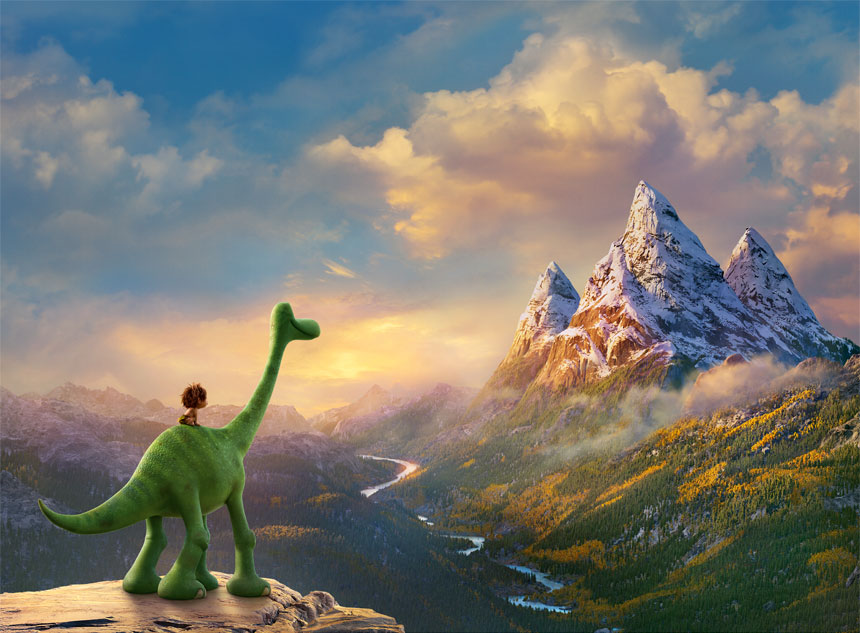
The Good Dinosaur (3/5 Stars)


When Jerry Seinfeld spoke about making a twenty-minute television episode he described it like running with an egg. That is to say there is this obstacle course one must cross all the while holding on to this very fragile thing and at any point in the obstacle course this very fragile thing could drop and be ruined irrevocably. To reiterate, everything from idea to writing to preproduction to directing to acting to editing to final presentation must be done perfectly. A misstep in any part of the process will render the final product inferior. When a movie fails completely it becomes clear that mistakes were made at most parts of the process. When a movie fails inexpliacably (or say tragically) you can almost sense this heroic effort being undone by a single weak link far along in the chain. Almost never do you see a movie fail the way that “The Good Dinosaur” fails. It’s marketing was perfect, its editing was seamless, it’s animation a pinnacle of the art, it’s casting and voice acting totally fine. Even the writing is not all that bad. No, what went wrong is the idea. The premise of “The Good Dinosaur,” is the problem. Imagine if you will somebody breaking the egg at the first obstacle in the course and then proceeding to run the rest of the way all the way to the finish line with a broken egg. The time to stop production of this movie was during the pitch meeting.

The premise for this movie is that the meteor that killed the dinosaurs missed the earth and that the dinosaurs survived to be able to meet humans millions of years after. That’s not the problem. The problem is that the movie takes this imaginative leap with the dinosaurs that is not intutitive. For instance, the movie starts with a family of Apatasaurs. There is a Dad, a Mom, and three kids (one of which is our cowardly hero Arlo). They are farmers. They grow corn and talk about storing enough grain for the winter. This does not make sense. The main reason is that they have not evolved past anything that looks like Apatasaurs. That is they are still very big, move along on all fours, and do not have hands that can grasp anything. And yet they have somehow built a house and a granary and plow the ground with their noses. The most absurd thing is that they are vegetarians and live in a forest and instead of eating the trees around them are planting itty bitty things of corn. Animated movies always take a certain leaps when they anthropomorphize animals, but this can only go so far. For instance the fish in “Finding Nemo” talked and had dreams and anxieties but they never ceased being fish. What makes the best films of Pixar work is that recognition the audience has when they are presented with the fanciful. Sure, there are not actual emotional beings in our head at a control panel but if there were, it is conceivable that they would work the way they do in “Inside Out.” Wall-E gained a personality over several thousand years but he never ceased being a trash compactor. In “The Good Dinosaur,” the dinosaurs are no longer dinosaurs. The Apatasaurs are farmers but there is no intuitive reason why Apatasaurs would become farmers. And there is no intuitive reason why Tyrannasaur Rexes would become cowboys on a cattle trail. And there is no intutitive reason why Velociprators would become redneck cow stealers. All of this is very well committed to (the nicest touch has to be the casting of Sam Elliot as the father T-Rex) but because none of it seems more than arbitrary the movie has this aura of strangeness that permeates every scene. There are no “Aha!” moments. It is more like, “okay I guess we are doing this now.”

So the movie does not work on a fundamental level. At the same time, it has got to be some sort of pinnacle in animation. In fact, I can see why the sunk cost fallacy of this idea perhaps had so many legs. The storyline has to do with Arlo, the yound apatasaurus, becoming lost and having to find his way home through the wilderness. The animators at Pixar were grandly inspired to say the least at the challenge of composing an entire movie’s worth of landscape scenes. You almost never see this in an animated movie because I expect it is an excruciatingly hard thing to do. I mean imagine drawing a mountain and taking the time to draw every goddamn tree on it. Or drawing a churning river and making the water look like real water. In fact, nature in this movie is so grand and ever present in large epic ways that it is fair to call it the antagonist of the story. I have no idea how this movie was made but I would not be surprised if Pixar did a lot of groundbreaking innovating here. I really wish the egg had not broken at the start line.

One may want to give Pixar a shout out for making an original movie at all. They have so many great brands in their catalog that they could (and have plans for) moneymaking sequels ad infinitum. “The Good Dinosaur,” directed by first timer Peter Sohn encapsulates the reasons big studios can be so risk adverse. It is very hard to take to spend several hundred million dollars on a movie and have it come out subpar. Then again, this year’s “Inside Out” is the flip side to that. It was also an original and it hit the big time. In a year that Jurassic World broke box office records it would have been fair to assume it would be the other way around. William Goldman once had something to say about that. Keep making original movies Pixar, pretty please.


p.s. Thanks for the druggy scene. That was funny.

Saturday, July 25, 2015

Inside Out (5/5 Stars)


Imagine a movie that is at once wholly original and also completely familiar, startlingly simplistic in its scope yet containing multitudes of creativity and cavernous depths of emotion, and that can also make you laugh routinely, thrill you unexpectedly, and move you to near tears consistently. You would be describing Pixar’s newest feature “Inside Out,” a journey inside the mind of an 11-old-girl from Minnesota who has just moved to her new home in San Francisco. She endures a first day at a new school, a disappointing hockey tryout, and vegan pizza. Little stuff it seems to grown ups but to Riley it is the greatest obstacle she has gone through in a life that hereto had been filled with consistently joyful days. It is also the greatest obstacle her brain trust has ever handled. And by brain trust I mean Pixar’s anthropomorphized metaphor for her mind: a team of emotions that help Riley out from a mission control room in her brain.

The emotions have been perfectly cast from the broad and ever more productive landscape of quality television entertainment. At the center is Joy, voiced by the ever effervescent Amy Poehler (Parks and Recreation), Disgust, an appropriately snarky Mindy Kaling (The Mindy Project), Fear, a fever pitched Bill Hader (SNL), Anger, Lewis Black (The Daily Show) as himself, and finally Sadness, Phyllis Smith (The Office) in all her humble muted Eeyore-like glory. They function, in a tribute to Pixar’s ability to have it all, as part comedy team, part tearjerk squad, and part science lesson. (If their was an emotion left out, I would posit “desire” which would be the antithesis of Disgust much like Anger and Fear or Joy and Sadness play off of each other so well. Perhaps “Desire” shows up at 13).

This is the sort of movie that transcends movie-ness. Instead of talking about whether the movie looked good or was funny, you want to talk about how the movie was about what it was about. After all, everything that is shown onscreen corresponds to something everybody has experienced but does not really understand. We have these unconscious bodies that operate seemingly disconnected with our consciousness. What connect the two are our feelings. But how do those work? Pixar probably is not that far off. The emotions experience Riley’s life through her frontal lobe (this is a bit like the front windshield of a starship). They can’t tell Riley what to do, but they do color her experiences as they form memories (represented by luminous balls). If it is a happy memory, then Joy turns it yellow. If it is a fearful memory, Fear turns it purple. At the end of the day before the colored balls are shipped off to long-term memory (which apparently is consistent with what really happens when we are asleep), if the wall of short-term memory balls are mostly yellow than the team feels that they have had a good day. Their mission is to keep Riley happy. This presents a problem with the character of Sadness whose presence and efforts to help generally disrupt the mission. At one point Joy draws a circle around her and tells her to not leave it as a way of doing her job correctly. Psychologists have a word for this I believe. It’s called Repression. That’s a rather heavy topic for an animated movie to tackle, but Pixar goes even further. Near the denouement of this movie they will tackle the big D. Depression. And the way they do it will probably make you cry and afterwords you will probably think about why you cried and find a very plausible explanation in the way Pixar has portrayed the workings of the emotions in your mind. And you will probably feel better in an enlightened way because feeling sad is sometimes the most healthy way to respond to external stimuli. Psychologists would call that Emotional Maturity, an attribute that the marketers in our modern society have a habit of scorning. Fear it, they say, and buy this thing that will make you happy again. No, says Pixar, Sadness is there for a reason and the wise person would understand its utility. This is the sort of thing that Pixar has made a children’s movie about. To do that as perfectly as they demonstrate is to be a masters of emotions themselves. I tell you this: not since Hitchcock has a moviemaker been so in tune with what the audience is experiencing moment to moment.

But I get too serious. Let’s talk about comedy and how Pixar does not waste a moment in the entire movie when a joke can be somehow shoehorned in. First of all, the brain trust with all their distinct personalities form as good a comedy troupe as there can be. Through a mishap Joy and Sadness are stranded in Long Term Memory and need to find their way back to the control room.  Their journey takes them through several wonderful set pieces as Imagination Land, Abstract Thought, and Dreamworks Productions that has among other things a unicorn as a movie star.  They meet many comic characters. My favorite are the brain beureaucrats. One team works at Long Term memory and “forget” any balls that are rarely used. For instance they take away all of Riley’s piano lessons except “Heart and Soul” and “Chopstix”. But the really funny part is what they keep: a commercial jingle for ‘Triple Dent’ gum which they reuse again and again as a practical joke. Riley is destined to never ever forget it. Another good example is the two guards in front of the door of the subconscious (which hides an angry clown) that perform what sounds like an Abbot and Costello routine about whose hat is “my hat”. Then another time Joy knocks over two boxes, one of Facts and the other of Opinions. As she tries to put them back she exclaims how similar they look. And I haven’t even mentioned the imaginary friend voiced by Richard Kind who is the best part along with everything else.

“Inside Out” is one of Pixar’s best movies. And I say one of the best because I happen to believe “Wall-E” is one of the best movies ever made. So is this movie. When Wall-E (and “The Dark Knight”) failed to get a Best Picture nomination the Academy expanded the field to ten pictures the next year. That should easily include “Inside Out” this year and I’m not saying it should win (I can’t because I haven’t seen all the other movies) but I would be totally fine with the possibility.


Monday, June 27, 2011

Cars 2 (4/5 Stars)


A Bait-and-Switch Sequel

Technically speaking “Cars 2” is a sequel to “Cars,” the 2006 movie by Pixar, but not really. If anything it is the feature length version of a series of Pixar shorts entitled “Mater’s Tall Tales.” These shorts starred a side character of “Cars” called Mater the Tow Truck (Larry the Cable Guy) telling grandiose stories of his daring exploits that took place all over the world and almost certainly never happened. The shorts were true cartoons, limited to fast paced joke telling and brilliantly animated action. If Pixar was being totally honest with us it might have named this movie, “Mater the Super Spy, Ka-Chow!” But here they are having it both ways. They get to cash in on sequel box office while at the same time telling a completely original story in a completely different genre. It’s sort of like a “bait and switch sequel.” It’s very clever of them.  

The first “Cars” was about a big-headed race car named Lightning McQueen (Owen Wilson) that got lost on the way to a big race in a small town called Radiator Springs. He gained wisdom by the simple folk there and gradually learned all about small town values. By the end of the movie he was a much nicer car. “Cars 2” is basically a James Bond movie and follows quite the same structure. It starts with a British spycar named Finn McMissile (Michael Caine doing a superb Michael Caine) infiltrating an offshore oilrig run by a car with a monocle named Professor Z. Professor Z is smuggling some sort of weapon, Finn takes pictures, Professor Z notices Finn, a chase ensues, spy car gadgets help achieve a daring escape, and all of this is before the opening credits. Later this plot line intertwines with an ex-CEO of Big Oil, Sir Miles Axelrod’s (Eddie Izzard) plans to put on a three race around the world Grand Prix to demonstrate his new alternative fuel, Allinoil. Lightning McQueen and his buddy Mater head on over to Tokyo for the first race. There Finn McMissile and his fellow spy Holley Shiftwell (Emily Mortimer) mistake the uncouth rust-covered Mater as an American agent with an elaborate cover. Several car chases later, Mater is embroiled in the spy world. Somehow and why Big Oil is sabotaging the Grand Prix and they have to find out what its all about.

So this is Mater’s story all the way and whether you like the movie or not perhaps will rest on whether you like the bucktoothed hillbilly Mater. I liked Mater. He had plenty of good one liners and on top of that is uncannily smart, at least about cars. A good example of this is why the British agents thought he was the American agent in the first place. The spies had this code set up for meeting the agent they had never met. One car would ask a question about why the old Volkswagon engines didn’t need some very technical thing. The answer is because they have a some kind of air-cooled engine block (I don’t remember the exact words, but it was very technical). Supposedly this question was chosen because a normal car would never know such an obscure fact. Well, Mater knows it and finds nothing strange about the question. He answers it without hesitation in breathless kind of enthusiasm typical of geeks with finally someone to talk too and then goes on to describe the cooling blocks of several other like cars from that time period. There are plenty of examples of this high level of car knowledge “Cars 2” and it suggests that the people who made the movie really love cars and know everything about them. I know absolutely nothing about cars and do not harbor any fond feelings for them. In fact a big reason I like living in NYC is that I don’t need a car here. My driver’s license actually expired almost a year ago and I haven’t bothered to renew it. What I’m trying to say is that I hate cars. But I do take vicarious pleasure from watching a movie that is in love with its subject matter. “Cars 2” definitely is. If you enjoyed Pixar’s “Ratatouille” without having any knowledge of French cuisine, than you should have a fun time watching “Cars 2” whether or not you know about cars. I suspect people who do like cars will love this movie.

Much of the humor and creativity in this movie (and there is quite a lot of it) has gone into creating our human world in a way that is totally inhabited by cars. They are doing everything that we do just in car fashion. This leads to some really clever spectacles. One of my favorites is the Popemobile inside a Popemobile. Another is when the cars go through airport security and have to take off their tires to go through the metal detectors. These little details fill the movie end-to-end. One weakness in the jokes however is that a person might have to be a world traveler to get them all. In the Tokyo segment, I would think that the viewer would have to be knowledgeable of Japanese TV shows, those compartments that people rent to sleep in, and the fact that you can get everything in a vending machine over there, to get the jokes about them. The same goes for the jokes that are ingrained into the scenery in Paris, London, and a coastal Italian city that looks a lot like Cinque Terra. If you were familiar with these places, I would think your viewing pleasure would be enhanced a great deal.

The same goes for the evil scheme that is being perpetrated by Big Oil in this movie. It reminded me of the water scheme that the last James Bond movie, “Quantum of Solace,” featured. Most people thought that scheme was totally lame. I loved it, but I think that was mostly because I had just read a book about water wars (Cadillac Desert) and had known the scheme was based on something that actually happened in Bolivia. I can see people having the same reaction to the evil plot here as well. Before seeing “Cars 2,” it might help to watch the documentary, “Who Killed the Electric Car?” the utterly baffling tale of how a “business” named General Motors designed and manufactured an arguably superior product only to go to rather extraordinary lengths not to market or sell it. With that knowledge, the scheme in “Cars 2” may not seem so unrealistic because it isn’t really. Similar things have happened. Pixar has once again done their homework. One thing that this scheme does get right in line with James Bond movies is the car equivalent of the bad guys. In this movie they are lemons, really bad working cars, bent on perpetrating an evil plot because they’re so bitter about their inferiority. Surely, if there is anything I’ve learned from watching James Bond movies, it’s that you shouldn’t trust people with physical deformities.

Not that Pixar is up on a soapbox here about environmentalism. This movie is mainly about car chases, jokes, and cool spy car gadgets. There is a subplot that deals with McQueen and Mater’s friendship getting strained by Mater’s spy stuff, but it isn’t heavy stuff. Unlike the last several Pixar movies, this one isn’t about to make you start crying in the theater. Apparently that level of pathos (as opposed to say intelligence, wit, or creativity) is now what solely defines a Pixar movie as its omission in this movie is the primary reason why it is scoring a completely uncalled for 33% on RottenTomatoes. It should be noted that audiences leaving the theater have given “Cars 2” a Cinemascope rating of A-. I would give it a B+ but yes that is far more accurate than the tomato rating. “Cars 2” is not a masterpiece but it is as good as any decent James Bond movie, a worthy comparison because it is the gold standard of the genre this movie takes place in. At the very least, “Cars 2” is a better movie than “Cars” was. 


Some extra thoughts on the ingenious marketing strategy of "Cars 2," and the meaning of the term "Bait and Switch Sequel."


What do people want when it comes to movie night? I would argue that it is different depending on when you ask them.

When a person is deciding which movie from many to see, they generally try to make the safest choice possible. This is especially true if you are choosing a movie for a group of people. You don’t want to be the guy who suggests an obscure movie that everyone ends up hating. A sequel from a very popular movie has at least a decent chance of being mediocre. If it is awful, then there is always an excuse. I thought it would have been like the first. The people with you will understand because they were thinking the same thing before heading into the theater. That excuse is not available when bringing people to see a movie that doesn’t have a track record.

But what will you have wished you had seen once you leave the theater. Well, supposedly you will have wished you had seen a good movie. Fill in your definition of that here. In the case of a sequel to “Cars,” I think I would have liked to see, at the very least, exciting action sequences I had not seen before and funny jokes I had not heard before or, in other words, a good original story. 

A “Bait-and-switch sequel,” is a movie that baits people into the theater by marketing something recognizable but than switches into an original story once the money has been paid and the people are sitting down. If all goes to plan it would be the best of both worlds, both in terms of box office and artistic credibility. So the rule: the “2” helps get people into the theater. It doesn’t help tell the story. Like “Cars 2” it should be used accordingly. 

Sunday, October 24, 2010

Toy Story 3 (5/5 Stars) July 3, 2010

Pixar puts aside childish things. 

As Toy Story 3 opens, Andy is about to go to college. Now tall and mature, he rummages through his old toy box to see what he should take to college, put in the attic, donate, or throw away. He hasn’t played with Woody, Buzz, Rex, Slinky Dog, Mr. and Mrs. Potato Head, Hamm, Jessie, Buckeye, the army men, and the aliens from pizza planet in a long time. At the same time he hasn’t found it in his heart to get rid of them. A home video shows him at the tender age of ten rehearsing imaginative escapades with the song, “You’ve got a Friend in me,” playing in the background. For anybody who has childhood relics gathering dust in a closet somewhere (my Sunday comics collection for instance) the scene will send a nostalgic chill up your spine. There are just some memories you can’t bear to throw away.

The toys in this story, for those who live in caves, can think and talk and only pretend to be inanimate objects when humans are around. They act a bit like you think toys might act. They take on the personalities given to them by the children that play with them and the actors who lend their voices. Ken in particular follows this pattern. He is technically a straight man but he is also a girl’s toy, so he may be in love with Barbie but his personality and size of his wardrobe tend toward the feminine. The rest of this most impressive cast is as follows: Woody, voiced by everyman Tom Hanks, is a sheriff and the leader of group. Buzz Lightyear, voiced Tim Allen, is a brave space ranger action figure. Mr. Potato Head takes on the personality of its voice, Don Rickles, the king of insult comedy. Mrs. Potato Head is voiced by Estelle Harris, who you may remember from Seinfeld as George’s mother. Hamm (aka the evil Dr. Porkchop), is a piggy bank voiced by enormously laid back John Ratzenberger, the mailman from Cheers. Jessie, a cow-girl, is voiced raucously by Joan Cusack. Rex, the dinosaur, is voiced with a wild sideways lisp by Wallace Shawn, the little evil genius in The Princess Bride. R. Lee Ermey the drill instructor from Full Metal Jacket provides the voice of the army men. Joining the cast are other voices like Bonnie Hunt (a ragdoll), Jeff Garlin from Curb Your Enthusiasm (as a unicorn named “Buttercup”), the very British Timothy Dalton (as Pricklepants a toy thespian who doesn’t like coming alive because he’s trying to stay in character), Ned Beatty who seems to be channeling the totalitarian sheriff in Cool Hand Luke (as Lotso-Hugs, a big purple plush bear), Kristen Schaal from Flight of the Conchords (as a web-savvy Triceratops), and Whoopi Goldberg (as an Octopus). Finally rounding out the cast of toys are Ken and Barbie, the aliens form Pizza Planet, a psychotic monkey with cymbals, a sad clown with a tragic tale to tell, a bunch of thug action figures, an army of monkeys in a barrel, and a big really creepy baby doll. Whew, I hope I didn’t leave anyone out…Wait! There’s a slinky dog. Don’t forget the slinky dog! 

The person in charge of juggling all of these characters and giving each and every one of them their own moments, jokes, and arc is none other than Michael Arndt, the Oscar Winning screenwriter of Little Miss Sunshine. He does a truly admirable job. The movie is funny throughout, mixing comedy that simultaneously plays to both kids and adults. The plot goes something like this: There is a mix-up and the toys end up in a day care named Sunnyside. It turns Sunnyside is run by the hateful Lotso who runs the thing like a totalitarian dictatorship. The new toys are left to fend for themselves amongst toddlers who like to play rough and use finger-paints, while the older toys keep the more mature kids for themselves. The toys have to band together, form a prison break and get back to Andy.

How they do all this allows the director Lee Unkrich (Toy Story 2, Monsters Inc.) to present some Grade A action sequences. I mentioned in last week’s review that comedy/action sequences lends itself better to animation because there needs a great deal of control in order to achieve the continuity and timing needed for physical comedy. Well, watch the first scene where Mr. Potato Head hijacks a train and blows up a bridge but then Woody and Buzz save all the orphans but then evil Dr. Porkchop unleashes “Death by Monkeys,” and you will see what I mean. The explosion of the bridge is one of the best I’ve seen in a movie. I mean it is like super big. It’s a testament to what you can do when you can use computers to make the whole thing up and there’s no chance of stunt men getting hurt. The type of precision and creativity that Pixar uses in its action sequences is almost unparalleled in modern movies. The stakes are big, the fights are exciting, and you can always tell what is going on and how because Pixar uses long shots, wide angles, and applies the laws of physics. Hell, even the salsa dance that Buzz and Jessie do at the end is one of the best I’ve seen in a movie. Let’s see Antonio Banderas do that. 

The performances in this movie are powerful. In particular, Ned Beatty and Pixar have done an incredible job with Lotso. Never have I sensed such strong emotion in a cartoon. The clown who once knew him tells a sad story about a young girl who spent every moment of the day with Lotso. One day, the girl brought Lotso to a park, fell asleep, and was taken home by her parents who completely forgot to take Lotso along with them. A lost toy, Lotso somehow made it back, trudging through a thunderstorm, to the window of the girl’s home. He peered in the window and saw a replacement Lotso-Huggs bear sleeping in the bed with her. You can actually see the sense of betrayal in his face as his heart hardens. From then on, he is a toy without a soul. That huggable purple bear proves his is capable of some very bad things. Yes, Toy Story 3 is funny, heartwarming, and action-packed but it also happens to be the scariest movie Pixar has ever made. It is a very good question as to what would happen if a cartoon character was nominated for an Oscar. Who would get it: The voice actor, the animator, or both? I don’t know but the movies of Pixar are ripe for deserving such recognition. (You don’t believe me. YouTube the clip of Dory, voiced by Ellen Degeneres, in Finding Nemo trying to speak Whale. Try to tell me with a straight face that she doesn’t deserve some type of award.)

If Toy Story 3 doesn’t make you laugh as much as previous Pixar movies, it won’t because of any substantial lack of wit. What you are experiencing is what happens when a movie becomes too good to laugh at. A good example of this is Barbie’s line near the end of the movie. It is the climatic scene where the toys rise up against the evil Lotso. She speaks against Lotso’s tyranny and passionately declares, “Power in government should derive from the consent of the people!” Now this is funny for the obvious reason: Barbie is supposed to be a dumb blonde and here she is, to all the other toys’ surprise, saying something very smart. But you wouldn’t laugh too hard because it isn’t entirely obvious whether Pixar means for it to be a joke. You wouldn’t know that because the movie itself is a perfect allegory of the evils and abuses of a despotic regime and the ultimate moral superiority of democracy. I wouldn’t be surprised if North Korea or China banned this movie. It’s dangerous to assholes. But back to Barbie’s plea. Either you will find it funny or it will strike you as a profound statement of political science. Or it may strike you as both. The point is that it works all three ways. Such is the genius of Pixar. This movie is a perfect illustration of what is meant by “family entertainment.” It is the type of movie that will please every single member of the family no matter what their age.

At this point, I am in awe of how Pixar keeps on making vastly superior movies year after year after year. I take delight in seeing how much money they are making at the box office. Hopefully other studios will get greedy and start making movies at the high artistic level of Pixar. The only thing Pixar hasn’t gotten, rather unfairly I believe, is Oscar Gold. Certainly, they have several golden statues in the Best Animated Feature Film and the Best Animated Short Film but it is about time they got recognition in the categories that weren’t made especially for them. (Wall-e in particular, I felt should have won the Oscar for Best Picture in 2008. It would certainly find itself on my list as one of the 100 best movies ever made). The Academy made a mistake in having an Animated category at all. They have essentially voiced the opinion that animation should be relegated to the kiddie table while the live action adults are having dinner. That they would start this tradition during the cultural Renaissance that is Pixar is tragically ironic. In making the argument that cartoons can be considered as great art I quote Sam Jackson’s substance over form argument as he talks about the existence of miracles in Pulp Fiction: 

Vincent: Okay, so God stopped the bullets-
Jules: No, you’re judging this shit all wrong Vincent. Its not that God stopped the bullets, turned water into wine, or found my fucking car keys. What is important is that in that moment I felt the touch of God.”

The movies of Pixar routinely make me laugh heartily, enthrall me with visual delights, and move me deeply. To say that it doesn’t count as great art as much as live action movies is like saying the comic strip Calvin and Hobbes isn’t great literature or that a Richard Pryor standup routine isn’t on the level of a soliloquy by Shakespeare. All of which is complete bullshit. 

I was ten when I saw the first Pixar movie, Toy Story. I must have watched it a dozen times in a period of two years. I pulled it out again in preparation for Toy Story 3. It was still a great movie but like Andi, in the third movie, I was now looking back at those toys as an adult who has put aside childish things. If like Andi and I on the eve of college, you also boarded up the remaining vestiges of your childhood and consoled your mother when she noticed how empty your room was, you might just cry a little. I eagerly await the next movie by Pixar, the best storytellers of my generation. 

Note: The animated short that precedes this movie, Day and Night, is as good as any other animated short Pixar has made. They deserve yet another Oscar for Best Animated short film.

UP (4/5 Stars) June 8, 2009

UP is the latest film from Pixar, that collossas of animation studios that have spawned such great works of art as Toy Story, Monsters Inc., Finding Nemo, Ratatouille, and Wall-e. Pixar’s reputation is second to none. They are the most consistent creator of not just great-animated features great movies in general. And to say one of their movies lives up to the Pixar reputation doesn’t merely infer that the movie is good. It infers that the movie is great. That it contains warmth, humor, creativity, a wealth of imagination, images that will dazzle the eyes, and a story that will delight audiences both young and old. UP, a story of adventure about an elderly man and his floating house lives up to Pixar’s reputation.
UP starts with a love story between two young adventurers, Carl and Ellie. Their dream is to fly to South America and explore the rain forest. They grow up and get married. Ellie is a zookeeper and Carl is a balloon salesman. They save up for the trip but life gets in the way and eventually Ellie gets cancer and passes away. All of this is played without dialogue and accompanied by one of the happiest/saddest melody I’ve heard in a movie in some time. At 78 Carl has turned into an old grump threatened by developers and being coerced into a nursing home. What does he do? He attaches a mountain of balloons onto his home and takes off in his flying house toward the jungles of South America. An over-enthusiastic boy scout who was attempting to earn his merit badge for assisting the elderly unexpectedly joins him. Together they have adventures in the brightly colored rain forests of South America encountering a rare bird and a truly evil long forgotten explorer who lives in his very own museum/blimp catered to by his army of masterly trained talking dogs. Adventures ensue that include much slapstick comedy, sight gags, and elderly combat that surpasses anything seen in Indiana Jones and the Kingdom of the Crystal Skull, the last film about old people adventuring in South America. Plenty of the daredevil antics take place in very high places. People afraid of heights should beware. Up is definitely up there for most of the time. 
The only drawback this had was the 3-D aspect of it. Now this is the best 3-D movie I have ever seen, but that in it is not saying much. Traditionally 3-D doesn’t so much help in telling a story as it directly provokes the audience. In this movie, Pixar has done a lot of good work in all the close shots, adding some impressive depth and detail to the picture. But in faraway shots, the 3-D looks distorted and blurry (especially with the 3-D pigeons and clouds). Quite frankly, it distracts from the picture. 3-D is a good gag in Disneyland amusement rides but it doesn’t help when one is trying to suspend one’s reality. 3-D has a tendency to take the viewer out of the picture and point out to the viewer that he is not in South America but in a movie theater wearing silly glasses. Another thing that 3-D does is unintentionally make the screen darker. The sunglasses that need to be worn diminish some of the brightness that is associated with animation. The rainforest in UP are not as stimulating as they should be. Having said all of this, I recommend that people see UP on the biggest screen possible without 3-D. I bet the movie will be brighter, more involving, and, dare I say, better.
UP concludes a trio of films by Pixar (started by Ratatouille and Wall-e) that are based on almost unmarketable ideas (rats that cook, robots that love, and now old adventurers). Their next films are said to be Toy Story 3 and Cars 2. Perhaps we will look back on these three years and proclaim it as Pixar’s golden age, the time when they were so on the top of their game that they could turn weird quirky ideas into not just great insightful animation but also crowd-pleasing blockbusters. Could it get any better than this? It’s hard to believe, but with Pixar anything seems possible.

Wall-E

The one word I keep going back to when I think of this movie is 'visionary.' This movie is visionary. It's deep, it's dark, it's intelligent, and it stands next to other Pixar masterpieces like 'Ratatouille, Monsters Inc., Finding Nemo, and Toy Story' as yet another vastly superior (at least in the realm of animation) work of art. I haven't seen any other animated movies this year, but as i said about Ratatouille the year before, it would stun me if another movie took away the Oscar statuette. This movie is that good. 
Wall-E is a chaplinesque fable about a the last robot on Earth. His name is Wall-E (which stands for Waste Allocation Load Lifter Earth Class) and he was left on Earth as all the humans had turned the place into an unlivable garbage dump and exiled themselves to a spaceship resort. Being the only thing left on Earth Wall-E is unbearably lonely and spends his time making trash skyscrapers, hangin with his cockroach pal (apparently the last of his kind too), and watching an old VCR tape of 'Hello Dolly.' When a spaceship lands and unloads a hi-tech female robot named EVE, there is nothing more that Wall-e would want to do than hold its hand, which is seemingly as far Streisand got in 'Hello Dolly.' To say this movie succeeds as a sweet robot love story though is too sell the story short. It is also as a cautionary portrait of dystopic future. 
The Second Half of this world is contained in the human space colony where the race has turned into severely obese couch potatoes who live in front of TV screens and have robots take care of their every need. Its a harrowing portrait. Everything is really bright and cheerful, but everyone is fat, stupid, and lazy. Does that sound like something you'd see in a children's movie. Like Ratatouille this movie will generate more appreciation, I think, in adults or those with some life experience. The ideas in this movie are profound. I had seen a few of them in small unknown movie called Idiocracy (like huge Costco's, and stupid fat humans) but here they are handled in a superior movie. 
But I'm leaving something out and that's this movie is also very funny. It also works as a comedy. Since it is mostly wordless most of the jokes are robot beeps and physical comedy. Still its very funny at parts. I especially liked it when he tried to get Eve's attention on Earth and when all the humans attempted to walk. 
Overall though the greatest joy is the sheer beauty of the world Pixar has created here. The attention to detail, the magnificent spacescapes, the whole other world. This movie succeeds not only as a comedy, a love story, a social satire, but also, more importantly perhaps, a top-notch science fiction tale. 

Ratatouille 07/21/07

I personally don't care much for baseball. Never watch it, probably never will. But for hours, I could listen to Billy Crystal talk about it. It's not so much the baseball that's interesting, it's the excitement and intensity that it conjures up in fanatics such as Crystal. That I just love. This movie has that in spades. Though it's not baseball it's cooking.
The film is about a rat named Remy, voiced by somewhat known comedian Patton Oswalt, who loves food and dreams of being a chef. There is something so special about this charachter that its intoxicating. I just couldn't get enough of him. He not only loves food, he raves about it, he'll even risk death to get into the kitchen of a famous restaurant and cook something up himself. The way Remy delights in food fuels the entire picture. This is a smart, intelligent, funny, fantastic, beautiful and moving movie. and it works even if, like me, you know very little about cooking.
There's a fantastic scene when Remy is cooking a mushroom on a weathervane and is struck by lightning. He tastes the mushroom, finds it delicious and decides he would want to do it again. And then another great scene when he tries to get his family of rats to stop eating garbage, and taste real food. But not just scarf it down, savor the peculiarites of taste in different flavors. And another great speech at the end by a food critic that is downright poetic and spine-tingling. These are fantastic roles, and this movie is probably a lock for best animated feature. I feel comfortable saying that in the middle of July. 
The movie was written and directed by Brad Bird, same man who did The Incredibles. Although the Incredibles has more mass appeal, this is a superior film. Not just for animation, but film in general. Only problem it might have, is that I wouldn't say it's geared specifically toward kids. There's plenty of slapstick but still the movie's heart and soul has a refined mature palate. This is probably a film that parents drag their kids to see not vice versa. Other than that, Pixar has added another classic film to its already spectacular film canon. I don't care what the next film is about, I will be in line already. As Ego, the film critic, gleefully says with full confidence in the chef at the end, "Surprise me."